 By Joe Monninger
When I first saw Temple University’s 1986 schedule printed on a glossy magazine page, it brought back memories. Above the list of games was a motto, something to the effect that Temple Is For Real! Of course I understood what the ”for real” meant. Temple was going big time. Over the past few years the Owls have played an increasingly difficult schedule, one that has included Georgia, West Virginia, Pitt, Syracuse, Boston College, and Florida State. More than once Temple has given top- notch teams a rough time. Though I didn’t see the games, friends told me that Temple had even outplayed Penn State several times over the past few seasons. Last year, when Penn State was pushing toward what looked like a national championship, the Owls almost beat them early in the season.
Temple did beat Pitt 13-12 on Sept. 22, 1984, for an important victory — important partly because Temple recruits in some of the same regions as Pitt and Penn State. The game also marked a new age for Owls football. Temple had at last defeated a major eastern rival, and all of its plans to go big time were finally about to come to fruition.
The ”for real” slogan made me smile because I was a player for Temple at the very beginning of the surge. The move couldn’t have come at a more difficult time. It was the fall of 1972, and football was held in dubious esteem by my dorm mates, my girlfriend and my teachers. I once had to sit in a class and listen to a history professor lecture about the imperialistic overtones of football, which he likened to the Vietnam War. Football was considered too brutal, too violent, too obvious. There were more serious issues at hand. My girlfriend, for example, marched in Washington to protest the war. And she waved peace signs at police cars as they cruised past Temple’s Philadelphia campus.
In contrast, the Owls practiced on Geasey Field, in the heart of a tough neighborhood. On my very first day of practice a kid rode by on his bike and, screaming epithets, grabbed a player’s chin strap, snapping it off as he sped by. I was more stunned than anything else. Later the same week I learned that students were protesting the presence of football at Temple. They demanded, without success, that football go the way of ROTC: off the campus. It was another expression of American imperialism — the catchword that semester — and some students even drew up a statement that claimed football was invented only after the frontiers of the West had been settled. Football, they said, satisfied our national need to conquer new lands.
In the face of this antagonism, head coach Wayne Hardin mounted a campaign to improve Temple’s football image. Hardin was a man of some prominence. He had been the coach at Navy when Roger Staubach led the Middies to the Cotton Bowl and had the rare distinction of coaching two Heisman Trophy winners — Staubach and Joe Bellino. The coach was a smal, blond man with invisible eyebrows and pale white skin. He smoked cigars continually, and they often flaked and floated ash over his cherry-red Owls blazer. His whiteness, his transparency, produced a color almost too elegant for a football coach. He reminded me of a tired bed of barbecue coals.
I was a sophomore on the varsity when I first became aware of the meaning of the ”big time” campaign. Temple was a school that had spent the last 10 years scrapping with Rhode Island and Xavier, but suddenly, with the arrival of Hardin in 1970, that period was history. ”We’re going to Japan to play an exhibition game that will be televised worldwide,” he told the team. ”We’ve got Penn State on the schedule, and Pitt is just about signed . . . maybe even Notre Dame. We’re going big time.”
We went big time in our locker room first. Our equipment became more extravagant; our training facilities, whirlpools and weight room suddenly had a new, impressive look. Coach Hardin had our uniform redesigned — I have never seen another uniform quite like it — adding odd stripes on the shoulder pads and checked stripes up the outside seam of the pants. Without the pads, the Owls looked as though they were distinctively dressed for a round of golf.
Those of us who made the traveling squad were also issued red blazers, just like the coach’s, which sported the cursive legend TEMPLE OWLS over the pocket. Since only a football team would have 50 or 60 men dressed in red, I always felt the TEMPLE OWLS over the pocket was redundant. But Coach Hardin and his assistants liked our look and were fond of saying, ”If you look like a team, you’ll play like a team.”
We did play like a team that season, but other teams played like bigger, better, more brutal teams. I was a second-string quarterback, so the weight of the losses did not fall as heavily on me as they might have, but it still bothered me to know that not only were we imperialists, we were bad football players as well.
I’m not sure when it happened, but I believe it was near the middle of the season when Coach Hardin introduced his masterstroke of propaganda. Too dignified to do it himself, he called us all to the center of the practice field and motioned for one of the assistants to explain the new drill.
What followed was a demonstration of the Hoot Cheer. The assistant coach, a tall, thin man who coached the defensive linemen, moved in front of the squad and ”balanced up.” He was in the position a center linebacker might take just before the snap, when suddenly he screamed, ”Hoot!” and brought his hands up in front of his face. His fingers were shaped in O.K. signs, and they looked like a pair of goggles which he pulled away as soon as he balanced up again.
”Good lord, are they serious?” a friend of mine asked, and we both looked at one another, astonished. The same look was being exchanged throughout the squad. No one had ever seen anything quite like this on a football field.
The Hoot Cheer was explained, and we were told to spread out as we did for agility drills. I stood in the back of the end zone for my first Hoot Drill. The same assistant coach stood in front of the group, called for us to balance up, then yelled, ”Hoot!” and brought his fingers up in a pair of goggles. The entire squad followed, though only the most zealous could bring themselves to shout.
”Louder,” some of the assistants called, and we were told to balance up once more.
We practiced for the next five or 10 minutes. We did an entire series of reaction drills, and each time we responded, we yelled, ”Hoot!” On calls for rapid reactions we yelled, ”Hoot, hooot, hoot- hoot-hoot!” The drill climaxed with the team running en masse, hooting at the top of its lungs. We were finally told to hoot it into the showers. We ran through the streets of this rough Philly neighborhood screaming, ”Hoot, hoot, hoot!” at passersby. I realized even then that there was nothing particularly menacing about hoots. They did not carry with them the aggressiveness one would have liked in a rallying cry. The truth was, hooting was slightly fey.
I wasn’t sure, at the end of that practice, whether the Hoot Cheer had been a onetime thing or not. In the showers a few of us speculated about what the finger goggles were supposed to be. Were they Owl eyes? Were they some sort of horns, perhaps for the Horned Owl (Temple’s mascot was a generic owl, but maybe we were getting specific)? We also wondered if this would lead to a national fad, with the Penn State Lions roaring in their huddles, the Texas Longhorns lowing through their agility drills.
Unreasonably, the Hoot Cheer gained momentum. Coach Hardin persuaded the school’s cheerleaders, men and women, to lead the crowds in Hoot Cheers. Until this point, Temple cheerleaders had been rather cool, dancing to jazz or moving around to a little rhythm, but now they were championing Owl Power. Their voices, amplified by megaphones, shouted, ”Hoot, hoot, hoot!” while their fingers waved O.K. signs high in the air. More often than not it was difficult to get the crowd to join the cheer. It was almost impossible to hoot in a dignified manner, particularly for couples. Even if one partner in the couple felt the urge, he or she had to be prudent and wait to see if the other was ready to charge in. Enormous embarrassment was a possibility. The strangeness of hooting, the odd shape the mouth was forced to make, coupled with the necessary widening of the eyes, was too much to ask of any crowd.
The Hoot Cheer remained part of our drills, but we did not unveil it in public until our September game against Boston College in Alumni Stadium in Chestnut Hill, Mass., and our entire preparation for the game was focused on going big time. If we beat BC, we were told, people would sit up and take notice. Unhappily, BC was itself making a run for the big time, and it had taken on some similarity to the Irish of Notre Dame. The Eagles’ uniforms were white and maroon, and their helmets and pants were classic gold, which made their thigh pads look enormous. Indeed, people were already calling them the Irish of the East, and they looked the part as they took the field.
We came out hooting. As we funneled out of the locker room and past the student bleachers, the assistant coaches hovered near us and began shouting, ”Hoot, hoot, hoot!” in a rhythmic chant. The Temple mascot, a person dressed as a large brown owl with a white T across his chest, began swooping around in front of us as we pooled together near the goalposts. Finally our captain turned to the team, raised his hoot goggles and began leading us in even louder hoots.
We broke then and jammed through the goalposts, passing through two columns of cheerleaders who were hooting back at our hoots. We spread into our positions around the end zone to take calisthenics, but it was too late. Even before we began our jumping jacks, I heard the BC student section ridiculing us, their hands raised and waving. ”Hoot, hoot, hoot!” they screamed, laughing so hard they had trouble continuing the cheer.
Boston College killed us 49-27 that night. Had they sent an emissary to our bench at halftime, our team would have voted to give up. BC was bigger, stronger, fiercer. They rarely did anything fancy, instead relying on sweep left, sweep right, dive, off-tackle. The view from the Temple bench was trrifying. Owls came off the field with injuries, real or imagined, and it was not uncommon to see linebackers literally carried downfield on the shoulders of BC’s pulling guards. It was a shameful, excruciating game.
To my surprise I was sent in during the second half for one play when the first- string quarterback broke a strap on his shoulder pads. I was extremely cold, my arm long since cooled from warmups, and I barely felt the ball when it was snapped. I dropped back, almost fell, then saw the intended receiver far down the field, completely covered. Above all, I wanted to avoid an interception, so I threw the ball as hard as I could and watched it spiral 10 rows up into the stands. A BC defensive lineman laughed.
The game ended as most one-sided games end. The Eagles kept substituting, putting in weaker and weaker players. As we left the field, hundreds of BC students hung over the rails and shouted, ”Hoot, hoot, hoot!” Two or three of the more rabid members of our squad screamed hoots back, but the Temple hoots had the plaintive quality of a desperate taunt from a weakling who has been chased off the playground.
We continued hooting the rest of the year, but the spirit of the thing was lost. We finished one game over .500 that season, feasting on weak teams and getting beat by better programs. Campus politics moved from football to new topics, and antiwar rallies became less frequent as the weather grew colder. I tore something in my right knee during winter drills and never played again. Hardin left Temple and retired, successfully turning the Owls into a legitimate Eastern football juggernaut that was admired and respected both in Philadelphia and beyond. I think of him now and then when I see Woodsy the Owl on television, dancing with his wings out and singing, ”Give a hoot, don’t pollute.” I wonder if the coach remembers us. Reprinted with permission from Sports Illustrated
Category Archives: Uncategorized
Others chime in with thoughts on Bruce Arians
 By Mike Gibson
Everybody knows how I feel about Bruce Arians.
Simply put, Temple football is at a crossroads.
Bobby Wallace will almost surely be gone by December.
Temple University cannot afford to hire another guy who was 0-11 at Rice University (Jerry Berndt) or a guy who never took the clipboard as a head coach at any level (Ron Dickerson).
The Bobby Wallace Model _ hiring a guy who had success as a head coach at a lower level _ seemed like the right way to go in 1998, but that, too, has proven to be a failure.
Only two people have proven they can win here in more than one season.
One, Wayne Hardin, is not available.
The other is.
Let’s go get him.
But I digress.
What follows below is some other opinions:
By MH55
Arians could do wonderful things w/ players considered marginal. For instance, Arians caused a huge controversy in Cleveland when he brought journeyman qb Kelly Holcomb from the Colts and took 6 milion a year Tim Couch’s job. Within this thread you have rationalizations why Temple could never attract top prospects. Arians did and had many top area players considering Temple when he was fired.
He also recognized raw talent and produced two 1st round picks and a 3rd rounder, proving that players flourished at Temple, something recruits are much more interested in rather than what conference they will be playing in, which has been nonsensical ever since Temple started turning in 1-2 win seasons.
Arians gambled and made some wild decisions but at least, accepted the responsibility and consequences. He was fired because he had Temple disappointed because we expected so much more rather than now, where we tolerate so little and consider winning a bonus rather than an expectation. I don’t know if Arians is right for the job now but, I do know that we need someone just like Arians…Committed to the region, the university. Someone who takes a podium in front of the press or an easy chair in a prospect’s living room and sells Temple Football.
By Hank D 69
Several of the Arians’ supporters, notably Owl87, put the advantageous of getting Arians here more eloquently than I can.All I remember is this:When Arians was here, his teams were tough, played a brutal schedule, never quit, never laughed on the sidelines during losses.They were very easy to root for.That gaunlet of a schedule to start 1985 _ defending national champ BYU (25-26) and No. 5 Penn State (25-22) and one other top 10 team whose name escapes me _ was something no other Temple coach had to go through and the Owls were tooth and nail in those games.The guy can recruit and he’s making about 225K as a position coach in the NFL after several years as a coordinator. He’s going backward in the NFL thinking, not forward. A head Division IA coach is above a position coach in the NFL.
By 87Owl
In my opinion, BA is the “only” choice to succeed BW at Temple.The challenge for anyone is to produce a “viable” candidate to be the next Temple coach.I told DOB that BW was not a “viable” candidate (for HC @ Temple) because he knew nothing about what it takes at Temple. Don’t get me wrong – I like and admire BW the person.
I dislike the results, but I do not cast total blame at his office. Temple shares the blame.Are there better candidates than BA? Yes. Go ahead and list 25 coaches. Now, how many of those coaches will accept the position? Zero!
Solich signed on at Miami(Oh) because he knows that the MAC is an up and coming conference and he has something to prove to Div 1-A football.
BA would sign on again at Temple because he has something to prove (either to himself or the coaching fraternity) and would probably accept an incentive laden contract at the MAC pay scale.
As Hank stated above, we lost close games against Nationally ranked opponents because we were “close” to putting it all together and BA was in his 20’s – inexperienced. We did not lose games because Temple was unprepared, unmotivated, overmatched……we lost because the other teams had the intangible or tradition of winning. We were that close at one point in the 80’s. Jerry Berndt took BA’s team and went 7-4 against basically the Big East and we all know he was a coaching hire mistake for Temple.The number one reason to re-hire BA at Temple: He sold recruits on accepting the challenge of playing football at Temple.
By two-ball
you are so right.I really wish someone in charge was so asute. Just like WH Bruce is made for TU. I talked to him when the job was open last time and he really wanted the job. There would be a ton of candidates for the job.But he is the right one.Another would be Rocky Hager.BW did not know what he had in RH.
All I needed to know about BW decision making occured the year he and Rob Likens were trying to run the offensive and Rocky was buried on the staff with little to say.Jesus Christ.
Like Sal and others I am excited about the Mac. But I also know that BW failures are about his inability to grasp the situation and provide his team the leadership it takes to win. Tney do not know him,so they will not go mto war for him, outside of a few on the staff they dont know him either.He will not win here and DA comments just show how much he knows about evauating a football coach.
By Jim Owl
I spoke with Bruce Arians the day before he was fired at “Bama”. His office there was loaded with Temple memorabilia and he spoke warmly of his time and association with Temple. Here’s another alumnus who would welcome his return to the Owls!
By Scarleto’hara
Saw a mention of Bruce Arians on here yesterday but can’t find it now so instead of fishing for that thread, I will post my story here. (I didn’t have time to yesterday; I was in the office.)
As a graduate assistant at Rowan in the summer of 2001 (a couple months before 9/11 and a couple of months after Temple had been given the boot from the BE), I had an opportunity to attend a Nike Coach of the Year Clinic.
Arians was giving a talk on coaching young quarterbacks.
I went and afterward had an opportunity to talk to Arians.
He could not have been nicer, so I said something like, “It’s a shame about Temple … yada … yada … yada.”
He said something his one coaching regret in all the jobs he had in the last 20 years was not getting the Temple job in 1998.
He said he felt he was the one guy who could turn it around, given the lessons he learned about coaching at Temple the first time around and given his NFL experience afterward.
He said he felt that some jobs are made for certain people and he felt the Temple job was made for him, that he just didn’t get it at the right time. He felt 1998 was the right time and said that Temple, in 2001, was poised for the kind of success he couldn’t get in the 1980s or even in 1998.
Certainly didn’t sound like a guy who would not come back to Temple now at the right price.
I got out of coaching because coaches don’t get squat in terms of money in Division II and III and I’ve made a comfortable living in the legal field.
When I talk to coaches in this area, every one to a man believes a guy who knows Philly, Pennsylvania and South Jersey can turn Temple around in a heartbeat.
There are no coaches out there who think it’s a hopeless situation.
Coaches don’t think that way.
Coaches are egomaniacs.
But, that day, at the Nike Coach of the Year Clinic, I told Bruce Arians I wish he would have got that job in 1998.
We shook hands and that was the last I saw of him.
Temple 49, Western Michigan 17
OWLS ROLL TO 49-17 VICTORY
PALMER’S RUNNING RIPS W. MICHIGAN
Sep 14, 1986
By Chuck Newman, Inquirer Staff Writer
KALAMAZOO, Mich. _ Midway through the first quarter of yesterday’s Temple- Western Michigan football game, a passenger train passed alongside Waldo Stadium and sounded its shrill whistle.
However, the warning blast was too late for Western Michigan , which already trailed 14-0 en route to a 49-17 shellacking.
The Owls’ easy victory was a morale-booster in the wake of their opening- game pounding at Penn State. The Broncos’ two touchdowns came against Temple’s deep subs in the second half.
Temple quarterback Lee Saltz ran his career passing yardage to 3,957, bettering the school mark of 3,913, set by Doug Shobert (1970-72).
But it was Paul Palmer who provided the bulk of the offense, collecting 175 yards in 20 carries before retiring from the game late in the third period.
Palmer may not be one of the leading Heisman Trophy candidates, but it’s unlikely that any of his competitors will get to 100 yards as quickly in one game as he did yesterday.
Palmer had 100 yards after his first four carries, getting there with 7 minutes, 30 seconds left in the first period on a 34-yard touchdown run up the
gut on a draw play.
The 5-foot, 9-inch, 180-pound senior enjoyed a 149-yard first half, but coach Bruce Arians was not about to let him try to run up 300 yards at the expense of embarrassing the Broncos (0-2) – especially after Palmer’s cranky hip acted up.
“I did think he could have a very big day,” Arians said. “But it wouldn’t have been fair to Western Michigan or to Paul.”
“When we looked at the films (before the game), we thought we could pretty well do what we wanted to do against them,” Palmer said. “I mean, if we executed correctly.”
The Owls, for the most part, executed meticulously both on offense and defense.
Saltz completed 8 of 12 passes for 111 yards, including a 20-yard touchdown pass to Stan Palys.
Palmer had TD runs of 55, 34 and 3 yards – it was the fourth three-TD day of his career – and was helped by a big blocking effort by fullback Shelley Poole.
“Shelley was destroying people,” Arians said.
Palmer, who went into the day leading the NCAA in all-purpose yards after gaining 268 against Penn State, yesterday racked up 203 more, including 28 on a kickoff return, raising his total to 471.
“I think it was a normal Paul Palmer day,” Arians said. “He really didn’t do anything that I haven’t seen before.”
The Temple defense was not to be denied, either. The Owls harassed Western Michigan quarterback Chris Conklin into a miserable day, sacking him four times. Conklin was 10 for 21 for 174 yards, but 156 of those came in the second half, when the Owls substituted liberally. Temple also held the Broncos to 107 yards on the ground.
“They really came after us, and we have to do a better job of protecting,” Western Michigan coach Jack Harbaugh said. “Temple has a lot of great players.”
The only Temple negative was a sprained knee suffered by starting defensive tackle Mike Swanson, who is expected to be out for at least three weeks.
“We did what we came here to do,” Arians said. “We wanted to win and win decisively. We wanted to have some fun, and we did that. Now we have a chance for a special season.”
After being staggered by a 43-yard return of their opening kickoff, the Owls yielded a first down that put Western Michigan at the Temple 43-yard line. However, the Owls then got a break when a delay-of-game penalty wiped out a 7-yard gain by the Broncos.
The call killed the drive and the Broncos.
Temple needed only two plays to go ahead after Western Michigan punted.
Saltz, faking a handoff to Palmer, found Willie Marshall racing up the right sideline and hit him for a 38-yard gain. The play would have gone all the way had not Broncos safety Willer Berrios lassoed Marshall by the shirttail.
No matter. On the next play, Palmer swept left, got a wipeout block from Poole and hip-faked safety Denny Robinson. Fifty-five yards later, the score was 6-0. It became 7-0 when Bill Wright kicked the extra point.
Temple’s next possession lasted only five plays. Palmer started it with a 2-yard gain and ended it with his 34-yard scoring run.
The Owls didn’t score again until Palmer went in from 3 yards out with 17 seconds remaining until intermission. The touchdown capped a 7-yard, two-play mini-drive that was spawned when freshman Loranzo Square recovered a muffed fumble.
But things got worse for Western Michigan before it could reach the safety of the locker room. Temple defensive back Terry Wright picked off a desperation throw by Conklin at the Broncos’ 20 and made it to the end zone after what seemed like an impossible journey through a maze of potential tacklers up a narrow alley along the right sideline.
The Owls made the score 35-0 on an 80-yard drive meticulously engineered by Saltz at the outset of the second half, and Western Michigan didn’t end the shutout until John Creek kicked a 34-yard field goal with 6:28 left in the third period.
Temple 35, Toledo 6
OWLS END SEASON IN HIGH GEAR
PALMER’S RUNNING SPARKS 35-6 WIN
Dec 01, 1984
By Chuck Newman, Inquirer Staff Writer
ATLANTIC CITY, N.J. _ Bruce Arians was talking as much about next season as about the season that had ended only 20 minutes earlier. That made sense, given the performance that his Temple football team had given last night.
The Owls completed the rescue of what at one time had appeared to be another disastrous season by demolishing California Bowl-bound Toledo , 35-6, before an overflow crowd of 15,586 spectators in the confines of Convention Hall last night. They did it with gusto, finishing with a 6-5 record.
Sophomore running back Paul Palmer, expected to have a big season but almost a rumor for the first eight games, led Temple with a career-high 148 yards and a touchdown. He had plenty of company in the hero department, as sophomore quarterback Lee Saltz completed 7 of 14 passes for 174 yards and two touchdowns, and junior defensive back Todd Bowles staged a one-man assault on the Toledo passing attack.
Then there was freshman Keith Gloster, who motored under a 74-yard scoring bomb from Saltz, finally fulfilling the promise that had been expected all season.
Arians mentioned all of them in his postgame comments, but not before citing the team, especially some seniors. “I’m very proud of a bunch of seniors who could have quit six or eight weeks ago but didn’t,” he said. ”They hung in there, believed in us and led a bunch of young players to a helluva football team.”
The Owls finished 1984 strong after eight weeks of adversity, much of it self-inflicted. The win over Mid-American Conference champion Toledo (8-2-1) was the Owls’ third straight and gave Temple its first winning season since 1979.
The victory was accomplished against a team that was ranked No. 2 nationally in points per game allowed (9.9) and fifth-best against the rush (94.3 yards per start).
And it was done decisively. The Owls rushed for 247 yards and rolled up not only a big point total but 421 yards in total offense in defeating their second bowl-bound opponent (West Virginia is going to the Bluebonnet Bowl) of the season. So you could understand Arians’ emotion.
“I just wish right now we had three or four more football games,” he said. “We’re looking forward to next season. There were just so many bright spots.”
Palmer was certainly one. The 5-foot-9, 168-pounder, who went into the season with big expectations after a 638-yard freshman year, finished with 985 yards. He collected 408 in the final three games against Cincinnati, West Virginia and Toledo .
Palmer also said he would like the season to be a bit longer. “By the middle of the season, I began thinking that some of the things that were happening to the team were my fault. I think it would be nice if we now got a chance to play a couple of more bowl teams.”
Palmer was in the middle of the Owls’ first two touchdown drives, ones that came after the defense had to stop four Toledo drives into Temple territory.
The Rockets scored first on a 49-yard field goal by Dave Walker and held a 3-0 lead as the Owls started their first scoring march at the end of the first period.
Palmer started the drive with four straight carries, eating up 27 yards, and Saltz finished the drive with a 26-yard bullet over the middle to receiver Willie Marshall.
Jim Cooper’s extra point made it 7-3, but Toledo closed to 7-6 on Walker’s 23-yard field goal 6 minutes, 59 seconds into the second period.
The Owls countered with an 80-yard, 10-play march, Palmer getting it started with a 12-yard blast and fullback Shelley Poole ending it with a 22- yard bolt over the middle on a draw play with 3:36 left in the half.
The Owls had to repel two drives into their territory at the start of the second half but then demoralized the Rockets with a 97-yard, four-play drive that ended spectacularly when Saltz unloaded a bomb that Gloster, a 5-9, 140- pound receiver who grew up in the shadows of a New Jersey drag strip, ran under to complete a 74-yard scoring play.
“Then things started to go downhill,” Toledo coach Dan Simrell said. “Temple has Big 10-type talent.”
That play made the Owls’ margin 21-6, but another big play soon followed. Bowles, who had destroyed two Rockets pass receivers after catches on two consecutive plays, rushed in from his roverback spot on the right side and ambushed Toledo quarterback A. J. Sager from behind, forcing his pass to pop into the air.
Owls linebacker Bob Pilkauskas, refusing the fair catch, took the ball in flight and went 20 yards to the end zone as Temple went on to a 28-6 advantage.
Owls safety Anthony Young, an all-America candidate, set up Temple at the Toledo 44 with a 17-yard punt return early in the final period, and the Owls made no mistakes. Palmer – who else? – started the drive with a 6-yard run, picked up 34 yards of the drive and finished it with a 2-yard bolt around the right side.
“I think we have turned the corner,” Arians said. “But it’s a long backstretch. And there are three pretty good horses in front of us at the start of next year.”
He meant Penn State, Boston College and Brigham Young – the Owls’ first three 1985 opponents.
Even that thought didn’t have that much of an effect on Arians. Not right after last night’s performance.
We have met the enemy and he is us
By Mike Gibson
One of my pet peeves is the negative hysterics of too many Temple fans.
For short, I will call the syndrome the Negative H Disease.
“Why would HE want to come here to coach? Why would HE want to come here to play?”
Perhaps our own worst enemy is our negative fans who remind me a lot of Don Casey.
When I was sports editor of the Temple News, I wrote a column asking why Temple never got the player of the year in either the Philadelphia Public or Catholic Leagues.
Don Casey called me into his office.
“Who’s going to be the player of the year in Catholic League this year?” he asked me.
“Dallas Comegys of Roman,” I said.
“Why in hell would Dallas Comegys want to come here?” Casey said.
“Did you ask him?” I said.
“No, it’s just a waste of my time.”
I sprinted back to the Temple News to write a column and included those quotes.
At the end of the column, I called for the firing of Don Casey and I asked my own question:
“Why not hire a guy with Philadelphia ties, who is respected in Philadelphia, who will go after the great Public and Catholic League players? Why not hire John Chaney?”
That was the end of my column.
Peter J. Liacouras saw me the next day and said it was a great column.
A few months later, John Chaney was the head coach at Temple University.
The next two Public League players of the year, Nate Blackwell (Southern) and Howie Evans (West Philadelphia) committed to Temple University.
We can get a great coach for football, too.
You can hyphenate that or put an exclamation point on it.
It’s as true now for football as it was for basketball then.
Photos for Owlified
Dave,
Just in case you don’t understand the placing:
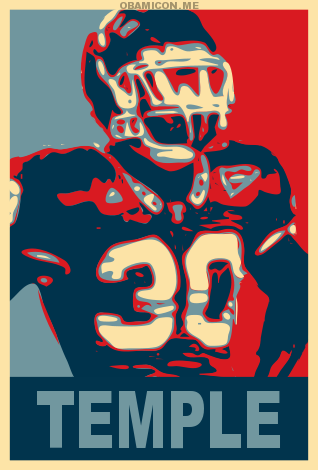
1) Bernard’s “halogram” =upper left;
2) Morkeith Brown (yes, that’s Morkeith) going crazy=upper right;
3) Temple end zone (lower left)
4) your photo … an Owlified photo of Temple 21, UCLA 7 =lower right
Same logo words out background for Temple Football Forever,
same color schemes… I’m just taking out the Al golden and Joe Jones photos… thank you and take your time … no rush…. Mike
upper left lower left
lower right
Bruce Arians
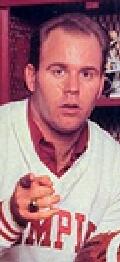
Bruce Arians, Temple’s head coach from 1983-88
now Pittsburgh Steelers’ offensive coordinator
Temple football forever bumper
Hunt for the Heisman

photos


 Temple Football Forever