Survive And Advance

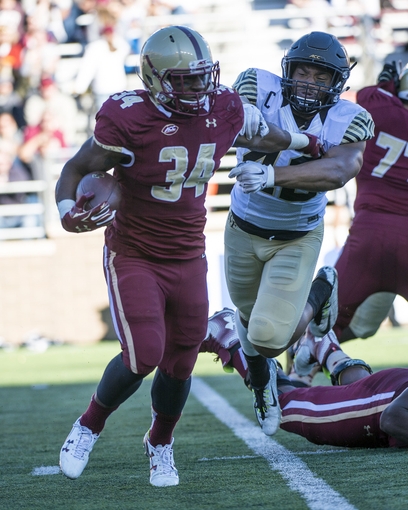
NCAA Football: Wake Forest at Boston College

A year ago,  Jordan Gowins (34) was running the ball for Steve Addazio at BC. Saturday, he will be running against TU. Gregory J. Fisher-USA TODAY Sports

One of my good friends is a great FCS official, warned me in the early part of the summer: “Mike, watch out for Stony Brook. Chuck Priore has a pretty good head on his shoulders.”

Consider myself warned.

In many respects, Priore’s career mirrors that of Matt Rhule in that both have one win over Army (SB’s was 23-3, 2012) and both have had one 10-win season. The difference, other than the obvious FBS and FCS designations, is that Priore literally brought the Seawolves up from the very bottom of college football. Starting as the team’s head coach in 2006, Priore had only 20 scholarships to offer and now has 63—that is quite a bit fewer than what Temple has, which offers 25 every season.

The thought process among many Temple fans is that the Owls are going to smoke Stony Brook. That might happen, it might not. My thought process is a little different. Remember, Stony Brook opened with a 16-9 win over a North Dakota team that beat FBS member Wyoming on the road last season.

For Temple, it’s got to be survive and advance because a loss means this season is done. There is no reasonable person who believes that Temple can open with losses to Army and Stony Brook and win the AAC. As Spock would say, it’s just not logical.


Priore has a good
offensive mind and
probably will try the
counters, deep throws
to stretch the field,
reverses and traps
the Owls eschewed
against Army in one
of the most boring
offensive game plans
I have ever seen in my
40 years as a Temple fan

I was against scheduling this game because, if you win it, it’s “meh.” If you lose it, you will hear Temple sucks for the entire next week and have no acceptable comeback. For me, Temple should always avoid the “too much to lose” games. That’s the athletic director’s job, though. The coach’s job is to win it and that is that is why Matt Rhule is making $1.5 million. He’s got to get the job done.

Stony Brook not only beat No. 19 North Dakota last week, it beat No. 13 New Hampshire last season. It is used to beating good football teams. The Seawolves have nine FBS transfers, so at least nine players have played significant time against opponents on a par with Temple. They have an All-American offensive tackle in Timon Parris (6-5, 310), who lines up on the left side. The two guards are P5 transfers, Mason Zimmerman (Maryland) and Jonathan Haynes (West Virginia). Running back Jordan Gowins (Boston College) is a talent.

Priore has a Philadelphia connection, having served as the offensive line coach and offensive coordinator at the University of Pennsylvania from 1992 to 1999. During Priore’s time at Penn, the Quakers compiled an impressive record of 52-27, including three Ivy League titles and a 24-game winning streak. In 1998, the Penn offense set a school record for points in a season with 297.

He is the older brother of the current Penn coach, Ray Priore.

Despite scoring only a special team’s touchdown last week, Priore has a good offensive mind and probably will try the counters, deep throws to stretch the field, reverses and traps the Owls eschewed against Army in one of the most boring offensive game plans I have ever seen in my 40 years as a Temple fan.

Hopefully, the snooze fest ends for the Owl fans this week in a 49-10 type win, but I will sign for a 16-9 Temple win right now because the alternative is too horrid to even think about and the coach on the other side of the field has a head on his shoulders he uses for more than a hat rack.

pickings

Saturday (posted by 10:30 p.m.): Game Analysis

Monday: Penn State Week

Wednesday: Rolling Pocket

Friday: Penn State Preview

Unintended Consequences

Thanks to TU’s refusal to play an 8-man front, we may have already reached our high-water mark for number of Temple fans this season.

Two steps forward, one step back.

That has been the pattern for Temple football, even in the era of resurgence that came with the hiring of Al Golden late in 2005.

Have a chance to get bowl-eligible in 2008, lose on a Hail Mary pass at Buffalo instead. Go to Ohio for a chance to win a title in 2009, lose that game instead. Bring 23K Temple fans to a frozen tundra in D.C., have them go home losers instead. Win a bowl game in 2011, have a disappointing season in 2012.

Two steps forward, one step back.

Now, it has happened again with the embarrassing and unacceptable loss to Army in the season opener. The Era of Good Feeling (two steps forward) was sustained for most of 2015 because of a 7-0 start and because of the big win over Penn State.

laborious

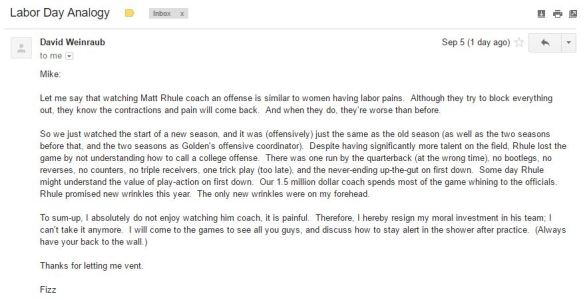
Former Temple player Fizzy brings up a lot of good points in this email.

Even last year, though, a dumb decision by the administration to turn down a chance to play Auburn or Virginia Tech resulted in a return to the MAC, where the Owls proved once again that they cannot beat a winning MAC team. That was a game the Owls could have and should have avoided at all costs, because they had nothing to gain and plenty to lose and they lost plenty. It was embarrassing and a step back in a two-step forward season.

If the Owls had beaten Army before a crowd of 34,005, they would have set themselves up for a nice run of home crowds in the first-ever season where they played seven home games. They would have not drawn the 34,005 for Stony Brook that they did for Army, but they might have gotten the 30,181 they got for a winless UCF team in the mid-point of last season. Hard numbers point to the major reason for disappointing attendance is a disappointing early loss. That pattern is likely to repeat itself because hard numbers do not lie.

Now, they will be lucky to get 22,000 fans—if that—for Stony Brook on Saturday. The fans cannot be blamed. The players did not deserve to be thrown under the bus (they were). It was just two God-awful coaching game plans, one on offense and one on defense, which deserve the brunt of the blame. Nine months to get ready for a one-dimensional team and the Owls approached the game like they were playing any other foe. Still have not heard a word from CEO Matt Rhule on how poorly prepared this team was or a word criticizing either of his coordinators game plan that showed little imagination on offense and no semblance of a clue as to how to stop even the most basic option on defense.

Do not hold your breath.

Accepting responsibility at the top is not coming, but the unintended consequence of a mostly empty stadium for the balance of the season is bound to be on display Saturday. It will be impossible to get the stadium as lively as it was on opening night unless the Owls take a long winning streak into the USF game.

That is the unintended consequence of two steps forward, one step back, which seems to be par for the course for Temple football the past few years. There are words to describe the feeling for the fans and they must include agonizing, frustrating and infuriating.

The fans deserve better.

Friday: A Look At Stony Brook

Monday: What’s News?

A pretty good recap of how James Madison exploited SB for 38 points.

They say bad news comes in threes, and so it was on Friday for the Temple University football team.

The first bit of bad news was in the form of a story on CSN.com that the stadium is a non-starter, at least from City Council’s point of view. The second showed up on Philly.com, quoting an AP source saying that Temple is now out of Big 12 consideration. A few hours later, the worst news came in the form of an ill-prepared and poorly-coached Owls’ team losing to team that posted a 2-10 record the year before. A 10-win team with plenty of starters back lost to a two-win team with only 14 players back from its two-deep depth chart. There is no way to sugarcoat or minimize how bad that looks, feels or is.


“We had 21 points
on the board before
we even started.
We probably would
never have discovered
that, had we not
graded all the film.”
_ Wayne Hardin
on how film study
won the 1979 GSB

This is not where we should be, but this is where we are. Maybe they are not related developments, but certainly all coming on Sept. 2, 2016, a day that will live in Temple football infamy.

Temple fell into recent bad Temple habits of “worrying about what we do, not what the other guys do” and “just concentrating on what we do best and the process will take care of itself.”

Will it?

No.

The entire Owl coaching staff needs to go into a room and listen to guys like Wayne Hardin and Bill Belichick tell them war stories of how they picked up this tendency and that tendency of an opponent and how they delighted about exploiting said tendencies.

Then, for their homework assignment, take three game films from last year’s Stony Brook schedule—William and Mary, Maine and James Madison—and determine just what the William and Mary and Maine defenses did well and what the James Madison offense did well, have every assistant and head coach contribute and apply those same principles to Saturday’s game plan. William and Mary shut out the Sea Wolves, 21-0, on Sept. 15, and Maine held them to 10 points a month later. In between, James Madison scored 38 points in a 38-20 win.


Then, for their
homework assignment,
take three game films
from last year’s
Stony Brook
schedule—William& Mary,
Maine and
James Madison—and
determine just what
the William&Mary
and Maine defenses
did well and what
the James Madison
offense did well

It’s probably no coincidence that Belichick followed Hardin around as a 7-year-old son of a Navy assistant coach. The current Temple coaches need to listen to this story about the Garden State Bowl and how the Owls had it won before the California coaches knew what hit them.

“Cal wanted to exchange films of every game,” Hardin said in a 2009 Inquirer story. “Usually you just take the first one, one in the middle and the last one. So I said, ‘Find out which coaches on their staff want them?’ Turned out, it was the defensive coaches. OK. We spent night after night after night, digging and digging and digging. We came up with one or two things we had to do.

“We found out that if we pulled our guards up the middle, we’d end up with one of them going down the field untouched into the secondary. So did the back. Get the hell out of the way. There was no one to block. We had 21 points on the board before we even started. We probably would never have discovered that, had we not graded all the film. …

“On offense, their quarterback [Rich Campbell] was taught, which we knew, to read when he didn’t see anything [to] throw blindly into the flat to the fullback. I mean, game after game. The fullback was catching the ball and making big yards. So we developed a two-man [pass] rush, which we wouldn’t have done. We’d have one guy come up to meet the fullback, whichever way he went, 5 yards deep in the backfield. And eight guys would drop into coverage. So there’s nothing to read, except a lot of jerseys.

“Those are the type of things that can happen. That’s how upsets are made. People study.”

Does anyone really think the Temple brain trust did enough study of Army? Were the A gaps left uncovered? (Err, yes. That’s where the fullback got his yards.) Did the Owls even try to make Army throw the ball to beat them by loading the box with eight?  Nothing on the field indicated it. (Duke beat Army, 44-3, last year by loading the box with eight and daring the Cadets to throw.) The Temple linebackers were 4 or 5 yards off the ball. You play Penn State that way, not Army.  In fact, nothing on the field the past three years indicates Temple does enough film study of any opponent.

Stony Brook might be a good one to start with.

Mix in a little Tribe defensive scheme with a dose of successful Madison plays and away we go. It’s all right if part of the process involves doing what you do well, but the ingredients for winning include a little of this and a little of that and if that’s not part of your process, you’ve got to get a new process. There’s a lot of chess and checkmating in football to be done these days, just like those days.

Otherwise, the bad news of last week could get a whole lot worse.

There would be no dishonor in Phil Snow stealing part or all of this game plan.

Wednesday: Unintended Consequences


Cherry and Vanilla

Phil Snow had 9 months to prepare for the triple option and this is what he came up with?

In one of those offseason brain-storming sessions between fans and coaches, new Temple offensive coordinator Glenn Thomas reportedly told the group that he felt the Owls’ offense was “too stubborn” last season.

If last year was too stubborn, then just what was that 34,004 Temple fans were forced to watch in a 28-13 loss to Army on Friday night?

falcons

Glenn Thomas: Too stubborn

Last night might as well been the return of the Single Wing, with the Owls trying to force feed two things they do not do particularly well—run the ball straight ahead and throw the ball in the pocket.

Fight, fight, fight for the Cherry and the, err, Vanilla.

When you have a quarterback like P.J. Walker, you move him around the pocket and create the threat of run/pass. When you drop him back, you invite him to get killed and that’s just what happened.

Thomas gets an F for his first night as the new coordinator, but the real responsibility rests with the CEO of the operation, Matt Rhule. What worked for the Owls was the little rollout passes Walker was able to complete and the Owls should have counterpunched by going over the top for the long ball. Army’s defensive backs could not hang with the Owls’ wide receivers but those mismatches were never capitalized upon. Rhule is not blind. He has to take charge when he sees mismatches.

Why?

Too stubborn was as  good a reason as any, maybe too nice a guy the other.

Phil Snow also gets an F, but we outlined here that Snow has a checkered history against the triple option—giving up no less than 31 points in each of his last four of his last five tries against it. (The one exception was a 34-13 win in 2013.) Last night, he improved upon that by three but the Owls allowed 324 rushing yards. Again, the buck stops with Rhule because Wayne Hardin never lost to a triple option team in his 13 years at Temple a testimony to studying film and countering it well—with blitzes from the blind side blowing up pitchouts before they got downhill.

At times over the last three years, it looks as though Temple never even looks at film of opponents. Rhule likes to preach the process but it’s painfully apparent film study of opponents is not a valued part of it. Fordham scored 37 on Army last year and Duke scored 44 and allowed just three points. Might want to copy what Duke did on defense and Fordham did on offense.

A team that recruits NFL players, like Temple and Duke does, should never lose to a team that requires a five-year military commitment. Duke and David Cutcliffe got the job done. Temple and Matt Rhule and his crew did not.They had nine months to work on a game plan for this one-dimensional foe and impressed no one with it.

Monday: What’s New?


Perfect Day For Openers

The key will be avoiding the letdowns that ailed TU last year.

In the closing months of a losing battle, Democratic primary contender Bernie Sanders told supporters that he was “good at math” but assured them that he still saw “a narrow path” to the nomination. Due to circumstances beyond his control (super delegates), that narrow path turned out to be as small as the eye of a needle.

So, too, it is for Temple’s path to the national championship game. Even folks who are good at math can see it’s a narrow path for Temple, but it’s a path nonetheless and it might be larger than the eye of a needle. The reality is that if both Houston and the Owls go 12-0 during the regular season, and Temple beats the Cougars in the title game, it would be extremely difficult to keep Temple out of a four-team playoff—especially if Penn State beats Pitt and has an upper-tier season in the Big 10.

depthchart

Biggest depth chart surprises:

  1. Adrian Sullivan beating out last year’s starter, Brian Carter, at RG; Logan Marchi earning a second team QB tie with Frank Nutile; Marshall Ellick beating out Ventell Bryant at WR and Brodrick Yancy earning a No. 1 at WR; On defense, freshman and special teams star William Kwenkeu earning a backup LB spot and true freshman Benny Walls doing the same at SS.

In that scenario, Houston would own a win over a team picked to win the Big 12 title and Temple would hold a road win against a Big 10 contender. If Penn State does the impossible and wins the Big 10, then the Owls would be shoe-ins for a four-team playoff but that’s probably asking for a bit much.

On this perfect day to open the season, maybe the Owls will finish perfect but that’s a lot of gravy to ask for because they had their head-scratching moments a year ago (USF, SMU in a win, Toledo) and lost four of their last seven. That’s been the pattern for long-time Temple football fans, even in good seasons, since 1982.

After Wayne Hardin’s tenure, even good Temple football seasons have gone like this: Beat someone you are not supposed to beat (Wisconsin, 1990) and lose to someone who are not supposed to lose to (Wyoming, 1990). The pattern repeated itself under Al Golden (UConn win and Ohio loss, 2010), Steve Addazio (Maryland win, Bowling Green loss, 2011) and Matt Rhule (Memphis win, Idaho and Fordham losses, 2013).

That pattern did not exist in Wayne Hardin’s best years, especially 1979 when the Owls only lost to two ranked teams, Pitt and Penn State, and the average margin of those two losses was eight points. No one on the current schedule, including Penn State, will probably be ranked and there is no reason why Temple has to repeat that pattern this season.

The key, of course, to break it and we have not seen it done in 30 years. I’ve said a few months ago that this team is more than capable of breaking the school record of 10 wins with 11, and that’s the minimum acceptable benchmark.

Anything else will be gravy and I like gravy.

Tomorrow: Game Analysis

Monday: What’s New?

Army’s Vanishing Problems

In my mind, Army’s biggest problem is Temple.

About a month ago, I thought Army had problems.

Yesterday gave me some perspective in the form an unrestrained pit bull.

I got bit minding my own business on my walk in the park in Huntingdon Valley on an otherwise great Tuesday afternoon. Said a friendly hello to a stranger who looks like Jeff Bridges in The Big Lebowski and the next thing I know is that the dog that should have been on a short leash was on a longer one and my right arm was spouting blood. Just got back from Holy Redeemer Hospital and eschewed the five rabies shots offered me. If I start frothing at the mouth on Friday night, it won’t be because of Temple’s vanilla play-calling as so beautifully chronicled by Fizzy in this January post.

lastvisit

Army’s last visit to LFF.

That just goes to show you how problems change in a month. I will take Army’s over mine right now because the Army looked like it had major problems a month ago.

Their leading rusher, Aaron Kemper, and one of their bigger playmakers on defense, cornerback Josh Jenkins, have left the team between spring and summer camp. Additionally, a fullback and a slot back as well as a starting lineman, all of whom were expected to contribute, have departed, meaning the Black Knights have lost five potential starters since May. Army only returns about a dozen seniors to a team that only had one FBS win last year.

Add Army’s starting QB from last season — Ahmad Bradshaw — to the list of key players that have left the team.  The next guy up, Chris Carter, is a sophomore who started two games last year.  He has not practiced since the first day due to a hamstring injury.  Behind Carter are four freshmen. If you don’t think that’s a problem against this speedy Temple defense, you have not been paying attention.

Let’s go with the most important player, Bradshaw, first. He’s not only back, but head coach Jeff Monken has said all is forgiven and he will be the starter for the Cadets on Friday night (Lincoln Financial Field, 7 p.m., 2 p.m. tailgate).

Well, that changes a lot of things because Carter is the quarterback who brought Army to within four points of an upset over a team all of us respect, Navy, and its great head coach Ken Niumatalolo and Monken figures Bradshaw is the better player.  Still, only 16 seniors on a roster of 142 players has to mean something. Jenkins is also gone, but does that mean new Temple offensive coordinator Glenn Thomas will use play-action passes to suck in the linebackers and safeties and go over the top to people like Marshall Ellick to attack the new guy replacing him?

Hell, yes, I hope so.

Or I will be frothing at the mouth. If the score is 0-0 and I’m frothing, call the EMTs.

Friday: Depth Chart Thoughts

Game Week: Don’t Sleep On Cadets


For all of defensive coordinator Phil Snow’s accomplishments, and there are many on this last-go-round at Temple, an Achilles’ heel for him has been trouble defending the triple option.

Army

That’s one reason why the Owls cannot sleep on the Army Cadets (7 p.m., Friday, Lincoln Financial Field). There are many more and we will outline those later in this post, but first let’s concentrate on Snow’s recent history against those teams. In three of the four games his teams have played against the triple option since 2010, his defenses have allowed those teams at least 31 points.

The reason for Snow’s problems have been simple. He stubbornly has played his base defense, the 4-3, against a speciality offense that requires a standard speciality defense. The way to stop the triple option is simple: 44 stack, nose guard over the center, the two A gaps (to the left and right of the center) covered by a tackle, eight in the box and force the triple option team to pass.

For some reason known only to God and Snow, he refuses to do that.

The most recent game was an abomination, a 31-24 loss to Navy played on a 92-degree day in September of 2014. (For those who say Navy was good that year, Western Freaking Kentucky—which I call WFK—beat them, 18-6. Their coaches found a way to stop the triple option.)  In 2012, while coaching Eastern Michigan, his defense allowed 38 points against the Cadets. Fortunately, the EMU offense bailed out the Eagles, winning that game, 48-38.  In 2010, his EMU defense allowed 31 points in a 31-27 loss to Army. The one outlier was a 33-14 win for Temple over Army in the 2013 game. The next year, though, the black-helmeted Owls sat back in the heat and waited for the triple option offense to attack them and often found themselves in 3-on-2 mismatches against a quarterback, fullback and pitch man. That’s how Navy won that game, 31-24.

Montel Harris, Nate Combs

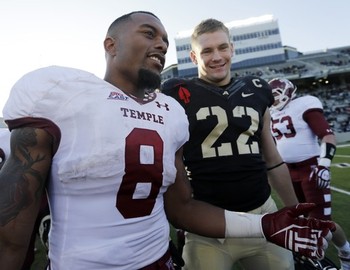
Temple running back Montel Harris (8) talks with Army linebacker Nate Combs (22) in my favorite Temple-Army photo of all time.

After that game, I asked former Temple coach Wayne Hardin—who never lost to a triple-option team while at Temple (he did at Navy, but that was to No. 1 Texas in 1962)—how to defend it and he told me that the triple option leaves the backside unblocked for blitzes. If you have a particularly fast corner, you can give up the backside by blitzing him and blowing up the play before it starts. He said the one gamble is vulnerability  to the throwback pass (ala Adam DiMichele to Matt Balasavage for a score in 2007), but that happens so infrequently it’s worth the risk.

For some reason, Snow has refused to do that. Maybe the Owls will try it with 4.3 sprinter Nate Hairston on Friday night.

The other reasons why you cannot sleep on the Cadets are rather obvious. First, their toughness is unquestioned. They are literally on the frontlines for this country. In addition, they play a fairly challenging schedule and are often in games against so-called Power-5 teams. Last year, they lost to a very good Navy team by four, Penn State by six and Wake Forest by three.

They will not be intimidated by the Owls and the Owls have to strap their helmets on tight Friday night. Hopefully, those helmets will be Cherry or White, not Black.

gameweek

Wednesday: Army’s Vanishing Problems

Friday: Depth Chart Thoughts and Predictions

Saturday: Game Analysis

Monday: What’s New?

Where’s The Beef?

Leon Johnson and Michael Dogbe are now grizzled veterans.

Every once in awhile, an advertising agency comes up with something brilliant and the 1984 Wendy’s commercial “Where’s The Beef?” was certainly an example of that.

That, incidentally, was one of the questions many of the Temple fans had filing out of the Boca Raton Bowl. They knew the Owls were losing a big beefster, Matt Ioannidis, on one side of the line and Kyle Friend on the other.

Without an official depth chart, it’s hard to tell but, at least on the defensive side of the ball the Owls have the potential of fielding a speedy defensive line that can not only hunt down opposing quarterbacks, but is beefy enough to be lock-down run-stoppers.

jacob

Jacob Martin (left) and Ventell Bryant

My dream starting lineup would be a 5-2 with Haason Reddick (6-1, 230) and Jacob Martin (6-2, 240) at the ends, Michael Dogbe (6-3, 280) and Praise Martin-Oguike (6-1, 255) at the tackles and Averee Robinson (6-0, 285) at the position he was born to play, 5-2 nose guard.  Robinson was a two-time heavyweight Class AAAA (largest school) wrestling champion and those same gap leverage skills would make any opposing center’s life a nightmare. Lining him up right on top of the center would create havoc right away.

Instead, defensive coordinator Phil Snow is more comfortable with the 4-3 and that’s what we will probably see.

Martin, who earned a single digit on Wednesday (No. 9), would be a surprise starter at DE. Since that was Ioannidis’ number and Muhammad Wilkerson’s number, I believe the message was clear that is Martin will be a starter. Martin had one of the 10 sacks in last year’s opener against Penn State, so he’s a proven Prime Time player long before the single digits.

Either the 5-2 or the 4-3 lineup will give the Owls more than enough beef up front. Another possibility is that former defensive line starter Brian Carter (2014 game at UCF), who lost his starting offensive guard job on offense could be moved back to defense.  It’s quite possible that Carter is more suited to defense than offense and that would give the Owls a 6-1, 304-pound body should one of the converted defensive ends (Martin-Oguike or Dogbe) not work out at tackle. It’s good to have that kind of flexibility.

Monday: Game Week Starts


The Franklin Field Scrimmage

Along with the banishment, Matt Rhule added an acknowledgement: “I would not read too much into this.”

Rhule was talking about kicking the first-team offense off the field nearly two weeks ago, but he could have also been talking about the Franklin Field scrimmage. There is no more anti-Franklin Field person than me, so thoughts of reading too much into the supposedly cozy relationship Temple athletics has with Penn athletics should be put aside for now.

There has always been the thought, first floated by former President David Adamany, that Franklin Field was a perfectly acceptable home for the Temple Owls. Then the most recent President, Neil D. Theobald, said pretty much the same thing two years ago when talking about what could happen if the Owls are not able to build their own stadium.

hitpost

Owl fans have been there, done this.

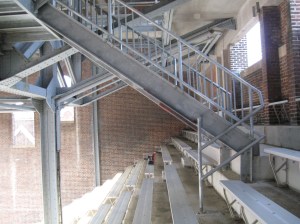
To me, there are only two options: Lincoln Financial Field and Temple Stadium, not necessarily in that order. There are two reasons for this. Any major conference needs to know a university has full control of its facility on game days, primarily for television scheduling purposes. That would not be the case with Franklin Field. Second, going “back” to Franklin Field would represent a backward step for the program that would be unacceptable to the fans. To go from comfortable seats to bleachers and toilets to peeing troughs is one thing if it comes with the convenience of walking from the dorms to the stadium; to do it after getting on the subway and transferring to the West Philadelphia elevated is another altogether.


“I can’t see why
playing at Franklin Field
isn’t good enough.”
David Adamany,
Temple President, November, 2001

“We’re looking possibly on campus,
possibly sharing with Penn.
We’re going to need
to answer that question.”
Neil Theobald,
Temple President,
November 23, 2013.

The only news from the scrimmage was that last year’s starter at guard, Brian Carter, was running second team, and wide receiver Marshall Ellick appeared to stand out above the rest and looks like a sure starter.

For now, though, getting away from 10th and Diamond to a stadium for a scrimmage is a perfectly acceptable move. It gave the Owls a practice in a large stadium to get prepared for the butterflies many of them will have on Sept. 2.

A word to interim President  Dick Englert: Don’t read too much into it, because Franklin Field would be an unacceptable future home for Temple football under any circumstances.

Friday: Where’s The Beef?

Temple’s Next NFL Back?

Matt Rhule is upbeat after scrimmage at Franklin Field.

It does not look like anyone is going to take Jahad Thomas’ starting tailback any time soon, but Temple head coach Matt Rhule turned some heads eight days ago when he said sophomore Ryquell Armstead had a chance to be the Owls “next NFL back.”

Rhule also said that Armstead possesses many of the same qualities Bernard Pierce had while he was recruiting that back out of Glen Mills. Both were track stars in high school and both ran a 10.8 100-meter dash.

signingday

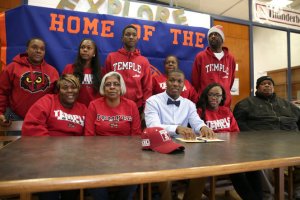
Ryquell Armstead got plenty of support on signing day.

The difference so far has been that Armstead was not able to make an impact because he did not see as much of the field that Pierce did. That could change this year, though, as Thomas could be split out into the slot and Armstead or fellow sophomore Jager Gardner will be given more touches. This strategy accomplishes a couple of things—it keeps Thomas fresh and gives the Owls another edge weapon, which they will need to stretch the defense.

This is all predicated on whether or not Armstead or Gardner can make the most of their reps in real games. If one of those two guys starts accumulating yards in their sophomore years like Pierce did in his freshman one, the Owls go from one explosive player (Thomas as an RB) to two (Thomas as an WR and Armstead/Gardner as a RB). Imagine the nightmare matchup problems that makes for defensive coordinators this season. Mix in wide receiver Marshall Ellick (who has been wowing people since the spring) and the Owls could be really stretching defenses thin.

It all depends, though, on the expected development of the two sophomore running backs who need to produce like Bernard Pierce once did.

Wednesday: The Franklin Field Scrimmage