
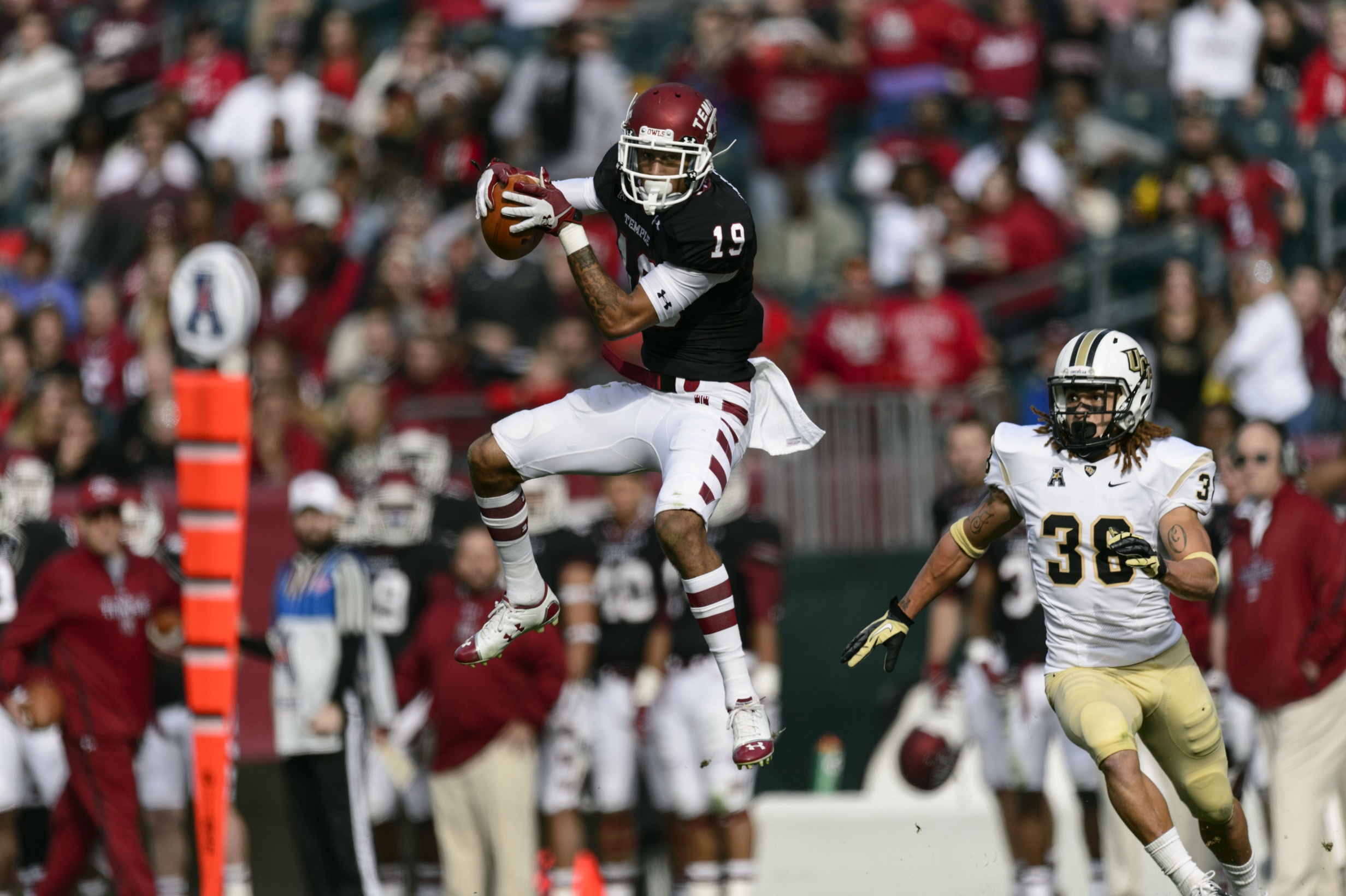
Robby Anderson returning punts for Temple is a bad idea when Nate L. Smith is on the same team. Click on Frank Stephens III’s great photo (originally published in Coach and Player Magazine) for story.
Robby Anderson returning punts for Temple is a bad idea when Nate L. Smith is on the same team. Click on Frank Stephens III’s great photo (originally published in Coach and Player Magazine) for story.
Another great job by OwlsTV.
You have to take it with a large grain, maybe a boulder, of salt but this is the best quote we’ve heard in three years from Temple head coach Matt Rhule:
“How do we differentiate ourselves? How do we make ourselves hard to prepare for? Put two backs on the field. Put two tight ends on the field.
“This is what your roots are. These kids have made themselves really tough. And that’s the only way we’ll ever win–by being a really, really tough football team.”

It was great to hear because two backs, not necessarily two tight ends, has been the essence of the “Temple Tuff” philosophy Al Golden took five years installing at Temple. By doing so, Golden paid tribute to the great Temple teams of the past under both coach Wayne Hardin and Bruce Arians in particular. Those were the Temple teams Golden remembered playing at Penn State, teams that would come at the Nittany Lions with a smash mouth approach and, though it took five years, Golden got it done at Temple.
When the Owls played UCLA in the Eagle Bank Bowl, Golden went with two backs and tried to ram it down the more talented Bruins’ throats. It would have been a successful approach had Bernard Pierce not pulled a hamstring at halftime. He beat Fiesta Bowl-bound UConn the next season with Pierce running behind a great blocker in fullback Wyatt Benson. The Owls did not have a quarterback people feared for either game.
In recent years, we have not yet seen what kind of offensive numbers this approach could lead to with a talented quarterback at the helm, but we might this season. Except for Adam DiMichele, who except for Joe Paterno’s pettiness would have been eligible for the Eagle Bank Bowl, the Owls have not had a quarterback perfect for this kind of offense. P.J. Walker is.
What we’ve seen offensively the past two seasons certainly has not been Temple Tuff. Too many empty backfields and single back approaches have not worked. Now the Owls have seemed to figure out that if you can attack a defense with more blockers than the defense has tacklers, you are giving your featured back a bigger hole to run through.
Whether that back is Jahad Thomas, Zaire Williams, T.J. Simmons or Jager Gardner, that extra lead blocker is going to make a difference. When the Owls show opponents they can run, everything else opens up. Watch P.J. fake it into the tailgate’s belly, pull it out and find Temple receivers open all day. That only works when the run is established first. I wonder what Wyatt Benson, who still has a year of eligibility, is doing these days?
If Matt Rhule is sincere about this approach, get your popcorn ready. It’s gonna be a show.
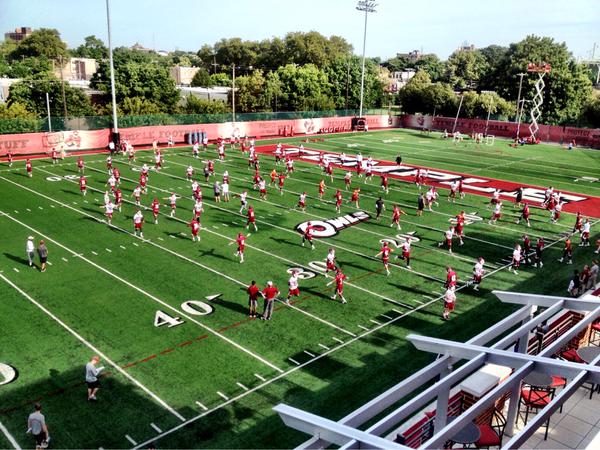
Owls began practice today for the big showdown 9/5/15.
One of the tricks of the trade David Murphy uses to compare players the Philadelphia Phillies might be after is to compare statistics of two guys and then unmask them at the end.
It is a useful exercise not only for baseball but for college football. One of the remarkable things about the first week of play this fall is that there are two quarterbacks with almost identical stats and almost exactly the same freshmen and sophomore years who will be playing that week.
One is talked about as being a first-round NFL pick in the 2016 Draft; one is not even in the discussion. A close look at both players indicates that there is nothing to separate them.
Player A
| Games | Comp. | Atm. | Pct. | Yards | TDs | INTs | Rating | Year | |
| 2013 | 9 | 152 | 250 | 60.8 | 2,084 | 20 | 8 | 150.8 | Fresh. |
| 2014 | 12 | 203 | 381 | 53.3 | 2,317 | 13 | 15 | 107.8 | Soph. |
By now, you might have figured out one quarterback is Christian Hackenberg and the other is P.J. Walker, but, except for the number of games involved, it is hard to tell.
In many respects, Walker—Player A—was the more productive quarterback as a freshman than Hackenberg was. He had just as many touchdown passes in three less games and two less interceptions. Hackenberg had more yards, but that could easily be explained by his three extra games. Walker’s QB rating was considerably better, 150.8 to 134.8.
Player B
| Games | Comp. | Atm. | Pct. | Yards | TDs | INTs | Rating | Year | |
| 2013 | 12 | 231 | 392 | 58.9 | 2,955 | 20 | 10 | 134.8 | Fresh. |
| 2014 | 13 | 270 | 484 | 55.8 | 2,977 | 12 | 15 | 109.4 | Soph. |
The next year, was similar with Hackenberg getting only the slightest of nods, a QB rating of 109.4 to P.J.’s 107.8. Still, in one less game, P.J. had one more touchdown pass than Hackenberg.
Both will admit they had down seasons, but the numbers suggest that there is not much to choose.
To borrow a new NCAA basketball phrase, there is something called the eye test. Because of his ability to escape the rush, I think P.J. is the better college quarterback. Hackenberg is taller and might be the prototype quarterback, but I think P.J. will come out on top 9/5/15.
In honor of Robby Anderson becoming eligible, we can only think of one song appropriate to the occasion.
Technically, it will not be until around 6:30 p.m. on the night of Sept. 5 before Temple fans learn whether their long Commonwealth nightmare is over. Substantively, though, they learned the result yesterday when Robby Anderson was declared eligible.
We will not paraphrase former U.S. President Gerald Ford by calling the failure to beat Penn State a long national nightmare but, since 1941, it certainly has been a Commonwealth (of Pennsylvania) nightmare. We should all wake from that slumber in one month and one day, thanks to the special talents of one Mr. Anderson.
Temple tested a smaller nuclear device last week when it learned Pitt transfer Adonis Jennings was declared eligible. Monday’s news about Anderson was one of those megaton Hydrogen-type jawns and the Nittany Lions have no idea of what is about to hit them.
After carefully observing both Anderson in 2013 and the Penn State secondary last season, I have come to the conclusion—sad for them, good for the Owls—that the Nittany Lions cannot stop Anderson or even hope to contain him. Anything Jennings can add to this mix is just a bonus. Anderson should help open a Temple offense that was closed tighter than one of those Kansas silos.
Anderson’s eligibility is huge because is a proven big-play receiver, not only in the AAC, but from a national standpoint. His 18.7-yards-per-catch average was second in all of college football in the 2013 season. His three touchdown receptions in a 41-21 win at Memphis was an exclamation point in a five-game season that saw him catch nine touchdown passes from true freshman quarterback P.J. Walker.
Walker, who started the same number of games at quarterback, finished with 20 touchdown passes and only eight interceptions. Without Anderson, who flunked out of school in January of 2014, Walker looked to be out of his comfort zone a year ago and suffered a sophomore slump in which he only had 12 touchdown passes and 14 interceptions. The news about Anderson came four days after Temple learned that the NCAA granted Pitt transfer Adonis Jennings, a four-star wide receiver recruit, a hardship waiver to become immediately eligible.
To be sure, there were signs this was coming over the last few weeks or so. A wide receiver transfer from Hawaii, Keith Kirkwood, who wore No. 19 last year, changed his number from 19 to 89 last week and Anderson attended a couple of team charity functions wearing his familiar No. 19.
As it turned out, those were clues to a mystery that was solved on Monday and will be the talk of AAC Media Day. More importantly, although there is still a lot of work to do over the next month, the confidence level of Temple fans going into a Penn State game has never been higher.
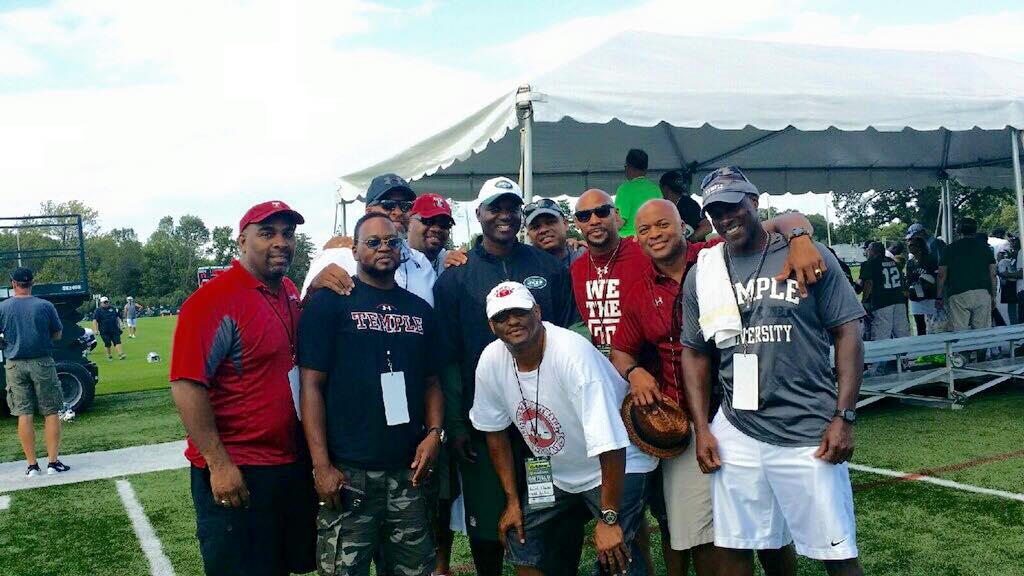
Bruce Arians’ players showing former teammate Todd Bowles some love.
When the Bruce Arians’ crew made the trip to Florham Park over the weekend for the first full day of New York Jets’ training camp, the contingent of ex-Temple players were treated like the champions they were.
The fact that Temple has a head coach in the NFL, Todd Bowles, cannot be minimized. Hopefully, Matt Rhule can use it as a recruiting tool. He already has the support of Arians’ players, guys like Sheldon Morris, Kevin Jones, Joe Greenwood and Paul Palmer and hopefully that kind of networking will work in Temple’s favor over the next few years.
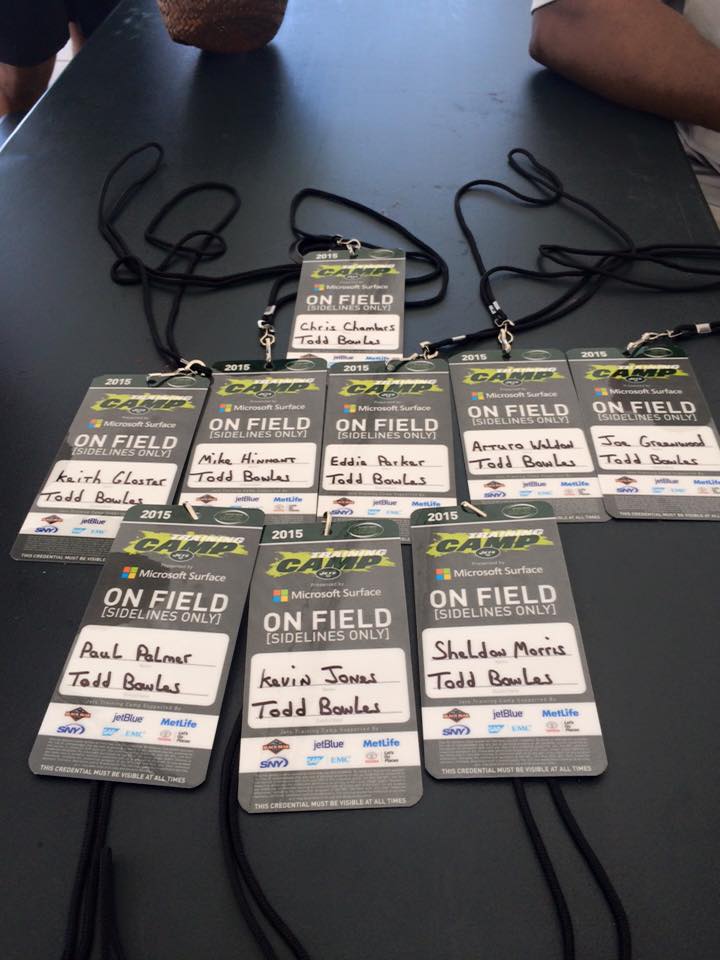
No, Arians’ players did not win the Big East—there wasn’t even a Big East back then—but they helped put Temple on the national football map by having two winning seasons in three years against two schedules that were ranked No. 10 in the country.
Think about that for a moment. Back then, Temple played a schedule equal or superior to the current powers the SEC, PAC-10,and Big 10 and more than held its own. It did so practicing on a rock-strewn field (now the Student Pavilion) when Geasey Field was taken over by the lacrosse or field hockey teams of the day. The weight room was located next to a bowling alley in the basement of McGonigle Hall.
When Arians was asked if beating the Super Bowl winning Seattle Seahawks was the biggest win of his career–he was the last team to beat them before they won the 2014 Super Bowl–he stopped the press conference by saying no. “My biggest win was when I was at Temple, beating Pitt for the first time in 39 years,” Arians said.
Through it all, they beat Pitt three out of five years, beat West Virginia, blew out a Virginia Tech team that won 10 games and a Toledo team that was 9-2-1. They had a Heisman Trophy runner-up in Palmer, who should have been a Heisman Trophy winner. They went down to East Carolina and shut out the Pirates, 17-0. Even in those days, places like Pitt, West Virginia and Virginia Tech had multi-million dollar dedicated practice facilities but Temple did more with less.
It had to.
Arians built his teams around a great running game with a great blocking fullback and hopefully Rhule can take something from that formula, which has been the way Temple has played football for a long time. Arians had an eye for good quarterbacks, like Lee Saltz, Tim Riordan and Matty Baker.
The guys who played for him have always been “tight as a fist” and it was good to see them enjoying and supporting their former teammate the other day.

Robby Anderson is on the far right, wearing his familiar No. 19.
Anyone who went to the Elmwood Park Zoo yesterday got a good sighting of a beast Penn State should fear the most and we’re not talking about a charging Rhino or an Alligator here.

Look who P.J.’s right-hand man is ….
We’re talking about Temple wide receiver Robby Anderson (and, yes, it is now officially Robby; more on that later). That has got to a be a good sign because Temple Summer Session II classes end on Friday and grades are released on Aug. 3. Temple head coach Matt Rhule said Anderson’s eligibility is tied to those Summer II grades. (His Summer I grades were more than acceptable.) This is not a case like Bernard Pierce in 2009, when the NCAA Clearinghouse waited until the week before the Villanova game to approve Pierce’s participation as a true freshman. In Pierce’s case, the NCAA was concerned about the Glen Mills’ course load, which was later approved. Pierce had 44 yards on six carries in his first college game. Had this issue been cleared up before then, he probably would have started and went for 100 plus.

There is that best helmet in college football again with the buckle allowing the ‘][‘ to be clearly shown.
For Rhule to even allow Anderson to participate in a team function has to be a sign that the coach is satisfied with Anderson’s academic progress.
(Now to the spelling of Robby’s first name: Since he is now spelling it Robby, instead of Robbie, on his twitter account, that’s how we will spell it here henceforth and Temple Football Forever. Or at least until he changes his twitter account back to Robbie.)
Why is Anderson’s eligibility so important? Temple did not have a single game-changing offensive player Penn State could fear a year ago. Anderson is just such a player and his very presence in the Penn State game makes quarterback P.J. Walker a game-changing player and it makes running back Jahad Thomas a game-changing player and possibly SEC-talent-level tight end Colin Thompson a game-changing player. Heck, he makes Romond Deloatch more dangerous in the red zone. In my mind, Temple beats Penn State with him and it would be very difficult to win this game without him. Penn State cannot cover him I doubt it can even hope to contain him.
So, while Sept. 5 is the most important date in Temple football history, Aug. 3d is shaping up to be pretty darn important, too. Robby Anderson being at the Zoo made July 26th a good day for Temple football, just how good will be determined soon.
This post probably comes under the saying “you-can-lead-a-horse-to-water-but-you-can’t-make-him-drink” but click on the eye to see the water anyway.

Matt Rhule’s Jetpack has been on Go Fund Me for half a month now without a single penny raised.
Nothing major gets done at Temple University without it being approved at a Board of Trustees Meeting.
That was true for the Apollo of Temple, now known as the Liacouras Center, and also true for the $50 million basketball practice facility and the $17 million football training facility. To assume that a $300 million stadium is going to get done behind the scenes with all that as a backdrop is a fallacy.

With this Jetpack, Matt will no longer have to take the SEPTA 24 bus to practice.
So another meeting of the BOT having come and gone without a stadium announcement—or even a discussion of a stadium—speaks volumes. Meetings were held in December, March, May and now July without mention of a stadium.
The next question has to be why. For that, all you have to do is look at the funding for Matt Rhule’s Jetpack. As a joke, a poster named “Victory Engineer” set up a “Go Fund Me” for a Matt Rhule Jetpack on July 3 and posted it on Owlsdaily.com. It has been seen by nearly 2,000 viewers and raised a grand total of zero dollars.
You would think someone, even as a joke, would have given five bucks in two weeks but, so far, nothing.
What does this have to do with a stadium?
Temple people are notoriously protective of what is inside their wallets–perhaps as a Pavlovian Response from spending four years near the edges of the Green Zone (17th Street on the West and 10th Street on the East)–and the strong rumor is that the BOT will not allow discussion of a stadium until $25 million is raised by stadium backers. So far, that figure has fallen far short—about $24 million short—and, at this rate, a stadium will not be discussed until the October meeting.
October, 2068.
It’s time to extend the Lincoln Financial Field lease now and worry about a stadium later.
As far as Matt Rhule’s Jetpack, that has a much better chance of happening on Sept. 6 should the result of the Penn State game turn out to be in the Owls’ favor.
Related:

If recent Temple hires in key positions are any clue, the stadium going up at 15th and Norris should look something like this.
Usually the middle of July is a dead period in sports as baseball is in the middle of an all-star break, NFL training camp has not started and the NBA, NHL and college football are a couple months away.
For Temple University, though, July 14th might be the most important day in its sports history. That’s because the school’s Board of Trustees will hold a rare meeting amid rumors that there could be talk of an on-campus stadium on the agenda.

Even if a stadium is not on the docket that could be more telling than if it is because the school’s BOT let a May meeting, a March meeting and a December meeting come and go with no discussion of a stadium. If it is not on this agenda, there likely will be no stadium because the next meeting after this one is in October and the school’s 15-year lease with the Philadelphia Eagles to rent Lincoln Financial Field expires at the end of the 2017 season.
Temple fans on sports message boards seem obsessed with the topic as seemingly innocuous discussion threads get turned into stadium ones at the drop of a hat. When it comes to the people who really matter, the BOT, the topic hasn’t even moved the needle. There were meetings on December 9th, March 11th and May 12th and not a word on the stadium at any of them. That could all change on Tuesday. Or not.
Since the last meeting on May 12, former Indiana University chief bean counter (CFO), Neil Theobald, the current Temple president, kicked a former Indiana U. aide, Kevin Clark, upstairs from AD to No. 2 in command (COO). Then he hired a former Indiana football player, Dr. Pat Kraft, as AD. Yet another former Indiana guy was brought in to raise money for athletics.
If that means a stadium that looks like Indiana’s is about to go up at Broad and Norris, we should know soon.
Or not.
The next meeting after this one does not come until Oct. 13th. By then, any reasonable person could see that there will not be enough time to get shovels into the ground and a stadium completed by the opening day of the 2018 season. Even if it is discussed on Tuesday and approved (highly doubtful), there will be a mad dash to get the stadium done. So if a stadium at Temple is just an unfounded rumor, fans should know by Wednesday. No discussion probably means no stadium, at least not for a decade down the road.
The question of where Temple will play in 2018 is an urgent one. The logical answer is to extend the Lincoln Financial Field lease. That could be costly because the Eagles are asking for a 300 percent increase in Temple’s $1 million-per-year rent, but it is a price Temple must pay to remain a viable program and about 10 times less costly than building its own stadium.
The AAC, like the Big East before it, will demand that Temple have exclusive rights on Saturdays to a stadium and the only other stadium with a size that fits its needs would be 57,000-seat Franklin Field at the University of Pennsylvania. Penn has those rights so Franklin Field is not an option nor is the 18,000-seat PPL Park.
Temple’s only means toward keeping those rights is to stay where it is right now and build its own stadium and, if the Board is silent again like it has been in the past that means a stadium is a long, long ways away if ever.
Then the next most-important date becomes Sept. 5 and that will not have anything to do with a new stadium.
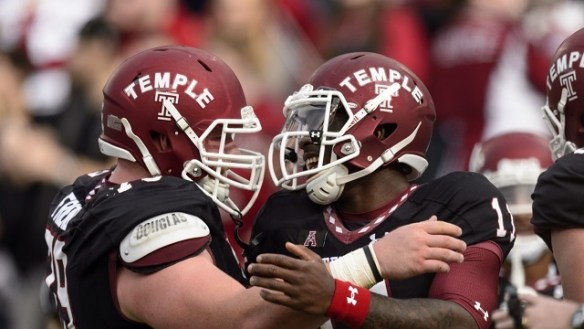
Click on the best helmet combination in the FBS for the story.
 Temple Football Forever