1. Both Ball State and NIU took an early 1900’s approach to offense in winning their games this weekend primarily through the ground game. This brings the question: Are you satisfied with the balance of your offense currently? Would you like to see more passing or more rushing?
TFF: Absolutely not. When you have one guy, Bernard Pierce, getting 40 carries in his last game, it’s like allowing Pedro Martinez 130 pitches a game. He might be on his game, but you are setting yourself up for failure (i.e., injury) later. I come from the offensive school of run when they are expecting you to pass and pass when they expect you to run. That’s the best way of putting up 40 points a game on a consistent basis.
2. The two best teams in the MAC in Central Michigan & Temple take on non-conf opponents in Boston College and Navy respectively. What positives or negatives come from playing OOC opponents this late in to the season?
TFF: Same positives that can come early in the season. CMU has a pass because it gave the conference a great boost with the win at Michigan State. Bowling Green, NIU and Toledo all earned impressive out-of-conference wins. It’s Temple’s turn to give back to the conference and add to its prestige by beating a Navy team everyone around the country respects.
3. For fun, predict the outcome of the impending doom the 0-7 Eastern Michigan Eagles face as they travel to Arkansas this weekend.
Eastern Michigan will cover the 36 1/2-point spread and lose something like 45-17, 42-21.
4. If your team/coach were to wear Halloween costume, what would they be?
Tom Cruise. Al Golden wouldn’t need much makeup. He looks like Cruise’s younger twin brother anyway.
5. MAC Power Poll Time
1. CMU
2. Temple
3. NIU
4. Ohio
5. Toledo
6. Bowling Green
7. Western Michigan
8. Kent State
9. Buffalo
10. Akron
11. Ball State
13. Miami
MAC blogger: Week 5
1) Throughout the summer the MAC has been mostly left out of expansion/raiding conversations EMU athletic director Derrick Gragg seemed to hint that there are serious thoughts about adding more team(s). Dust off you DeLorean and tell us what the MAC looks like in 2014. Who stays, who goes and who’s new? What would you’re realistically ideal MAC look like.
TFF: I don’t think Temple will be around then (I’m thinking it will head to the Big East) so I would replace the Owls if I’m the MAC with Marshall. That’s a better fit, geographically, for the MAC than Temple is and I think Marshall could be convinced the MAC is a better fit than CUSA. Problem is I don’t know who goes to get the number even.
2) Most teams out of conference schedules are now winding down. Who has had the most disappointing and the most surprisingly impressive set out OOC games?
I have to give the MAC a lot of credit for scheduling BCS teams. Quite a few impressive wins. Northern Illinois over Minnesota (I don’t care how down Minny is), that’s impressive. Bowling Green over Marshall. Temple over UConn, Toledo over Purdue, etc. Not disappointed in anyone.
3) Which MAC Coach, new or not, should sit upon the hottest seat in the conference?
Stan Parrish.
4) I am asking out of order for a reason: Rank them first to worst
1. Temple
2. CMU
3. OHIO
4. Northern Illinois
5. Toledo
6.Miami.
7. Bowling Green.
8. Buffalo.
9. Western Michigan
10. Ball State
11. Kent State
12. Eastern Michigan
13. Akron
5) Of the bottom five teams which one(s) do you think have the best chance of making some noise in conference this season? And of the top 4 who is most likely to fall apart?
Bottom team likely to make some noise: Kent State.
Top team likely to fall apart: Unfortunately, Temple, if Al Golden doesn’t make a quarterback change soon. Good news is he has two potential great quarterbacks waiting in the wings. Bad news: He’s stubborn and loyal to Chester Stewart to a fault
SI’s great story on Bruce Arians’ firing
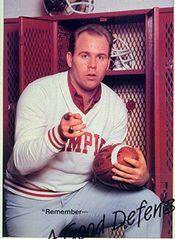
By Douglass C. Looney
Sports Illustrated
THE CORNERSTONE OF TEMPLE UNIVERSIty’s philosophy was put in place in 1884 by the institution’s founder, Dr. Russell H. Conwell: ”Great deeds with little means.” Bruce Arians, the football coach at the Philadelphia school for the past six years, confessed last week, ”It took me a while to learn to live with that. When I started here, I was asking for buildings. Pretty soon I was only asking for pants and jerseys.” He didn’t get buildings, but he got the pants and jerseys. He also got fired.
The announcement by Temple said that Arians ”has relinquished his duties in a mutual agreement with school officials.” In fact, Arians relinquished his duties during a 45-minute meeting in which the university’s executive vice-president, H. Patrick Swygert, told him he was no longer employed. The only mutual agreement was that the school would pay Arians for the remaining year of his three-year contract — slightly more than $100,000 — and in return he would not talk ugly about his dismissal. Arians later met with president Peter J. Liacouras — once such a fan of Arians and his program that he broke a finger catching a kickoff at a practice — and they told each other what a great guy the other one was. A very civil divorce.
At Arians’s Marlton, N.J., home, the phone rang constantly, signaling condolence calls — from Akron’s Gerry Faust, Tennessee’s Johnny Majors, Mississippi State’s Rockey Felker, Texas Tech’s Spike Dykes.
Arians, 36, whose record was 27-39, said simply, ”I got fired because I didn’t win enough games. The way for Temple to win is to make a Miami-style commitment.” In the mid-’70s, Miami was either going to give it up or get good by pouring big bucks into football. The pouring worked. What Arians wanted for Temple was an indoor practice facility for bad-weather days, more practice fields, a bigger weight room and a football dorm. Lack of money, he said, torpedoed his hopes.
Athletic director Charlie Theokas said a lack of space in an urban setting — Temple’s campus is in North Philadelphia — was a more difficult problem than lack of money. ”We have adequate facilities, but we don’t have great facilities,” Theokas said. ”I do admit it could hurt recruiting.” He said Temple’s football budget ”puts us about in the middle of the pack.” He would not, however, disclose budgetary figures. In any case, Theokas said, it was time to ”resell, remarket, reenergize.” Translation: win.
Arians, a former assistant to Bear Bryant at Alabama, said the first time it occurred to him he might be fired ”was the day I got the job.” The second time was after the Owls lost their last seven games in ’87 to finish with a 3-8 record. The third occasion was this year’s Oct. 22 game at California. The Owls were up 14-10 at half, then blew it in the second half with fumbles on the Cal six- and 19-yard lines and lost 31-14, leaving Temple 1-5. Says Arians, ”We turned it over, and I turned my job over that day.”
Through the turmoil last week, Arians — who says the high point of his stay at Temple was beating Pitt three times, the low point never beating Penn State — was surprisingly upbeat. At his farewell press conference he thanked everyone, including — honest — the unrelenting Philadelphia press. Then he went back to his now all-but-bare office, closed the door and philosophized: ”This is just a new beginning. I don’t feel one ounce of failure. I’m just thankful to have another day. I know I’ll land on my feet. You never know what will be the next opportunity or the best opportunity. But I’ll be coaching somewhere next year. If you lose trying, that’s O.K.” And with that, he put his football office in his rearview mirror; stopped off at the Casa Lupita restaurant in Marlton for a beer; went home to his wife, Christine, a lawyer, for warmed-up pot roast; called his best friend, Chris Courtney, and learned Courtney had just resigned as coach at Garfield Senior High School in Woodbridge, Va.; watched two plays of Monday Night Football; and went to sleep.
Arians’s essential problem was that Temple — under the legendary Pop Warner — had played in the first Sugar Bowl, on Jan. 1, 1935. The school desperately wants to return some day, and every year the Owls don’t is considered another failure. But Temple has never even been close to getting back to New Orleans, because it’s far too ambitious a dream. The Owls, 4-7 in ’88, keep tilting at windmills, scheduling teams like Syracuse, Alabama, Penn State and Pitt. They lost to each this season.
In fact, Arians did a creditable job at Temple. In ’85 the Owls lost their first three games, to nationally ranked Boston College, Penn State and BYU, by a total of seven points. In ’86, Temple went 6-5 playing the 10th-hardest schedule in the nation — the Owls saw five of their opponents go to bowls. ”I knew the schedule when I came here,” says Arians. ”You keep your job by winning, but that’s not how you coach. You don’t coach to win at all costs. I’m a counselor, a teacher, a father, a brother — and a coach. I helped some kids.”
Arians, who went to Temple in 1983 after two years as running back coach at Alabama, says he was lucky to be hired. ”In no way was I prepared for this job when Temple gave it to me,” he says. ”I don’t know why they did, but I’m glad they did.” Liacouras said then that it was because Arians was the ”most promising football coach in the country.”
He wasn’t quite as promising last week, but his two children — Jake, 10, and Kristi, 8 — were not upset. Said a sanguine Jake, ”Oh, Dad’s on TV again.” And as the coaching roulette wheel spins, Arians will be back on the transactions wire and back on TV again and again, perhaps even performing great deeds — although, in truth, it might help if he is provided with slightly greater means.
Reprinted with permission of Sports Illustrated.
Villanova trash talk
Chris Harris’ courageous rant against Bobby Wallace
 |
| The Great Chris Harris. |
By Mike Gibson
In the late stages of Bobby Wallace’s tenure as Temple coach, a player named Chris Harris stepped up and went public in a very courageous way. What Chris Harris did below might have saved the program. It certainly led to the hiring of Al Golden ….
The signs have been there all along.
Even the casual Temple football fan knows there is something seriously wrong with the leadership of the program.
From suspect recruiting, to suspect execution (false starts abound), to suspect discipline (laughter on the sidelines during losses), something is seriously wrong.
Then there is the story of Chris Harris, former Temple football player.
In all my years of following Temple football, I have never seen a more courageous and situation-specific treatise on what is happening behind the scenes.
His grammar may be rough, but his points seem to be well made.
Some might dismiss the following diatribe as the rant of a disgruntled former player.
I don’t.
I think the following post deserves a wider audience so I’m posting it in its entirety here in its complete and unedited form. Temple needs a new head football coach and now.
I think a lot of what he says rings true, a lot truer than what the current head football coach at Temple says.
It follows in White:
Hello, I am Chris Harris the Starting right tackle from Last season¡¯s team. There have been many questions about the program and my situation and I am going to lay it all out right now. I found out at the end of the summer that I was not going to make my NCAA 75% senior rule. It states that a senior has to be done with 75% of his major to be eligible.
Therefore, I had to take classes online at BYU to achieve this grueling goal. I was playing football, taking 15 credits here at Temple and 9 credits at BYU. So all season I have been at practice playing scout team and playing my starting right tackle position. I took fewer reps so Tariq Sanders can get his reps in.
I finally finished my classes, so I was waiting for the classes to transfer in from BYU so I could play in the Toledo game, but they never came in. Coach Turner (the Greatest), Coach Brock, and I contacted the BYU office that Monday to see why my grades did not come in. They said that I had missing assignments. I showed them on the websites that I submitted the grades and that the dates were posted. I was told to do them over because they did not have them.
So that following weekend I could not stand on the sidelines because the players got a notice in the locker room that if you were not on the dressing team or ineligible, you could not stand on the sidelines, so I was in the stands.
A reporter had asked Coach Wallace about my situation and he said that I quit the team and that he has not seen me since Monday. He stated that he did not know if I had financial problems or if I had failed a class but he said that I quit. I have not quit anything in my life. I have fought blood, sweat, and tears for this program (in the little time I have been here). Therefore, after that LIE was made to save his ass, I decided not to come back to the team.
All of my teammates understood my decision and wished expressed their common feelings towards Coach Wallace. I still go to the facility and Talk to Coach Turner, which I must add is the best coach ever. The entire team wishes he was the head coach.
This program has many problems. There is no discipline on our team. When somebody does tries to discipline, the Head Coach does not reinforce their efforts. We have top talent on this team.
We almost beat V-Tech last year. We have players here that top schools wanted. I am extremely impressed with this years recruiting class, I feel that these guys are going to win some games in the future, they have great attitudes but they are going to need help.
Everybody is talking about axing the program but that is not the answer. We need a new leader.
Somebody that is going to bench an important player if he is a problem. It happened this week with Goo, but If a higher power did not come down on Coach, Goo would of played. We need a leader that has a proven record of accomplishment on the D-1A level. It hard to play football here. There are too many things going on here besides football.
As players, there are unnecessary things about this team and school that stresses us. The team is split apart.
For example, a player will not go to practice all week but start in the game. Players miss weight training and there is no penalty.
I am officially done with college football. My senior year is ruined. My GPA is fine and the classes are on their way in. I thought I was the 1st person this happen to but as I talk to former players it is a common them.
We need a change. There are coaches on this staff that are priceless but we need more. We have the talent to win big games but an army is only as good as their general. Too many people want to see this team succeed and we will, but there is more than what the fans see.
Also, Paul Palmer is the spirit of Temple football. For those who do not know the whole story please understand that Paul was disrespected and mistreated. He means a lot to the players. I remember the speech that he gave the team before the Penn State game and I felt the fire in the team. That Fire is gone. The Chicago Bulls would not do that to Jordan, the Lakers would not do that to Cookie and Magic, so why do we do it to Paul.
Some players dont want to speak out because of back lash they might recieve but I’ll be a voice. If enough people stand up and fight for us, we will win.
As a player, a fan, and Owl I am asking someone to help. You can email me at Chris56@temple.edu and catch my family and me in the stands during all of the home games, Id love to talk and share. Thank you for your time Christopher Harris TU Football #56
Our last visit to Camp Randall Stadium
TEMPLE UPSETS WISCONSIN, 24-18
Sep 23, 1990
By Mike Bruton, Inquirer Staff Writer
People around here might have thought that something catastrophic had occurred yesterday at Camp Randall Stadium, but the clamor that arose was only the Temple Owls celebrating.
The Owls, distressed by a 1-10 record a year ago, spared nothing of themselves as they upset the Wisconsin Badgers, 24-18, before a bewildered crowd of 41,817.
It was Temple’s first victory against a Big Ten Conference opponent, although the Owls had clipped Michigan State, 21-19, in 1940 before the Spartans joined the Big Ten.
“The kids are believing in themselves and playing as a team,” said Temple coach Jerry Berndt, who was doused with water and Gatorade by his jubilant players. “They believe they can win. Today was a great win for Temple and a great win for Eastern football. “
Aside from smothering Wisconsin’s running game, the Owls (2-2) used practically everything in their minds, bodies and playbook to beat the Badgers (1-2), who entered this game basking in the afterglow of their 24-7 victory over Ball State last week.
The Owls tried a fake punt and a halfback pass, which were unsuccessful, but they also employed a reverse, which held together the 63-yard, six-play drive that put Temple ahead to stay, 21-18, with 8 minutes, 38 seconds left.
Wide receiver Kevin McCoy spun off 17 yards on the reverse to move the ball down to the Wisconsin 35-yard line.
Two plays later, the Owls ran the option as if Barry Switzer were standing on the sideline instead of Berndt, and they caught the Badgers napping.
Temple quarterback Matt Baker, challenged by safety Greg Thomas, made a late pitch to Conrad Swanson , who skittered 32 yards down the sideline to score.
“We’re not an option football team,” Berndt explained. “That was a very heady play for both those guys. “
With 1:58 left, Bob Wright tacked on a 39-yard field goal for good measure.
The Owls delivered the death blow with seconds left when Kenyatta Rush, recording his second sack of the day, separated quarterback Tony Lowery from the ball with a vicious lick, and defensive tackle Eric Fenwick recovered the fumble.
“We were going in for the last series and you’ve just got to go all out,” said Rush. “I was coming around the corner and I saw him. I got him as his arm was moving up. “
It was fitting that the Owls finally clinched the victory by upending Lowery, the player who was almost their undoing.
While the Owls were devastating in allowing the Badgers only 62 yards rushing, they were much too loose otherwise, as Lowery shredded their secondary with 23 completions on 36 attempts for 294 yards, including a 50- yard scoring strike to Bill Williams 4:18 into the third quarter.
The Badgers cut Temple’s lead to 14-11 when Lowery connected with tight end Jim Bourne for a two-point conversion.
On the previous series of downs, the Owls had scored when Baker threw a bull’s-eye to tight end George Deveney, who beat linebacker Todd Orlando and raced 63 yards to score.
After the Badgers closed the gap, the Temple defense remained rigid against the run and started to put a bit more pressure on Lowery, but the crowd, which had bitten off its collective nails watching this adventure, was thrust back into the game by a pair of costly fumbles by Owls tailback Leon Brown.
Brown, who led Temple’s ground game with 78 yards on 21 carries and opened the game’s scoring with a 14-yard TD run near the end of the first quarter, coughed up the first fumble at the Wisconsin 24-yard line to halt a promising Temple drive late in the third period.
The Owls held on defense, but two Temple possessions later, Brown fumbled at the Owls’ 32-yard line.
It took the Badgers just three plays to go ahead as fullback Kevin Ellison slammed into the end zone from the 1-yard line to make the score 18-14.
Swanson, who had 67 yards on 18 carries, replaced Brown at tailback after the second fumble.
“They had a chance to put it away at the end but we just held our composure,” said Baker, who completed 12 of 21 passes for 132 yards. “We came out to win here at Wisconsin. “
For the fifth time this season, the Temple defense stopped an opponent from scoring inside the 10-yard line when it held in the second quarter.
The Owls forced the Badgers to turn the ball over on downs again at the Temple 17-yard line on the next Wisconsin possession, and went into the dressing room at halftime leading, 7-3.
Building some credit with this MAC card
“Winning cures all ills. It boosts the overall image of the institution.” … Peter J. Liacouras, Chancellor, Temple University
By Mike Gibson
A few days ago, a friend of mine turned 40.
That’s usually the kind of milestone day you immerse yourself in some deep introspection about where you’ve been and how you got to where you are.
It includes a measure of angst, even grief over the all-too-quick passage of time.
A happy birthday it’s not.
Neither is 50. Or 60. Or 70.
The introspection becomes more acute with each passing decade.
You get the idea.
On days such as those, you can only offer consolation.
“Consider the alternative,” I said.
Then the day doesn’t seem so bad after all.
So, too, it is with Temple football, which is about to turn 108 years of age in a few months. The old boy was on the death bed the last couple of years and even friends considered pulling the plug.
Other friends insisted that this was a life worth saving, especially those of us who remember the 1970s, when the Owls were consistently among the most respected programs in major college football because of what head coach Wayne Hardin was able to accomplish.
Russell Conwell, the school’s founder, was noted for his “Acres of Diamonds” speech about finding a treasure in one’s own backyard and Hardin’s Owls were the embodiment of the founder’s philosophy.
Using overlooked players mostly from within a 90-mile radius of Temple, those diamonds in the rough enabled Hardin’s Owls to go 80-52-1 from 1970 through 1982.
The high-water mark was 1979, when the 10-2 Owls drew 55,956 of almost entirely their own fans to Giants Stadium for a 28-17 beat-down on California in the Garden State Bowl.
The last 25 years have not been as kind and that’s how the old boy found himself on life support in recent years. Kicked out of the Big East, the Owls were facing an uncertain future.
A task force was formed by board of trustees chairman Howard Gittis and since that group included an anti-football president, David Adamany, there was apprehension about his influence on the proceedings.
Instead, the task force carefully and courageously considered the available data and decided to continue to play football at the Division IA level, actively seeking a new conference.
On May 17, the school accepted an invitation to join the Mid-American Conference, a solid football league with the best bowl record of any major conference since 1999. Yesterday, school officials attended the MAC kickoff press conference in Detroit.
At 108, Temple football looks as young and vigorous as it looked in the 1970s.
Maybe even better.
The school has 13 years remaining on a contract to play at Lincoln Financial Field, what many consider the best football stadium in the country. It has a relatively new $7 million on-campus practice facility and a brand new state-of-the-art all-weather $500,000 practice field. There are some coaching issues, but I’m confident those will be resolved by the end of the calendar year.
The sons of those overlooked players who put Temple on the map 30 years ago are out there, many of them overlooked jems right in the Owls’ backyard.
What happened before can happen again.
After taking a deep breath at the conclusion of the May 17 press conference, I asked a fellow supporter, a friend who calls himself Sal The Owl, if he was happy.
“Yeah,” Sal said. “Consider the alternative.”
All Temple football fans are going to Heaven
 By MIKE GIBSON
I’M A TEMPLE football fan – and I’m going straight to heaven when I die. All Temple football fans will.
I say that because we are doing our time in hell right now.
“Temple football fan?” St. Peter will ask. “Go right ahead. You’ve suffered enough.”
Suffered through a dozen straight losing seasons, where many of us had just been beaten down too much and just gave up.
Not me.
Hope is all I have.
Hope . . . and suffering.
Suffering from being a fan of a school that’s the only one in history to be booted out of a major conference.
Suffering through the agony of not knowing until Aug. 13 where – or if – we would have a home field for a season that started on the road later that month.
Suffering, too, when newspaper estimates noted up to 10,000 fans turned away because of Temple’s poor ticket service at the first game at Lincoln Financial Field. (Lord knows, we need as many fans as we can get.)
But that suffering pales in comparison to what we go through watching what transpires on the field.
Take the last two games, for instance . . .
Please.
In the 106-year history of Temple football, there have been only two overtime games – the last two.
Two excruciatingly painful overtime losses, the first to a city neighbor, Villanova, that plays its ball in Division IAA, a full classification lower than Temple’s. Temple blew a chance to win in overtime when it had two consecutive false starts and then lost in double overtime.
If that weren’t bad enough, we Temple fans had to deal with that sour taste in our mouths waiting two full weeks for the next game.
That game, on Saturday at unbeaten 13-point favorite Cincinnati, finally came. So, Temple’s kicker missed field goals from 37 and 24 yards. Temple, with a 24-10 fourth quarter, threw a bomb on 2nd and 2. Incomplete, of course. The Owls also threw three passes when they had a first-and-goal on the Cincinnati 2.
INCOMPLETE, of course. Lost in three overtimes.
No one fully understands the searing, deep-in-the-stomach, pain that causes – other than a long-suffering Temple fan.
I should know. I’m the football fan a certain weekend sports talk-show host is referring to when he says, “My friend, Mike, the Temple football fan, says . . .”
My “friend” the talk-show host uses the word “the” for a reason. It’s his friendly dig at Temple fans, calling me the only one.
But I’m not.
More than 30,000 came out for the first Temple game at the Linc. And, judging from the cheering, more than three-quarters were pulling for the Owls.
Many of us remember the halcyon days in the ’70s of Wayne Hardin – the coach who went 80-52-3. And many of us have been waiting for a similar savior to come along to return us to the Promised Land. But while we remember, most others have forgotten.
Our suffering goes beyond the field to vague areas like perception, outdated stereotypes and beliefs.
With each loss and the thousands of ways we seem to find a way to lose, the suffering becomes more intense.
So excuse us when we bypass you in that long line at the Pearly Gates.
This story first appeared in the Philadelphia Daily News, Sept. 25, 2003.
Temple football: Oh, the pain
 By Mike Gibson
Back in the 1960’s, a character named Dr. Smith on the TV show “Lost in Space” had a stock line:
“Oh, the pain. The pain.”
I’ve thought of Dr. Smith often this fall _ usually at halftime of Temple football games, walking out of whatever stadium the Owls are playing, because there is only so much pain I can take.
Judging from the stream of fellow fans wearing Temple garb following me out the door, I have plenty of company.
The score halftime score of a recent Saturday’s monstrosity against Bowling Green at the Linc was 42-9.
The halftime score of the opener against Virginia was 30-0.
At Maryland, it was 28-0.
Bad guys in the lead every time.
Before I can even get comfortable in my seat, the game is over.
Football is a relatively simple game. Fundamentals are paramount. You block. You tackle. You harass the other guy’s quarterback. You keep the other guys off your quarterback.
At Temple, the game recently has been made out to seem like a class taught in one of those advanced mathematics courses on Liacouras Walk.
The current coach, Bobby Wallace, came to Philadelphia from North Alabama, a place where he won three Division II national titles by using a triple option offense.
Not long into his tenure on North Broad Street, he scraps the triple option for a much more complex spread offense.
Simply put, the idea is to spread the field with receivers, creating matchup problems with the defensive backs.
It seems to work everywhere but Temple.
Temple can’t protect its quarterback in that offense. The “bad” guys are in so frequently on Temple quarterbacks that they can’t even make the simple decisions necessary to advance the football.
On the other side of the field, the Bowling Green quarterback sits there is the same offense and surveys the Temple defense with all the urgency of a bird watcher on Hawk Mountain.
All the time in the world.
The Owls have hit rock bottom. Consider:
Temple has lost, 45-17, to a Toledo team that gave up 63 points to both Kansas and Minnesota. Bowling Green put up 70 on the Owls, a week after losing, 32-14, to that noted power Northern Illinois.
The losses to Maryland, 45-22, and Virginia, 44-14, fall into the expected category.
Certainly, the coaching staff shares the largest part of the burden here. Maybe all of it.
If Temple had never won in football, maybe an argument can be made that winning in this sport is impossible there.
That argument just cannot be made because Temple has won and won impressively in the past. Temple is sitting on a gold mine if it can win at the Linc.
As recently as 1990, the Owls went 7-4 and defeated Virginia Tech, 31-28, and won at Wisconsin, 23-18. (The same program that beat Penn State last week.)
Between 1970 and 1982, under a mastermind named Wayne Hardin, the Owls won 80 games, lost 52 and tied three.
In 1979, Hardin’s team went 10-2, losing only to Penn State (22-7) and Pitt (10-9) and finished 17th in both major polls.
All of this was accomplished with virtually no facilities, no great stadium, no conference affiliation. The practice field was a rock-strewn one on land now occupied by the brand new Student Pavilion.
Hardin proved winning can be done at Temple even under extreme adversity.
Now Temple plays its home games in arguably the most spectacular football stadium in the world, has a $7 million practice facility built in 2001 exclusively for football with a new $500,000 state-of-the-art turf practice field installed in August. The alumni and friends of football have paid for the facility and the turf.
So far, all that has bought them is a whole lot of pain.
Right now, there is a university-charged task force studying both what can and should be done with athletics at Temple, specifically football. The findings come out in January.
If they are not into pain, hiring a coach as capable as Hardin was seems like the most logical recommendation they can make.
This story first appeared in the Philadelphia Metro, a daily newspaper, in Oct., 2004.
Former Temple QB’s great story in Sports Illustrated
 By Joe Monninger
When I first saw Temple University’s 1986 schedule printed on a glossy magazine page, it brought back memories. Above the list of games was a motto, something to the effect that Temple Is For Real! Of course I understood what the ”for real” meant. Temple was going big time. Over the past few years the Owls have played an increasingly difficult schedule, one that has included Georgia, West Virginia, Pitt, Syracuse, Boston College, and Florida State. More than once Temple has given top- notch teams a rough time. Though I didn’t see the games, friends told me that Temple had even outplayed Penn State several times over the past few seasons. Last year, when Penn State was pushing toward what looked like a national championship, the Owls almost beat them early in the season.
Temple did beat Pitt 13-12 on Sept. 22, 1984, for an important victory — important partly because Temple recruits in some of the same regions as Pitt and Penn State. The game also marked a new age for Owls football. Temple had at last defeated a major eastern rival, and all of its plans to go big time were finally about to come to fruition.
The ”for real” slogan made me smile because I was a player for Temple at the very beginning of the surge. The move couldn’t have come at a more difficult time. It was the fall of 1972, and football was held in dubious esteem by my dorm mates, my girlfriend and my teachers. I once had to sit in a class and listen to a history professor lecture about the imperialistic overtones of football, which he likened to the Vietnam War. Football was considered too brutal, too violent, too obvious. There were more serious issues at hand. My girlfriend, for example, marched in Washington to protest the war. And she waved peace signs at police cars as they cruised past Temple’s Philadelphia campus.
In contrast, the Owls practiced on Geasey Field, in the heart of a tough neighborhood. On my very first day of practice a kid rode by on his bike and, screaming epithets, grabbed a player’s chin strap, snapping it off as he sped by. I was more stunned than anything else. Later the same week I learned that students were protesting the presence of football at Temple. They demanded, without success, that football go the way of ROTC: off the campus. It was another expression of American imperialism — the catchword that semester — and some students even drew up a statement that claimed football was invented only after the frontiers of the West had been settled. Football, they said, satisfied our national need to conquer new lands.
In the face of this antagonism, head coach Wayne Hardin mounted a campaign to improve Temple’s football image. Hardin was a man of some prominence. He had been the coach at Navy when Roger Staubach led the Middies to the Cotton Bowl and had the rare distinction of coaching two Heisman Trophy winners — Staubach and Joe Bellino. The coach was a smal, blond man with invisible eyebrows and pale white skin. He smoked cigars continually, and they often flaked and floated ash over his cherry-red Owls blazer. His whiteness, his transparency, produced a color almost too elegant for a football coach. He reminded me of a tired bed of barbecue coals.
I was a sophomore on the varsity when I first became aware of the meaning of the ”big time” campaign. Temple was a school that had spent the last 10 years scrapping with Rhode Island and Xavier, but suddenly, with the arrival of Hardin in 1970, that period was history. ”We’re going to Japan to play an exhibition game that will be televised worldwide,” he told the team. ”We’ve got Penn State on the schedule, and Pitt is just about signed . . . maybe even Notre Dame. We’re going big time.”
We went big time in our locker room first. Our equipment became more extravagant; our training facilities, whirlpools and weight room suddenly had a new, impressive look. Coach Hardin had our uniform redesigned — I have never seen another uniform quite like it — adding odd stripes on the shoulder pads and checked stripes up the outside seam of the pants. Without the pads, the Owls looked as though they were distinctively dressed for a round of golf.
Those of us who made the traveling squad were also issued red blazers, just like the coach’s, which sported the cursive legend TEMPLE OWLS over the pocket. Since only a football team would have 50 or 60 men dressed in red, I always felt the TEMPLE OWLS over the pocket was redundant. But Coach Hardin and his assistants liked our look and were fond of saying, ”If you look like a team, you’ll play like a team.”
We did play like a team that season, but other teams played like bigger, better, more brutal teams. I was a second-string quarterback, so the weight of the losses did not fall as heavily on me as they might have, but it still bothered me to know that not only were we imperialists, we were bad football players as well.
I’m not sure when it happened, but I believe it was near the middle of the season when Coach Hardin introduced his masterstroke of propaganda. Too dignified to do it himself, he called us all to the center of the practice field and motioned for one of the assistants to explain the new drill.
What followed was a demonstration of the Hoot Cheer. The assistant coach, a tall, thin man who coached the defensive linemen, moved in front of the squad and ”balanced up.” He was in the position a center linebacker might take just before the snap, when suddenly he screamed, ”Hoot!” and brought his hands up in front of his face. His fingers were shaped in O.K. signs, and they looked like a pair of goggles which he pulled away as soon as he balanced up again.
”Good lord, are they serious?” a friend of mine asked, and we both looked at one another, astonished. The same look was being exchanged throughout the squad. No one had ever seen anything quite like this on a football field.
The Hoot Cheer was explained, and we were told to spread out as we did for agility drills. I stood in the back of the end zone for my first Hoot Drill. The same assistant coach stood in front of the group, called for us to balance up, then yelled, ”Hoot!” and brought his fingers up in a pair of goggles. The entire squad followed, though only the most zealous could bring themselves to shout.
”Louder,” some of the assistants called, and we were told to balance up once more.
We practiced for the next five or 10 minutes. We did an entire series of reaction drills, and each time we responded, we yelled, ”Hoot!” On calls for rapid reactions we yelled, ”Hoot, hooot, hoot- hoot-hoot!” The drill climaxed with the team running en masse, hooting at the top of its lungs. We were finally told to hoot it into the showers. We ran through the streets of this rough Philly neighborhood screaming, ”Hoot, hoot, hoot!” at passersby. I realized even then that there was nothing particularly menacing about hoots. They did not carry with them the aggressiveness one would have liked in a rallying cry. The truth was, hooting was slightly fey.
I wasn’t sure, at the end of that practice, whether the Hoot Cheer had been a onetime thing or not. In the showers a few of us speculated about what the finger goggles were supposed to be. Were they Owl eyes? Were they some sort of horns, perhaps for the Horned Owl (Temple’s mascot was a generic owl, but maybe we were getting specific)? We also wondered if this would lead to a national fad, with the Penn State Lions roaring in their huddles, the Texas Longhorns lowing through their agility drills.
Unreasonably, the Hoot Cheer gained momentum. Coach Hardin persuaded the school’s cheerleaders, men and women, to lead the crowds in Hoot Cheers. Until this point, Temple cheerleaders had been rather cool, dancing to jazz or moving around to a little rhythm, but now they were championing Owl Power. Their voices, amplified by megaphones, shouted, ”Hoot, hoot, hoot!” while their fingers waved O.K. signs high in the air. More often than not it was difficult to get the crowd to join the cheer. It was almost impossible to hoot in a dignified manner, particularly for couples. Even if one partner in the couple felt the urge, he or she had to be prudent and wait to see if the other was ready to charge in. Enormous embarrassment was a possibility. The strangeness of hooting, the odd shape the mouth was forced to make, coupled with the necessary widening of the eyes, was too much to ask of any crowd.
The Hoot Cheer remained part of our drills, but we did not unveil it in public until our September game against Boston College in Alumni Stadium in Chestnut Hill, Mass., and our entire preparation for the game was focused on going big time. If we beat BC, we were told, people would sit up and take notice. Unhappily, BC was itself making a run for the big time, and it had taken on some similarity to the Irish of Notre Dame. The Eagles’ uniforms were white and maroon, and their helmets and pants were classic gold, which made their thigh pads look enormous. Indeed, people were already calling them the Irish of the East, and they looked the part as they took the field.
We came out hooting. As we funneled out of the locker room and past the student bleachers, the assistant coaches hovered near us and began shouting, ”Hoot, hoot, hoot!” in a rhythmic chant. The Temple mascot, a person dressed as a large brown owl with a white T across his chest, began swooping around in front of us as we pooled together near the goalposts. Finally our captain turned to the team, raised his hoot goggles and began leading us in even louder hoots.
We broke then and jammed through the goalposts, passing through two columns of cheerleaders who were hooting back at our hoots. We spread into our positions around the end zone to take calisthenics, but it was too late. Even before we began our jumping jacks, I heard the BC student section ridiculing us, their hands raised and waving. ”Hoot, hoot, hoot!” they screamed, laughing so hard they had trouble continuing the cheer.
Boston College killed us 49-27 that night. Had they sent an emissary to our bench at halftime, our team would have voted to give up. BC was bigger, stronger, fiercer. They rarely did anything fancy, instead relying on sweep left, sweep right, dive, off-tackle. The view from the Temple bench was trrifying. Owls came off the field with injuries, real or imagined, and it was not uncommon to see linebackers literally carried downfield on the shoulders of BC’s pulling guards. It was a shameful, excruciating game.
To my surprise I was sent in during the second half for one play when the first- string quarterback broke a strap on his shoulder pads. I was extremely cold, my arm long since cooled from warmups, and I barely felt the ball when it was snapped. I dropped back, almost fell, then saw the intended receiver far down the field, completely covered. Above all, I wanted to avoid an interception, so I threw the ball as hard as I could and watched it spiral 10 rows up into the stands. A BC defensive lineman laughed.
The game ended as most one-sided games end. The Eagles kept substituting, putting in weaker and weaker players. As we left the field, hundreds of BC students hung over the rails and shouted, ”Hoot, hoot, hoot!” Two or three of the more rabid members of our squad screamed hoots back, but the Temple hoots had the plaintive quality of a desperate taunt from a weakling who has been chased off the playground.
We continued hooting the rest of the year, but the spirit of the thing was lost. We finished one game over .500 that season, feasting on weak teams and getting beat by better programs. Campus politics moved from football to new topics, and antiwar rallies became less frequent as the weather grew colder. I tore something in my right knee during winter drills and never played again. Hardin left Temple and retired, successfully turning the Owls into a legitimate Eastern football juggernaut that was admired and respected both in Philadelphia and beyond. I think of him now and then when I see Woodsy the Owl on television, dancing with his wings out and singing, ”Give a hoot, don’t pollute.” I wonder if the coach remembers us. Reprinted with permission from Sports Illustrated
 Temple Football Forever