
Click on the photo of TU student section for story.
Click on the photo of TU student section for story.
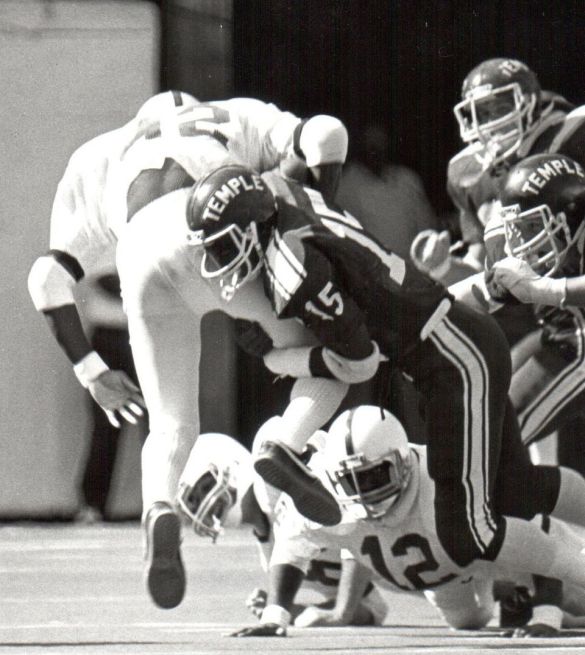
Click on the photo of Todd making a tackle for Temple for more.
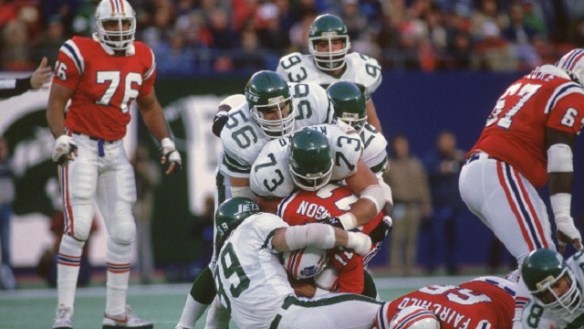
Thirty-seven years ago, Temple sent Joe Klecko to the Jets and four years ago the Owls sent Muhammad Wilkerson to the Jets. Now Temple will send Todd Bowles to the Jets (more on that tomorrow but click on the photo for 5 reasons why Joe belongs in the Hall).
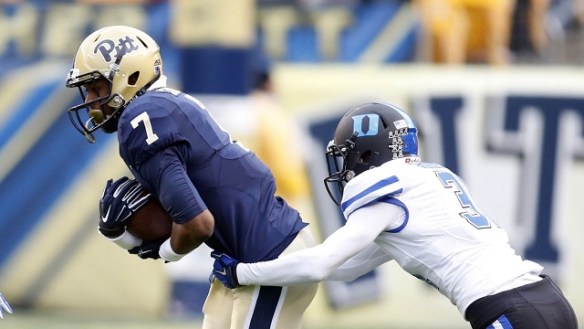
Click on the photo for details.

Ted’s own photos from the more recent past, including these from the New Mexico Bowl. Hopefully, the current coaching staff delivers with several of these bowl experiences starting next year. Note spelling is not a strongpoint of the New Mexico Bowl scoreboard operator.
There is a great Temple fan named Ted DeLapp out there who went searching for Temple football history like one of those guys with metal detectors you see on beaches.
To say Ted is a great fan really is a misnomer. He’s The Greatest Fan, until I stumble upon another with his credentials of investing in the program by purchasing way more season tickets than he really needs for a 30-plus year period.
He hit on gold with some nuggets this week that we think deserve a wider audience than his own personal facebook page.
The first one involves a challenge game between the New York Giants of the National Football League and the Temple Owls. Turns out both the Owls and the Giants had an open weekend and Giants’ owner John Mara, eager to gain some credibility for his team, challenged the Temple Owls to a game in 1935. That year the Owls were 7-3 with wins over Texas A&M and Vanderbilt. Here’s what Ted found:

Another was Temple luring Pop Warner from Stanford. Love the way sports pages used cartoons back in those days:
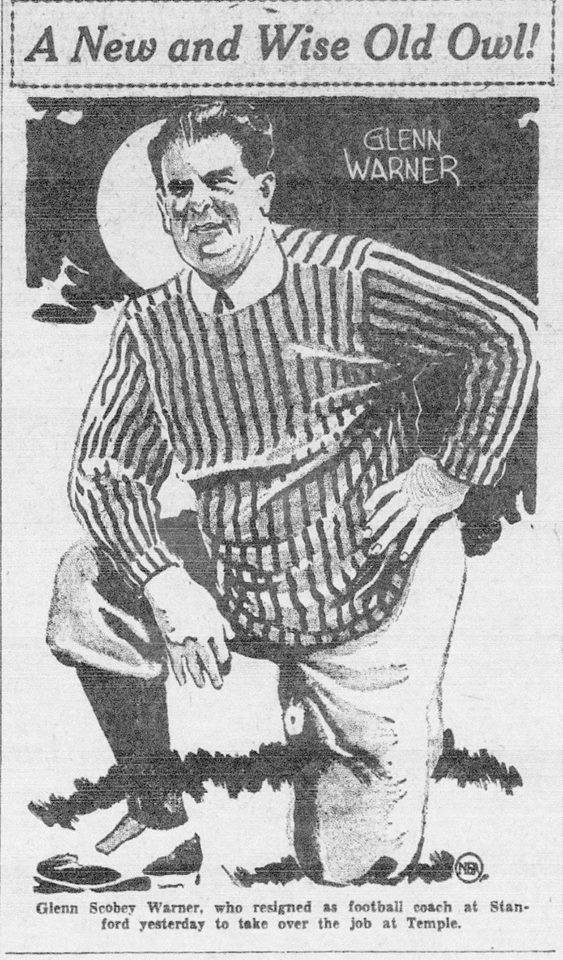
Not often you find one coach with two nicknames “Pop” and “Scobey.”
Temple lured him for the princely sum of $18,000 after Stanford refused to match the offer. Temple’s BOT in those days was forward-thinking, learning that the only way to make money is to spend money and go after the top head coaches available. Unfortunately, due to an arm’s race that would make the Cold War look like Kid’s Play, Temple is now out of that high-stakes poker game.
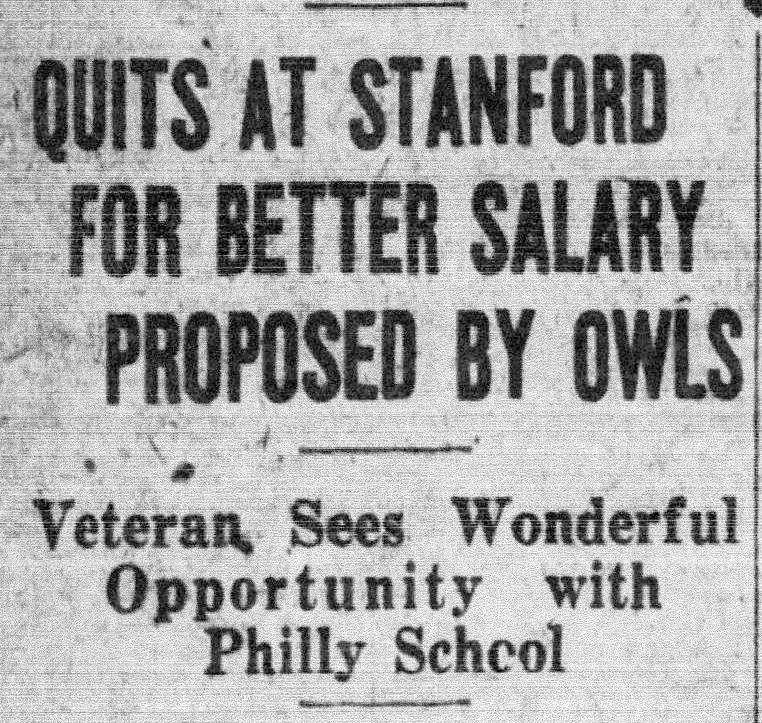
Interesting that a clause in Warner’s Temple contract allowed him to hold a job at a bank on the west coast during the six months between Jan. and June. Bobby Wallace had no such clause, but was away for much of the time of his eight-year contract, maintaining a home in Gulph Shores, Ala.

Temple TUFF about 100 years ago.
See that block at the 11-second mark on Gray’s first TD? That was a blocking FULLBACK (No. 32). Until Temple also employs such a player, talk of a revived running game could be just that.
Do not know what Temple football coach Matt Rhule got under that Christmas tree on Thursday morning, but do know what he needs more than anything else.
A running game would have been nice to unwrap. A blocking fullback would have been nicer.

When you dead last, running the same kind of offense over and over again is the very definition of insanity.
If there has been one constant about all of the bowl-winning teams this year, it’s that every one of them have had a 1,000-yard plus runner this season. I think it’s possible that one of the current players in the program can do that—most notably Jahad Thomas, Zaire Williams, Jabo Lee and Jamie Gilmore—but none of them have a chance to do it under the current offensive philosophy. Lee is coming off two years of inactivity and Williams one and Thomas became a forgotten man after running for 157 yards against Tulsa, so to expect any of them to do it would be too much. Gilmore is a third-down back and his ceiling is Matty Brown, but that’s a pretty good roof.
So that leaves one of the incoming guys. Maybe they can do it under a spread system with a rebuilt offensive line. Bernard Pierce proved that a true freshman can make an immediate impact as a runner, but Pierce had a blocking fullback like Wyatt Benson running interference for him in addition to a good offensive line.
Maybe there is a mystery running back yet to be recruited but, until then, these three guys have the best shot since they are current commits:
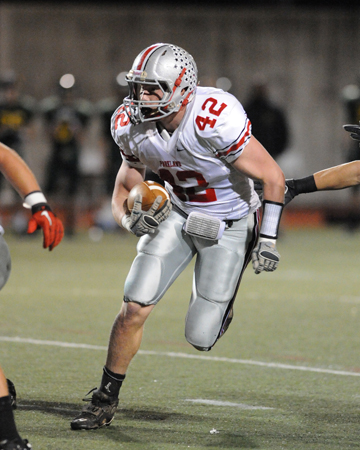
Rob Dvoracek could be the key to unlocking the Owls’ running game in 2015.
Ryquell Armstead _ He certainly has the stats to match Bernard Pierce’s high school numbers from Glen Mills. Playing for Millville (N.J.), Armstead is exactly the same height (6-0) and weight (205) coming out of high school. Armstead ran for 341 yards and four touchdowns in Millville’s 44-40 win on Thanksgiving Day over rival Vineland and fellow Temple recruit Jeremiah Atoki. Like Pierce, Armstead holds a PR of 10.81 in the 100-meter dash. Pierce’s 10.8 won him a Pennsylvania indoor state championship. Interesting that Philly.com lists Armstead’s weight as 185 and his hometown Vineland paper lists him at 205. We’ll go with the hometown weight. Armstead finished with 1,488 yards and scored 18 touchdowns as a senior (Pierce had 2,005 yards and 26 touchdowns as a senior).
Chapelle Cook _ He’s probably ticketed for a strong safety or linebacker position on defense, but can help the Owls’ running game if asked. He’s 6-2 and 215 and played a running quarterback on offense at Lakewood (N.J.), home of a Phillies Class A farm team. As a quarterback, he carried the ball 31 times for 197 yards in a loss to Rumson-Fair Haven.
Raekwon Gray _ At 5-8, 170, he’s more of a Matty Brown-type than a BP type but would you have not given a right arm for Matty Brown last season? Still do not know if this coaching staff would have been smart enough to figure out what it had in Matt Brown if he did stick around a few more years . I have my doubts based on what they did with Thomas after his 157-yard day. Gray’s best year came as a junior, when he averaged more than 8 yards per carry over 12 games. He finished with 2,295 yards and 30 touchdowns on 283 carries on his way to being named to the Consensus Maryland All-State team for Urbana High.
The key guy could be someone who is already here, like Rob Dvoracek. With a glutton of good linebackers, the Owls would be wise to move Rob to fullback, where he enjoyed great success at Parkland. As good a runner as he was–he had 347 yards and six touchdowns in a District 11 win over Allentown Central Catholic–he was even a better blocker. Rob is fully recovered from an infection and would be a big key to unlocking the Temple running game from a fullback position. Plus, you think Rob would not at least help solve Temple’s documented problems on 3d and 1, either as a short-yardage runner or blocker?
Hopefully, that’s one gift Matt Rhule decides to unwrap.
Related:

Merry Christmas from Temple Football Forever and thanks for all the visits and comments over the past 360 days. We will be back with a new post tomorrow.
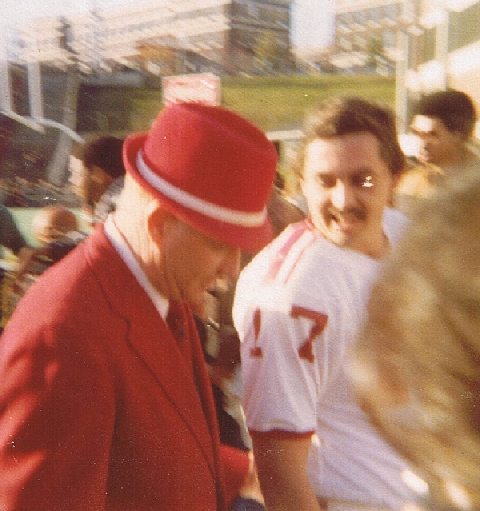
Wes Sornisky says something to Wayne Hardin after a 17-17 tie at Cincinnati.
Every once in a while, somebody sees something that needs to be done and makes a difference.
Meet the undisputed heavyweight champion of the Temple spirit, which Wes Sornisky was and someone who I had the honor to know well for at least a few years of his all-too-short life.
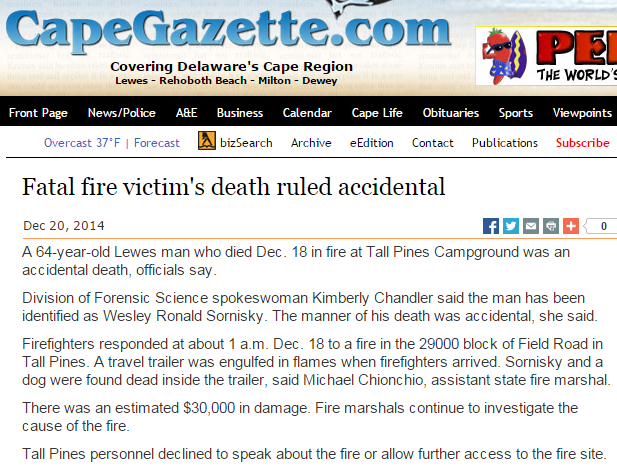
Wes died tragically in a fire in Delaware a few days ago and I cannot help but think much of the football tailgating scene at Temple now, a scene that went from dreadful to really good, was due to him making a difference.
During the darkest of Bobby Wallace days, Wes organized a group of ex-football players into something called the “Fourth and Goal Club” and they picked the Jetro Lot at 11th and Damien as their headquarters. It started out with a few and ended with many and eventually made the move over to Lot K, where the ex-player group thrives under all-time tackle leader Steve Conjar.

Wes finally made Sports Illustrated for this fact in the weekly college roundup.
Wes would bring one of those food trucks you’d see at Temple and make it tailgate headquarters. Eventually, word spread and other tailgaters would join the group.
There’s something extra special about the kickers and their connection to Temple. Almost all of the ex-kickers make it regularly to the games and I’m sure Brandon McManus would, too, if he didn’t have a job kicking in the NFL.
Wes and Cap Poklemba, another kicker, separated by 30 years or so but united by a common spirit, even held a tailgate at a Temple basketball game. That idea never caught on, but that was more due to the weather than the idea itself.
Wes could have been a big part of history in the 1976 Penn State game when Temple went for a two-point conversion to win at the end instead of allowing him to tie it with an extra point. Wayne Hardin told me last year it was a mistake because a tie would have been viewed as a win for Temple. (I disagreed and told him he absolutely did the right thing.) After that game, though, Hardin said a tie “was like kissing your sister.”
The next year, at Cincinnati, Hardin allowed Sornisky to kick a field goal to tie, 17-17. After the game, Sornisky is seen in a photo saying something to Hardin. I asked Wes what he said. “How’s kissing your sister feel?” is what Wes told me he said.
Wes knew of my affinity for the old “TEMPLE” helmet and wanted me to have his a few years ago and we decided to meet a couple of miles from his home at the Montgomeryville LA Fitness Center. Something came up and Wes had to cancel but said we would meet again somewhere along the line.
And that was the last I’ve heard from Wes, who moved to Delaware, which was like moving to Kansas. He never came to a game again, but he made a big difference in his life at a time when a difference needed to be made.
RIP, Wes.
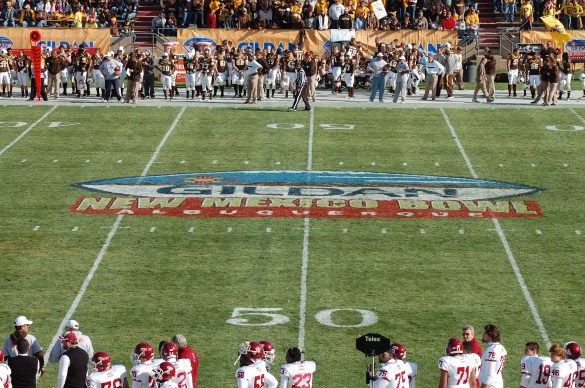
Click on photo of New Mexico Bowl, where the Owls played three years ago today, for the reasons.
A great quarterback prospect is like the famous Potter Stewart quote about pornography: “It’s hard to define, but I know it when I see it” he said in the case of Jacobellis v. Ohio, 1964.
The Supreme Court Justice went to Yale, so he was around when Brian Dowling was throwing around the pigskin for the Bulldogs. Being a smart man, he probably also know great quarterbacking when he sees it. So do most of us. I knew Adam DiMichele had “it” the first game I saw him in a Temple uniform. I also knew whatever Chester Stewart had wasn’t it in his first game, a 7-3 loss to Western Michigan on a dreadful day at Lincoln Financial Field.

Ben DiNucci after winning WPIAL Class AAAA championship for Pine-Richland.
Trust me on this one: Pine-Richland’s Ben DiNucci has “it.” He will go down as the most productive quarterback of the next four years on the college level Pennsylvania, too, including whomever Temple, Pitt or Penn State recruit. The 6-3, 190-pound Gatorade Pennsylvania Player of the Year became the first Pennsylvania player to throw for more than 4,000 yards, setting a PIAA record for single-season passing with 4,269. DiNucci was 32 of 46 for 383 yards and four touchdowns in a 49-41 loss to St. Joseph’s Prep in the Class AAAA title game Saturday night. DiNucci also set a PIAA playoff record with his 32 completions and a championship game record with 383 yards passing. His four touchdown passes tied Berwick’s Ron Powlus (1992) for the most in a championship game.
More than all of those records, though, he possesses the elusive “it” factor in quarterbacks that make or break coaches. Forget that he wasn’t offered by the big schools. Big schools often miss big players. Ask Marty Ginestra. Or Henry Burris. Or Brian Broomell. Or Matty Baker. Or Tim Riordan. DiNucci falls into the category of a very good quarterback who can be very productive for Temple.
Some people have a better “it” radar than others. Al Golden’s Achilles’ heel was not having a good quarterback GPS installed (he inherited ADM from Bobby Wallace). To borrow a Potter (not Chester) Stewart term, the jury is still out on Matt Rhule’s quarterback radar.
Trust me with this one, though: Ben DiNucci will be a great college quarterback at any level and the good news that he has chosen to play his college football in Philadelphia. The bad news is that it will be at Penn.
DiMichele currently is spending the weekend recruiting in the Pittsburgh area. If he’s smart, he would swing by Pine-Richland to investigate the level of interest DiNucci has playing the game at its highest level in the same city for Temple. If Temple is smart, it would offer him a scholarship now.

