Spring (Practice) Is In the Air

mondayeve

This is what will be on the ground for the first day of spring practice

Like last year’s Temple football team for instance, the last month of weather has been a tease. Those back-to-back 77-degree days of late February have been replaced by some brutal cold since. Since last year ended OK (not great), we’ll say by Cherry and White Day it will be nice and warm.

We think.

The calendar says the Owls start spring practice tomorrow, but it won’t look that way. Spring practice is in the air. Spring, on the other hand, seems a long way away.

aramark

At least the new indoor facility is the equal to anything a P5 team has.

Either way, the Temple Owls’ football team will have to deal with the 1-3 inches on the ground or move the first practices of the “spring” a couple of blocks away to the spectacular new $50 million Aramark Star Facility at 15th and Montgomery.

That’s a call for head coach Geoff Collins to make, though.

Bruce Arians used to come to Geasey Field on spring practice days—there was no indoor facility back then—and open with “get your work done” in that Southern accent he developed while a player at Virginia Tech, even though he was from York, Pa.

Either in rain, sleet or snow, the Owls have a lot of work to do to address these questions (in no particular order):

What will Trad Beatty’s role be?

The super quarterback recruit from South Carolina obviously is a Dave Patenaude favorite but, in the entire history of Group of Five football, no true freshman starter has led his team to a G5 league championship. That factor has to be weighed in the development of Beatty and the goal of the Owls to win the 2018 AAC title, just like they did the 2016 one. In Frank Nutile, they have a bowl-winning quarterback and a guy who has the best passing stats in the nation against a rush. Juice will be awfully tough to beat out.

Who are the defensive backfield replacements?

The Owls lose three of their four starters at the key positions of cornerback and safety. The only returner is first-team AAC safety Delvon Randall. They will have to plug around the edges. The speedy Linwood Crump Jr. has the inside track on the left corner spot, while the right corner spot will probably be occupied by Rock Ya-Sin, a first-team All Big South performer who had more interceptions against Wake Forest (one) in 2016 than the whole Temple AAC championship team did.

Other than Ya-Sin, who starts immediately?

My money is on Nickolas Madourie, an incoming junior college transfer from Dakota College at Bottineau in North Dakota. Shortly after former Central Florida coach Scott Frost took the same position at the University of Nebraska earlier this month, Madourie rescinded his verbal commitment from the Knights. Madourie had 45 tackles during his recently completed sophomore season, including 17.5 sacks. If the Owls go three wides on offense, look for true freshman Sean Ryan from NYC to join Isaiah Wright and Ventell Bryant. Me, I hope they scrap the three wides, use a tight end (Kenny Yeboah) and a fullback (Rob “Nitro” Ritrovato).

We should find out the answers to those questions by April 14.

Hopefully, by then, spring will have already arrived.

Wednesday: The Greatest Cherry and White Ever

Fiasco at Mitten Hall

hearyou

The community asked for answers and responded this way

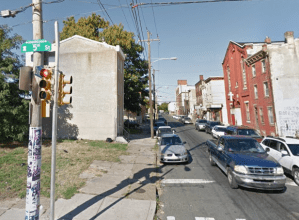
For today’s social experiment, we ask you to depart the Temple campus–on foot, not vehicle–and proceed to walk East of, say, 9th and Berks for five blocks.

Now walk West of 17th Street on Norris and complete a similar five-block trip to 22d and Norris.

youngchaney

“Temple should pack it up, move to the suburbs, and leave a hole in the ground and a statue of the Mayor and the Council president holding hands.” _ John Chaney, on the opposition to building what is now the LC


That is what the heart of North Philadelphia would look like without Temple University. That’s pretty much life in a lot of inner cities in America. It’s not the fault of the people who live in them, certainly. In Philadelphia, what the neighborhood looks like surrounding Temple is certainly not Temple’s fault.

The community has legitimate concerns about the new stadium Temple wants to build entirely on Temple property and ask the questions they need to and get their answers. In fact, Temple has pretty much hit on all of the key bullet points–no one will be displaced, the Amos Recreation Center will stay right where it is and the stadium would be available for community events.

Yet the session they asked for turned out to be a Mitten Hall Fiasco. I left work and made it in time to see a group of clergy urging their congregation to listen and the congregation having none of it.

The “stadium stompers” asked for the town hall in the guise of a question and answer session. They never allowed it to get to a Q and A, with loud shouts of “YOU LIE!!” that would not allow the event to continue. It was all a ruse. I would say there were more pro-stadium people in the house than anti-stadium but the pro-stadium people sat in what only could be described as polite silence mixed with nauseating disgust.


Why should other urban
universities located
in densely populated
residential neighborhoods,
like Georgia Tech in Atlanta
and Boston College
in Chestnut Hill, Mass.,
have stadiums on property
owned by them and Temple
not be allowed the same right?

Temple set only two ground rules for the meeting and it was no signs were allowed and that civility was expected.

One side broke both rules and ruined it for all sides.

Asking for a Q and A and not allowing questions or answers is the very definition of a ruse. This is pretty much the level of discourse in the U.S. today.

Why should other urban universities located in densely populated residential neighborhoods, like Georgia Tech in Atlanta and Boston College in Chestnut Hill, Mass., have stadiums on property owned by them and Temple not be allowed the same right? The community did not protest when Temple built a library, a dorm, $30 million of new classrooms and even a $17 million football practice facility but basketball and football arenas somehow cross an imaginary line because they are hot-button issues. The irony of this is that libraries, dorms and classrooms have an impact on the community 350 or so days a year, while a football stadium impacts it only a maximum seven of the 365 days.

diamond

5th and Diamond

When the great John Chaney was asked what Temple should do in the face of similar opposition to the building of The Apollo (now the LC), he said, simply this: “Temple should pack it up, move to the suburbs, and leave a hole in the ground and a statue of the Mayor and the Council president holding hands.”

The administration should have followed his advice then. On Tuesday,  it tried to be a good neighbor, but neighborliness is a two-way street. Nobody can say Temple did not hold up its end of the bargain.

Monday: Spring (Practice) is in the Air

Wednesday: Our New Scheduling Buddies

Friday: The Greatest Cherry and White Ever

Monday 3/19: A Rock and A Hard Place

Wednesday (3/21): The Bullhorn Lady

Eye on Atlanta: Root for Georgia Tech

urban

Hopefully, Temple’s stadium will be closer to this than the crude drawing released recently

Hard to believe, Harry (Donahue), that one of the websites that list such things has placed Georgia Tech’s Paul Johnson on the hot seat.

A few years ago, Johnson was one of the hottest coaches in the country at The Naval Academy, now he’s sitting on a hot seat. That’s life in the Power 5.

If you are a Temple football fan, you’ve got to root for him and his Georgia Tech team this season because when Owls’ head coach Geoff Collins called Temple “a developmental program” a month ago tomorrow, he probably meant it with his coaching staff, too. Three of four of Collins recent hires are from the state of Georgia and his current defensive coordinator, Andrew Thacker, was a position coach at Kennesaw State (also known as the Owls). Kennesaw is in Cobb County, which is in the Greater Atlanta metropolitan area.

Collins himself as a history at Georgia Tech, being the recruiting coordinator there for the Yellowjackets. If you don’t think this staff is being developed for a place like Georgia Tech, you probably don’t believe that General Billy Sherman burned the town to the ground 168 or so years ago. If Collins does well here this fall, he certainly would move to the top of the Georgia Tech wish list.

So that’s probably what Collins means by a developmental program. Ask him if he considers Georgia Tech a developmental program.

Still, rooting for a solid year from our friend Paul Johnson is almost as good as rooting for the Owls themselves.

That’s the lay of the land, though, in the “developmental” AAC.

In January, Navy head football coach Ken Niumatalolo interviewed for the Arizona opening. While he  decided to remain in Annapolis, had he left the Midshipmen it would have left Tulsa’s Philip Montgomery as the longest-tenured head coach in the American Athletic Conference, after only three seasons with the Golden Hurricane.

Coaching turnover has become a fact of life in the American with six head coaches leaving the AAC for jobs at “power five” schools. Next year, Memphis’ Mike Norvell and USF’s Charlie Strong are sure to attract suitors.

A good year for Paul Johnson probably won’t mean Collins will be here for life, but it would certainly close at least one very attractive door and limit the damage to Temple’s program for at least another year.

How’s that Georgia Tech fight song go again?

Friday: Thoughts on The Mitten Hall Fiasco

Monday: Spring (Practice) is in the Air

Wednesday: Our New Scheduling Buddies


Three Facts and Five Questions

No matter what you call it, the “Town Hall” being held tomorrow night (6:30) at Mitten Hall has all the potential to be either a public relations disaster or a bonanza  for Temple University.

I’m not betting on Hos Cartwright here, though.

Television cameras from all four local stations will be there with the express purpose of finding some sound and fury that would make for good fodder for the 11 p.m. newscast.

If Temple fans who want the stadium show up and dominate the session with applause and support for the ideas presented, that segment would probably find a way to the cutting room floor. If, say, for every 10 people who attend, one voice is against it and nine are for it, the narrative will be “there were some opposed and some in favor” and they will find one voice in favor and one opposed, even if there are more fans for it than against. That’s the way the drive-by media works these days. If no fans show up and only “community” members expressing opposition are there, it will be the top news story of the night.

I think we are going to be somewhere in between those two extremes, though.

mitten

It was pretty ingenious for the university to set this town hall up at a time when the students are gone. Most of the “Stadium Stompers” among the students are from relatively far-flung places like Allentown, Lancaster and Scranton and their activism on the topic probably only extends to the time they have to be in North Philly. It’s hard to imagine them giving up a spring break visit to Florida or time home with their Penn State friends for idealism. At least when idealism is not convenient.

President Dick Englert did not even address the stadium when he talked at the recruiting “celebration” on Feb. 7 so to me, the forum presents an opportunity to answer some hard questions that were not even broached then. Here are five of them:

yulman

Yulman: Rejected by ESPN

How did the stadium shrink?

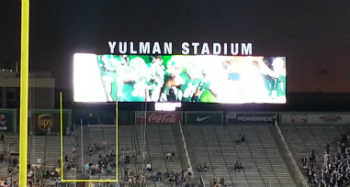
Two months ago, when the plans were officially released, the minimum seating was going to be 35,000. Now, we’re hearing “between 30-35 thousand (see above video).” Not good. Why is this important? Because 30,000 will make the stadium look like Tulane’s Yulman Stadium and, by most accounts, that stadium was obsolete the day it opened. All of the Temple fans who I talked to and have been there hated it.  It’s nothing more than a glorified high school stadium and the league told Tulane the TV sightlines and lighting almost made it impossible for ESPN to schedule a night game there. Temple should go bigger (at least 35K) or go home, making the stadium look more like successful ventures like Houston, Cincinnati and Florida Atlantic. Moody Nolan needs to come clean. Will this look more like Tulane or more like FAU?

What, exactly, will go into the retail outlet?

What kind of retail will be considered or will the university build five empty franchises and hope that the market dictates the tenant? Some kind of smaller version of Xfinity Live would work, maybe a WAWA. I wouldn’t put another student bookstore or pizza shop in there, though. When I lived in Doylestown, we desperately needed a grocery store in the center of town. Instead, we got five coffee shops that mostly went out of business because wives of the rich guys who lived there always had the fantasy of opening coffee shops. Build what the students and community will need and support.

smuboulevard

Where will the traditional tailgating be held?

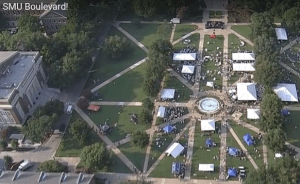
We all know that the university is planning to put the thousands of students who now take up a large portion of Lot K into Polett and Liacouras Walks and that’s a terrific idea. SMU has shown how successful that concept can be. Still, how many of the university’s 11 outside parking lots be set aside for more traditional tailgating on Saturdays or are the days of the traditional smaller tailgates over?

What is the timeline?

The university should set a timeline that it expects to meet. City Council approvals by this summer, next summer or the summer after or somewhere in between? At what point does this project cross the Rubicon of no return and what are the options other than Franklin Field if it is abandoned? Temple cannot allow the endless speculation on this to continue and must set some realistic parameters for getting this done.

success

Does the University Have the Stomach to Play Hardball?

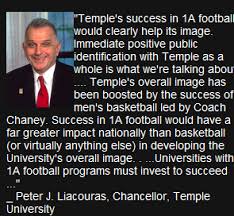
We’re not talking about restoring the baseball program here, although you could probably configure the stadium for those purposes if needed. If the City of Philadelphia does not give the necessary permissions, can the architects reconfigure a stadium that would not require 15th Street to be shut down? That’s what is going to have to happen for the uni to pursue legal action to get this done. An argument can be made that if places like Maryland, Rutgers and Georgia Tech have the legal right to build whatever it wants on property owned by them so, too, should Temple.  Hardball–threatening to move the uni out of Philadelphia–is what ultimately got the LC built and the uni might have to play some sort of hardball to get this done as well. Pete Liacouras had that stomach. Does the current BOT?

Wednesday: Eye on Atlanta

Friday: Reflections From Mitten Hall

What a Revolting Development ….

revolting

With only a few seconds in an eminently winnable game NBA at Miami, something stood out like a 6-foot-11 sore thumb.

The Philadelphia 76ers were winning and this decade’s version of “Hack-A-Shack” was in the game. Of course, instead of two 90 percent free throw shooters Mario Bellinelli and J.J. Redick being in there to catch the ball and get fouled and win the game, Ben Simmons was spotted and fouled immediately and the Sixers lost at the buzzer mostly because he missed two free throws.

What does this have to do with Temple football?

ceremony

Because after the game, Sixers head coach Brett Brown said it was “more important for Simmons’ development” to be in there than it was to win the game.

The word “development” caught my ear because I heard, by my count, Temple football head coach Geoff Collins a derivative of it not one, not two but four times at the recent recruiting celebration. Collins said “we’re a developmental program”  while reviewing some recruiting film and saying a lot of these players are in the developmental stage and are coming here to be developed. It wasn’t the first time he used it. This is what he said in an interview on SI.com last May:  “I think this place is a developmental program, so I take pride in that.”

I guess Florida wasn’t a developmental program.

Hmmm. I’m sure Collins means well, but I don’t like the term.

Developmental program is a term I’ve never associated with Temple football before Collins came to town. AAC championship program, yes. Top 25 program, yes. Developmental program, no. While players certainly have been developed and nurtured (the most recent example is Haason Reddick), the primary purpose of Temple football has been to win as many games as possible. If someone got developed along the way, fine, but development was always secondary to playing in championship games.

To me, like the Sixers’ game above, winning is not the most important thing, it’s the only thing. I could not give a rat’s ass about Simmons being in there to learn a lesson, nor could I give a similar derriere for Logan Marchi’s “development” as a quarterback meant keeping him in there for seven games, looking awful against a bad Villanova team and stinking up Lincoln Financial Field in winnable games against Houston and UConn. A seven-game career as a starter was way too long for Marchi, who failed an eye test two games into his starting career and should have earned a permanent spot on the bench.

Big-time college football is a business and, in business, it’s either up or out. Marchi wasn’t treading upward after a brutal Game Two performance against Villanova and should have been out.

One of William Bendix’s catch phrases in the old TV show “Life of Riley” was “What a Revolting Development” and that applies to the word “developmental” and Temple football. A year ago, Collins was touting Temple as a “Top 25 program” and now it’s “developmental program.”

I prefer Top 25, thank you.

Let’s hope Temple never becomes the Sixers and sacrifices a precious game for the development of any single player. The football Owls don’t get to play 82 games a year. They can’t afford to trade wins for development.

Monday: 5 Questions for The Stadium Meeting

Wednesday: Eye On Atlanta

Friday: Reflections on The Town Meeting

3/12: Spring Practice Begins


Current Staff? Meh ….

raponecould

This is the resume Nick Rapone could have brought to Temple.

Everything in life is a trade-off and, so it is with Temple football coaching staffs as this story illustrates.

“My son said, ‘Dad, it’s like Night and Day between this staff and Al Golden’s staff,’ “ John Palumbo’s father told me during Steve Addazio’s first Cherry and White Day. “He said, Dad, these guys are all National Championship coaches. They know what they are doing.”

interested

Palumbo knew what he was talking about. He started at center for both Golden’s last team and Addazio’s first team. Daz took Golden’s talent and made it a bowl-winning team.

Golden was the great CEO-type, someone with a binder full of recruiting contacts up and down the East Coast and nobody was more well-equipped to stock the Temple roster with the talent it needed to succeed—if not win—the MAC.

Addazio was the ambitious successor, a guy who supposedly loved the macaroni and South Philly Italian food so much that he would stay here 10 years. We later found out what he was, a bull-bleeper who could sell snowballs to the Eskimos. In that sense, Daz bought an all-star staff with him to Philadelphia—the defensive coordinator at Florida, Chuck Heater, and Scot Loeffler, a damn good offensive coordinator.

rosscard

They were a good sight better than Mark D’Onofrio and Matt Rhule, Golden’s last coordinators but part of the price of bringing that kind of talent to Philadelphia was that Daz probably promised that he would take them along to a P5 stop in a year or two.

When the Owls hired Geoff Collins from Florida, I had a feeling it would be more like a Daz hire than a Golden or Rhule hire in that he’d poach the Florida staff of a couple of top position coaches with a promise of making them coordinators here. No such luck. The only person he poached from the Gators was the equipment manager.

It wasn’t what I expected.

You get what you pay for. Two days after he was hired, Steve Addazio wooed his buddy, then Florida national championship co-defensive coordinator (really, THE guy according to Urban Meyer), Chuck Heater. Temple paid Mark D’Onofrio $200,000 to be DC in the 2010 season. Daz convinced Lewis Katz, his guy, to kick in an extra $200K to secure the services of Heater. Katz is gone and probably so are the days of Temple outbidding P5 teams for any assistant football coach’s services. Heater loved it here, biked every day from Center City to 10th and Diamond and had a good relationship with many Temple fans, big donors and small.

Now, we have an offensive coordinator from Coastal Carolina, a defensive coordinator from Kennesaw State and position coaches from West Alabama and Georgia State. It’s particularly sad in that Nick Rapone, a former FCS defensive coordinator of the year who spent the last few years with Bruce Arians with the Arizona Cardinals, expressed an interest in the DC job after Taver Johnson left. So did Temple legend Kevin Ross, who was the DB coach with the NFL team.

Instead of NFL guys, we have Kennesaw State and West Alabama guys. Not the kind of resumes that will make sons of the current Owls tell their fathers that the Rhule and Phil Snow did not know what they were doing.

Maybe the trade-off is a little more loyalty for fewer wins. Give me consistent wins on Saturday or any day of the week against mediocre 7-6 records and loyalty every year of the decade. I know I would have them with guys like Scot Loeffler, Chuck Heater, Nick Rapone and Kevin Ross.

These small school guys?

Not so much.

Friday: Developmental Program?


Coaching Shuffle: It’s Who You Know

vested

When it comes to getting an assistant coaching job at Temple, as anywhere, it really comes down to who you know.

Geoff Collins.

If you know Geoff Collins, you are in, and that was pretty much what happened with the hiring Nathan Burton as safeties coach after being the “quality control” coach at North Carolina State last season.

performance

Coastal Carolina soft

Burton met Collins when he was walk-on in the last century at Georgia Tech and Collins was a graduate assistant there.

Prior to his time with NC State, Burton served as the defensive coordinator at West Alabama for three seasons. West Alabama was the place where former Temple head coach Bobby Wallace finished his career after making his chops at North Alabama.
Burton was hired as safeties coach but will take over the entire defensive backfield due to the exit of Cory Robinson for Rutgers. Robinson had been the defensive backfield coach at Temple last year.

To me, that was addition by subtraction.

One of the most disappointing areas of the team was the play of the defensive backs. Three starters returned from the AAC championship team and a fourth, Mike Jones, eschewed a chance for being a late-round NFL draft pick last year (Mike Mayock had him projected as the steal of the sixth round of the 2017 draft) to play for Temple.

Time and time again, the Owls were burned by touchdown passes late in the games (particularly Army and Navy) and they appeared to be out of position and the communication was not there like it was two years ago. Fran Brown and Phil Snow did a much better job with essentially the same players.

Defensive coordinator Taver Johnson, who presumably had a role in that miscommunication, was “demoted” to co-coordinator, probably saw the handwriting on that wall and took a lesser job at Ohio State.

Larry Knight will take over the linebackers, a role current defensive coordinator Andrew Thacker had last year. Knight had been the “director of player personnel.”

To me, the Knight move was interesting considering that he performed that same role at Georgia State in both 2015 and 2016.  Nick Rapone and Kevin Ross, probably overqualified to be DC and DB coach at Temple, expressed interests in the open jobs through back channels. No doubt in my mind they would have been better for the kids than the guys hired, but Collins is comfortable with who he hired and it is Collins who will sink or swim with them.

Would I like to see more ex-Temple guys like Nick Rapone and Kevin Ross included in this staff? Sure, but they did not know Collins before now and apparently Collins apparently did not have the same comfort level with them.

At least those of us who care about those things still have native son Adam DiMichele and adopted son Ed Foley. Hopefully, that’s enough to swing the pendulum of the offense back in the direction of Temple TUFF and away from the Coastal Carolina SOFT we witnessed too much a year ago.

The defense is pretty much all Collins anyway. Maybe it takes a year to install the Mayhem we have been promised. Let’s hope so because I didn’t see any evidence of that last year, the lone exception being the bowl game.

Wednesday: Comparing Staffs

5 Best Trick Plays of The Ed Foley Era


A couple of days ago in this space, we outlined that Temple—not Clemson—was responsible for The Philly Special that goes under the name “Clemson” in the current Temple playbook and the proof was that Temple pulled off the same play in the Penn State game a year before Clemson did and was credited with it.

The special teams’ coach on the day of that Penn State win was Ed Foley and now that he is assistant head coach in charge of offense—presumably supervising current offensive coordinator Dave Patenaude—he will have some input at least into the play-calling and game-planning on the field.

At least that’s the hope.

The other hope is that the Owls will have more trick plays than the two they succeeded at last year. Here are five successful ones that should be rolling around Foley’s head since he was on the staff for all five:

The Good Old Fashioned Flea-Flicker (2006)

Head Coach: Al Golden

Offensive Coordinator: George DeLeone

Ed Foley’s Role: Tight Ends Coach

After being pummeled (70-14 and 70-21) by Bowling Green two years in a row, the Owls needed some trickeration to end a 20-game losing streak and DeLeone pulled out this one from the playbook. Quarterback Adam DiMichele received the snap from center Alex Derenthal, handed the ball to running back Timmy Brown, who pitched it back to ADM, who hit 4.3 sprinter Travis Sheldon all alone for six. Temple won, 28-14.

The End-Around Touchdown Pass (2010)

Head Coach: Al Golden

Offensive Coordinator: Matt Rhule

Ed Foley’s Role: Recruiting Coordinator

With the Owls just outside the red zone at Army, Rhule had speedy wide receiver Joe Jones take a reverse handoff from quarterback Chester Stewart. While on the run, Jones hit wide receiver Michael Campbell on a 24-yard touchdown pass in the corner of the end zone for the points that made a big difference in the 42-35 win.

The Double-Reverse Touchdown Pass (2013)

Head Coach: Matt Rhule

Offensive Coordinator: Marcus Sattersfield

Ed Foley’s Role: Tight Ends Coach

Even though the Owls finished 2-10 that year, that doesn’t mean they did not have their fun moments. All season in this space we called for wide receiver Jalen Fitzpatrick—the starting quarterback in the Big 33 game—to throw a pass in a real game. We finally got our wish on Oct. 26 at SMU when Fitzpatrick reversed to take a handoff from Zaire Williams and found Robby Anderson all alone behind the defense for an 86-yard touchdown pass. Temple lost, 59-49, but it clearly was not the offense’s fault.

trick1

The North Philly Special (2015)

Head Coach: Matt Rhule

Offensive Coordinator: Glenn Thomas

Ed Foley’s Role: Special Team’s Coach

Previously outlined in this space two days ago, it was the precursor to The Philly Special that the Eagles ran in the Super Bowl. It is in Temple’s current playbook by the name “Clemson” but they might want to change that name since Clemson stole the play from Temple. Former quarterback John Christopher took a pitch from Jahad Thomas who threw back to Walker for a 25-yard gain in a 27-10 win over Penn State. In the Super Bowl, the role of Thomas was played by Corey Clement, while Nick Foles (P.J. Walker) and Trey Burton (Christopher) assumed the other parts.

The Hokey Pokey (2007)

Head Coach: Al Golden

Offensive Coordinator: Matt Rhule

Ed Foley’s Role: Recruiting Coordinator

Only unsuccessful by the result (a bad call), the Owls used this to unofficially beat (but officially lose to) UConn and only a very bad play call by the MAC officials and upheld by Jack Kramer, the Big East replay official, ruined it. In the play, another wide receiver—former Hyde (Conn.) Leadership Academy quarterback Dy’onne Crudup—took the ball on a reverse and threw the ball ostensibly for quarterback Adam DiMichele in the end zone. DiMichele tipped the ball backward, where Bruce Francis caught the ball one-handed with one foot clearly inside the back of the end zone. Temple lost that game, 22-17, but really won, 24-22. Both national announcers on the TV broadcast that day said Temple was jobbed as did Connecticut-based ESPN, which replayed the play several times on Sports Center that night. The fatal flaw on this play was obvious to anyone who knows Football 101. Never have a guy take a pitch and force him to throw against his body. Crudup should have been lined up to the left, not the right, and made a natural right-handed throw.

Monday: The Coaching Shuffle

Wednesday: Staff Comparisons

Friday: Developmental Program?

The Philly Special


Even though I am an avowed fan of so-called “trick” plays (I prefer the term innovative), I understand that some do not like them.


“We saw Temple use
it to beat Penn State,”
would have been great
local currency, but
Pederson did not go there.

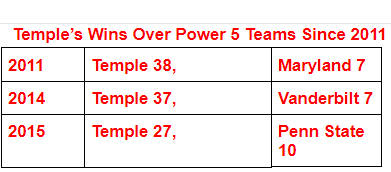
I had a conversation with a fellow Temple fan after Toledo used five trick plays to beat Temple, 36-13, a week after the Owls used no trick plays to beat Maryland, 38-7. Under then Temple (and ironically current Maryland) defensive coordinator Chuck Heater, the Owls were an over-pursuing defense susceptible to misdirection. Randy Edsall, the Maryland coach, didn’t try any the week before but Toledo must have picked up something on the Maryland game film.

folmeister

Ed Foley, Temple Nation turns its lonely eyes to you

“Pure genius,” I said of then Toledo coach Tim Heckman.

“I don’t like trick plays,” my friend said. “Line up and beat them the old-fashioned way.”

“You don’t like them because they beat us. You sound like Knute Rockne before the forward pass.”

I thought about my friend and smiled when the Philadelphia Eagles used at least one trick play–The Philly Special–to beat the New England Patriots in Super Bowl and remembered that play looked a lot like a play Temple used to beat Penn State nearly three years prior. The Eagles direct-snapped the ball to running back Corey Clement, who took off ostensibly running for the end zone but instead flipped the ball to receiver Trey Burton–a former quarterback–who found current quarterback Nick Foles in the end zone for six.

In the Owls’ version, they direct-snapped to running back Jahad Thomas, who took the same route to flip it to receiver John Christopher–a former quarterback–who found then current quarterback P. J. Walker for a big first down.

It would have been nice for Eagles’ head coach Doug Pederson to give a tip of the hat to the local college squad afterwards but, instead, he vaguely referred to “seeing some plays in college games that we liked” as the Genesis for The Philly Special. National TV people picked up the Clemson version of the Temple play a year later and pointed to it as being Pederson’s possible inspiration. “We saw Temple use it to beat Penn State,” would have been great local currency, but Pederson did not go there.

To me, anything from 1-5 trick plays a game is perfect. Six is probably too much or using the same play more than once in the same game is probably not advisable.

Generally speaking, there haven’t been enough trick plays in the Temple offensive arsenal for my taste since that Penn State victory. I can remember only one from scrimmage in a down-and-distance situtation last year–the scramble formation that allowed Isaiah Wright to score on a direct snap against Army. The Owls also tried a variation of the 2015 play last year on a two-point conversion with Wright hitting Frank Nutile.

That’s not enough.

Maybe new assistant head coach for offense Ed Foley can install at least one  for the upcoming season. The Maryland game might be a nice place to start. Ed, Temple Nation turns its lonely trick plays eyes to you. Foley has been around for all of the trick plays of the last 10 years–spanning four head coaches–and might be able to come up with the daddy of all trick plays and something we haven’t seen before.

If so, he can call it the North Philly Special.

Friday: The Five Best Trick Plays of the Ed Foley Era

Monday: The Coaching Shuffle

Wednesday: Developmental Program?


Flexibility: The New Scheduling Reality

photo

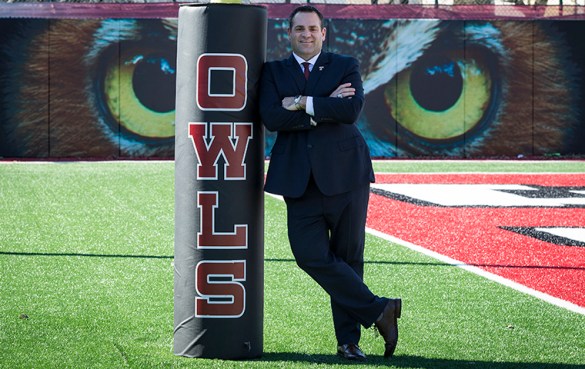
Pat Kraft pulled a major coup in getting home-and-homes with Maryland and BC.

When I think of the recent Temple football scheduling philosophy, there is one proverb in the Bible that applies: Pride Goeth Before the Fall.

Actually, in the King James version, 16:18, it reads: “Pride goeth before destruction, and an haughty spirit before a fall.”

Yep, that pretty much sums up a tenant of Dr. Pat Kraft’s philosophy, demanding a home-and-home from all OOC opponents.  There are few more affable and available athletic directors out there than our own Dr.  Kraft.  The guy is intelligent and approachable and tries to answer every question with brutal honestly.

Since he came from Indiana, I once asked him why Temple doesn’t try to schedule Indiana in football?

okie

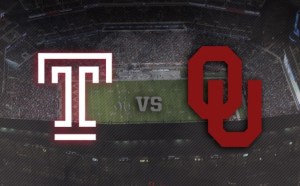
Owls should look for more marquee series, like this one against Oklahoma

“I tried to,” he said. “They don’t want to play us.”

Last year, I commended him for firing the men’s soccer coach because it had been my experience that Temple is unique among major universities in that they never fire any coaches.

“We won’t accept mediocrity,” Kraft said.

That was nice to hear.

That doesn’t mean I agree with the good doctor on everything. The morning of the Stony Brook game I casually mentioned to him that maybe Temple should not be playing the Stony Brooks or the Fordhams (or the Bucknells) of the world going forward; that, in my view, those games served no purpose for the advancement of the program.

global

As far as an Indiana-type foe goes, I find it hard to believe that the Northwestern and Illinois programs which scheduled Western Michigan in 2016 and are afraid to schedule Temple. Maybe not with a home-and-home, but certainly as a one-shot deal.

Ideally, Temple football should schedule like Temple basketball does. Load up on good OOC foes and try to win the AAC. If Geoff Collins is such a good recruiter and coach, he should be up to the task.

In hindsight, had the 2016 team played and beaten a team like Georgia Tech and not Stony Brook, that probably would have been enough to vault that team past Western Michigan and into the Cotton Bowl against Wisconsin (a team the Owls beat in 1990).

Instead, the 38-0 win over Stony Brook did nothing for Temple.

He said those “types” of games were sometimes necessary because a lot of Power 5 schools—the ones Temple prefers to play—won’t give Group of Five teams a home-and-home and want to schedule two-for-ones and three-for-twos.

“We won’t do those any more,” Kraft said.

“Not even for Penn State?”

“Not even for Penn State.”

That’s one of the reasons why PSU is off the schedule; a larger reason is Temple beat PSU, 27-10, and almost beat the 2016 Big 10 champs at their place, falling, 34-27.

Yet, if Temple can do it for Oklahoma, which it will starting in 2024, flexibility should be the guide in future scheduling templates.

Bill Bradshaw, the ex-AD, deserves kudos for getting Rutgers back on the schedule because he told me after the Owls played Rutgers, they requested a two-for-one and he turned them down. Bradshaw then said RU came to him in his final year and relented for a one-for-one that begins in two years.

Kraft then followed up by getting regional foes Boston College, Georgia Tech and Maryland to agree to one-for-ones. That’s progress. It’s a tougher schedule but a Temple that demands more than mediocrity should be up to those kind of challenges.

It would be nice to get Pitt back on the schedule, maybe Syracuse. These schools are major Eastern institutions, like Temple is. To me, the ideal Temple OOC schedule is to play as many P5 teams as possible and beat them. Maybe one low-level Big 10 team, like Indiana, and three former rivals from the traditional East.

Because the G5’s position is weakening compared to the P5, if that requires two-for-ones and three-for-twos, Temple should consider those options.

Pride goeth before the fall and, if pride means playing Bucknell and Idaho at home instead of at Pitt and at Syracuse, the fall could be the difference between relevance and irrelevance over the next five or so years.

Wednesday: The Philly Special