Ten Reasons To Build The Stadium

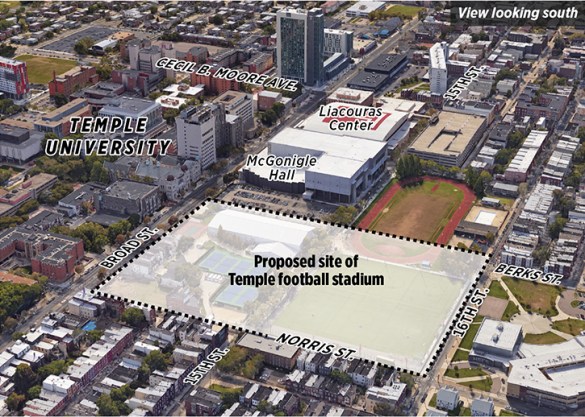
proposed

Snails have crossed the continental United States faster than Temple University has moved to build a football stadium since the first “done deal” was uttered by a member of the Board of Trustees to a follower in March of 2012.

That was the day that Temple beat North Carolina State in the NCAA basketball tournament. The listener was a long-time fan who made numerous road trips to support his alma mater in both basketball and football. The speaker was presumably well-connected with the powers-that-be at Temple.

Five months of March have come and gone and there has been no public announcement of the “done deals” so many of us have heard for five years. So call me skeptical that this thing will ever get built.

BOT meetings have come and gone and several of the last few have had “rumors” that the stadium would be discussed. Meeting agendas were released and no first “shovel in the ground date” could be found even in the fine print.

parking lots

There are 10 lots that will be mostly empty for tailgating on Saturday, plus a couple of garages for those who do not plan to tailgate.

An argument could be made both for and against a stadium and former Temple player Dave “Fizzy” Weinraub made such an argument against in this space a couple of weeks ago. My feelings have simply been this: If the university has reached the point where it feels it can no longer deal in good faith with the Philadelphia Eagles, then build the stadium. If it has created the conflict with the intent of going ahead and doing what it wanted to do in the first place, that would be a sad pretense on which to build.

It may have already reached one of those two crossroads. Five years of due diligence could be coming to an end and, hopefully, the university is doing what it has to do and not building it because it just wants to do it.
owlstudents

If it can cut a deal with the Eagles similar to what the Pittsburgh Steelers have with Pitt, then there is no reason to build. The alternative–Franklin Field–is not acceptable. Temple would have to have stadium control on Saturdays for television purposes and Penn, with its $6.9 billion endowment, could not be enticed to give that up to a school with a $579 million endowment.

Fizzy says the “neighborhood does not want it” but maybe if the neighborhood could get assurances that none of their houses would be torn down–and they won’t–and that local high schools like Engineering and Science can play their football games there and that stadium jobs would be available to immediate residents first, then something could be worked out.

Fizzy’s second point was that “Temple doesn’t need it.” If it wants to be a program that gets on television, and LFF’s rent is too high, that point could be disabused.

Fizzy’s third point was that “it closes off 15th Street” but 13th Street was closed for most of my four years at Temple due to various building projects between then Columbia Avenue and Norris and nobody died because they had to use Broad Street to travel Northbound.
studenttailgate

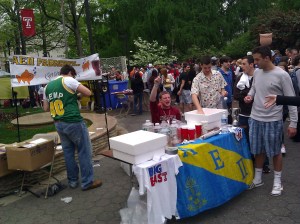
Student tailgate central

No. 4: “Parking Will Be Scattered Around Campus making it very difficult for older fans to walk to the stadium.” It’s not asking much to walk from, say, the No. 10 Lot at 11th and Norris to 15th and Norris but, I’m sure the university could provide a mode of transportation, maybe golf carts, for those who don’t feel they can make it. Owlclub members will probably get preferential parking in the McGonigle Hall outside lot, so that’s an option.

No. 5 is “there will be no common tailgating area” but that’s really not needed. Really, is the tailgating “one common experience” or is it smaller groups scattered throughout Lot K now? To me, it’s smaller groups who tailgate together and go in separately. Plus, students who take up a large part of Lot K now will be funneled to Liacouras Walk for their own tailgates. The official alumni tailgates now conducted under a large tent closer to the Linc entrance can be moved to the Bell Tower.

No. 6 “traffic will be horrendous” doesn’t really apply to football because fans usually don’t get there five minutes before a game. Their arrival is scattered starting with the opening of the lots five hours before the game, not five minutes, with groups filtering in four, three and two hours before the game. Traffic won’t be great, but it won’t be horrendous, either.

No. 7 “don’t take the subway” doesn’t really come into play, either because there is a perfectly good regional rail station located right on Temple’s campus that provides the kind of transportation option fans do not have going to LFF now. In fact, if the new stadium is built, my days of taking the subway to the Temple games–which I have done for 15 years–are over. I will hop on the Regional Rail and be at Temple in 20 minutes.

No. 8 “the Linc has easy accessibility” is true, but a football game is an event lasting from the start of tailgates to the end of the game and that’s an all-day deal.  Again, I don’t see all the traffic arriving at the same time. If you want to drive, get off the Roosevelt Boulevard extension and make your way down Broad Street.

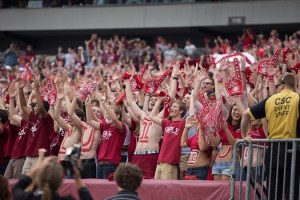
No. 9 “Temple will lose a large percentage of its older fans” and some of their contributions. I’m an older fan. They won’t lose me but the point is that the university has 40,000 students now and must cultivate that fan base which really has not been tapped into seriously. This stadium could create the kind of experience for them that binds them to the university for decades to come.

No. 10 “Temple will incur a large unnecessary debt” could be true, but the bean counters running the university say it will be more than offset by combining the money they pay for rent now with revenue gained from parking and concessions and the retail element of the stadium.

To me, there is a larger issue involved that goes beyond signage on the field or comfort in the stands. In my lifetime, I have never experienced a real home-field advantage following the Owls except for maybe the Tulane game in 2015 when all 35,000 fans were screaming their heads off for Temple. Getting 35,000 fans in a defined space on top of the field and making so much noise that the bad guys’ quarterback has to use hand signals to snap the ball is something I’d like to see before I leave this earth. It hasn’t worked for the beautiful new on-campus basketball facility, but maybe football is another animal.

The university needs to end five years of constipation on this issue and bleep or get off the pot.

Friday: The G5-P5 Conundrum

Monday: A Book That Needs To Be Written 
A New Year: High Hopes

Maybe Geoff Collins is right and I am wrong.

High Hopes was the song Harry Kalas popularized with the 1993 Philadelphia Phillies and it became the team’s unofficial fight song through the 2008 World Championship season.


Philly guy Ed Foley adopted the song for Temple football and, as Collins said, after the Gasparilla Bowl, “can we sing our song?”

High Hopes indeed because that’s how high Collins has set the bar for this 2018 season. Collins says Cotton Bowl and I will sign for that right now.

As we enter the New Year today, that is my most fervent wish for my favorite sports team: The Temple Football Owls.

In the pre-game game prep for the Gasparilla Bowl, Collins mentioned to both announcers that the goal for 2018 for the Owls was the Cotton Bowl. I can only assume that’s where the NY6 game involving the G5 “champion” is located.

bestoftemple

To me, the minimum way to achieve that goal would be to appear in the AAC title game for the third-straight year and win it for the second time in that limited frame and hope somebody like Boise State has a less impressive season than the Owls do.

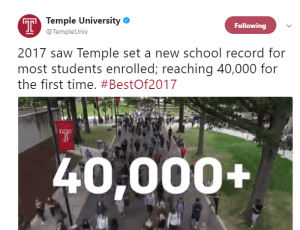
Personally, I don’t see it but Collins is closer to the team than I am so I yield to his expertise in that area. The recruits appear to include a handful who will challenge for starting spots, so maybe Collins figures he has plugged all the holes. Recruiting is the byproduct of a charismatic staff and a great school in a World Class city that appeals to more students than ever before. In 2017, Temple went over 40,000 students for the first time. Young people find Temple a very exciting place to be and it’s no surprise that some of those young people are great football players.

nickfinal

Nick Sharga’s final message to the team

As followers to this blog have learned over the last decade, we tell it like it is—good, bad or indifferent and, as much as I’d like to be sitting in the Cotton Bowl one year to the day from now (perhaps even beating, say, a Penn State), I do not see it happening. Not after losing the entire defensive secondary—except for its best player, Delvon Randall—or losing its two best edge rushers, two great wide receivers, a solid left offensive tackle and the best fullback in the country.

That’s a lot of losses, even more impactful than losing a first-round NFL edge rusher (Haason Reddick) and a four-year starting quarterback (P.J. Walker) from two years ago.

The positives are that the Owls have found at least one quarterback they can win with, Frank Nutile, and Ryquell Armstead and David Hood are big-time running backs who should both be fully healthy after injuries this season.

To me, getting back to seven wins would be more realistic and everything on top of that would be gravy.

Since I like gravy, I’m stashing away a little money each week so I can pour it on my crow and eat it exactly one year to the day from now in Texas. If high hopes are achieved, these wonderful ants will prove they can move a pretty big rubber tree plant.

Wednesday: Stadium Thoughts

TU Recruiting: Collins Deserves An A

beatty

Trad Beatty is the jewel of Geoff Collins’ second recruiting class here.

When I think of Temple football recruiting the words of Ronald Reagan come to mind:

“Trust, but verify.”

Reagan’s words came during nuclear armaments talks with Mikael Gorbachev when both the United States and the then Soviet Union were casting cautionary glances at one another.

It also helps to apply the same formula to judging Temple recruiting.

Al Golden never asked Temple fans to accept him at his word when he said he came up with a great recruiting class. He cited other sources as well. Golden was proud that both Scout.com and Rivals.com rated three of his five Temple recruiting classes as No. 1 in the MAC but even prouder when he could point out that at least five of his recruits each year were offered—not just getting interest—by Power 5 schools.

In just one month in his first year on the job, Golden—already having solid East Coast recruiting connections from stints at Boston College, Penn State and Virginia—convinced guys like Adrian Robinson to turn down Pitt for Temple and Kee-Ayre Griffin to turn down Boston College for the Owls.

ryanerasmus

Both of those guys are gone from this earth too soon, but certainly not forgotten to Temple fans. They were part of the core group of kids who stopped a 20-game losing streak and turned around a program many said could not be resuscitated.

That’s brings us to Geoff Collins’ second class of recruits and there are signs that this class is verifiably good. While we gave him a C for gameday coaching, we have to give him an A for recruiting based on the fact that other, even more highly-paid, staffs wanted kids who could have gone anywhere, but chose Temple.

It’s nice to trust him, but nicer that the trust can also be verified.

Think of it this way:

While Collins did not rely on East Coast recruiting connections, he certainly extended the circle of good recruits to areas where he was more comfortable recruiting: Namely, the South.

Getting quarterback Trad Beatty here from Ben Lippen High in South Carolina was a major coup because Beatty had solid offers from Mississippi State and North Carolina State.  You don’t win in college football without a big-time quarterback and Beatty has that kind of pedigree. Let’s put it this way: He’s likely closer to Adam DiMichele and P.J. Walker in skill set than he is to Chester Stewart and Vaughn Charlton. Get me to DiMichele and I’m happy.

Running back Kyle Dobbins, from South Jersey, had offers from Rutgers, North Carolina State, North Carolina, Northwestern, Boston College and Virginia Tech.

New York City wide receiver Sean Ryan had offers from places like Purdue, Nebraska, Syracuse and Maryland and defensive end Dante Burke had offers from Maryland and Georgia Tech.

I think the biggest impact player could be defensive end Nick Madourie, a JUCO, who had an offer from Purdue and 15.5 sacks this past season. Nick because he could be an immediate starter opposite Quincy Roche (and ameliorate the losses of rush ends Sharif Finch and Jacob Martin). Khris Banks, the top two-way lineman in New Jersey, could play right away as well.

Dobbins could play right away at running back, providing some needed depth behind Ryquell Armstead and David Hood. (Here’s hoping Jager Gardner—who has the longest run from scrimmage in Temple history—returns to full health. Plus, Tyriek Raynor, a former Arizona commit, could be healthy next year as well.)

Collins worked hard on this recruiting class and deserves an A. That he was able to wrap almost all of it up by the first signing date even with prepping the team for a bowl win is all the more impressive.

We’ll be able to determine the true value of this class five years down the line but, if you want to beat Power 5 schools (the Owls have a few of them peppered on the schedule), you’ve got to beat Power 5 schools for quite a few players.

Don’t trust Geoff or me, trust the more higher-profile Power 5 coaches who verified much of this class. It helps ease any anxiety that a whole different set of professionals watched the same film and see the same things Collins and his staff does.

Monday: High Hopes

Wednesday: Stadium Thoughts

TU Football: Season Grade is a C


Just once, as a Temple football fan, I’d like to go through one season where my Owls would beat all the teams they are supposed to beat and reach up and win one game where they are not supposed to win.

That would be a Grade A season.

I’ve never asked for a unbeaten season, which would be nice, or a national championship, which would be nicer, but just one season where the Owls would beat ALL of the teams they are supposed to beat and reach up and win one game they are not supposed to win. They haven’t done that since Wayne Hardin roamed the sidelines.

All the teachers ever asked of us on any test taken was to get the answers we should get and maybe guess right on one or two others.


Many of the outside
expectations had the
Owls finishing with
seven wins and a
third-place finish
in the AAC East and
that’s exactly where
they finished and
that’s why we give
this team and,
by extension, its
first-year CEO
a satisfactory (C)
for a final grade

After the Owls finished with their third winning season in a row, I’ve come to the conclusion that is never going to happen and we might just as well be happy where we are. Three winning seasons in a row with three-straight bowls is not bad considering where our once regional rivals and peer universities like Maryland, Rutgers and Syracuse are now.

They can have the Big 10 and the ACC as long as I get the wins. Nobody hates losing more than I do. All they have is hope their losing ends. Hope doesn’t get me into bowl games.

The Owls reached up and beat only one team (Navy) they were supposed to lose to, but lost two games they should have won (they had the Army game in the bag and committed the unpardonable sin of allowing  a triple-option team to pass on a prevent defense) and one of those two losses was perhaps the worst FBS team out there, UConn. They grossly unperformed against a rival they should have pummeled into the Stone Age, Villanova, and allowed UMass to stick around, which cannot be said for, say, FIU.

There were more wins than losses and that’s a measure of satisfaction so satisfactory is the operable word for this season.

Still, it could have been better.

Although I’ve seen first-year head coach Geoff Collins get as much as a B+ for his efforts on social media, I’m a hard marker. (I don’t think lifetime .279 hitter Ralph Kiner should be in the Hall of Fame, for instance.) I’d give him no more than a C.

A+ (outstanding) is an unbeaten season, which UCF just might get.

A  (excellent) is reserved only for that criteria previously outlined—beat everyone you are supposed to beat, reach up and win one game you are not supposed to win.

B (good) is a season where you’ve mostly exceeded outside (non-Temple) expectations and C (satisfactory) is finishing about where everyone said you would finish.

Many of the outside expectations had the Owls finishing with seven wins and a third-place finish in the AAC East and that’s exactly where they finished and that’s why we give this team and, by extension, its first-year CEO a satisfactory (C) for a final grade.

So, realistically, it was just satisfactory, nothing more and a lot of avoidable errors by a first-year coaching staff could have inched that grade up to at least a B.

They probably should have done what Collins promised the first game, give three quarterbacks an equal shot against Notre Dame and watch the cream rise to the top.

Instead, Collins said he and offensive coordinator Dave Patenaude had a detailed metric system of performance in practice that separated the quarterbacks and decided the issue. The problem with that, as we said even then, was that in all of Temple (and I suspect) other school’s histories was there were plenty of great practice quarterbacks who got exposed in games and plenty of kids who couldn’t practice worth a lick but were gamers.

Collins has one such young man, Adam DiMichele, on his staff. His then coach Al Golden said he was nowhere near the practice quarterback Vaughn Charlton was, but once given the opportunity in games, he excelled.

So did Frankie Juice. Logan Marchi got his chance and did not. Anthony Russo probably deserves a chance next year and Trad Beatty should probably be groomed to battle with Toddy Centeio for the job two years from now. That’s how great programs operate.

If Collins learns from his mistakes, particularly at the quarterback position, he could get a much better grade next year. Until then, any teacher worth her salt would crack his fingers with a ruler, circle his white paper with a big cherry C and tell him he must do better next time.

Friday: The Early Haul

TEN REASONS NOT TO BUILD TEMPLE STADIUM

faustadiumday

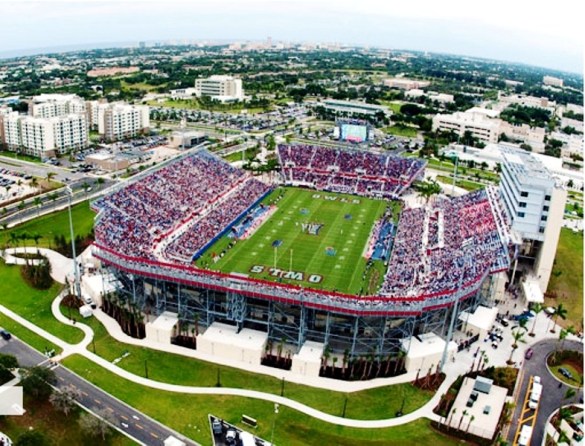
AECOM built the FAU stadium and will be one of the two architects for this one.

 Editor’s Note: Dave “Fizzy” Weinraub checks in with his thoughts on the stadium. He’s against it. I’m ambivalent. If no stadium means a permanent move to Franklin Field, I’m for the stadium. If we can extend the lease at the Linc, that’s the preferable option. Ironically, Fizzy played all of his home games in  a place called Temple Stadium.

By: Dave (Fizzy) Weinraub

  1. NEIGHBORHOOD DOESN’T WANT IT
  1. TEMPLE DOESN’T NEED IT – It needs the Eagles to give Temple the same deal the Rooneys give the University of Pittsburgh – Pitt just pays expenses and gets half the net from the concessions. A blue ribbon committee should meet personally with Jeffrey Lurie.
  1. IT CLOSES OFF 15TH STREET – Disrupting southbound traffic
  1. PARKING WILL BE SCATTERED AROUND CAMPUS – Making it very difficult for older fans to walk to the stadium.
  1. THERE WILL BE NO COMMON TAILGATE AREA WITH ACCESSIBILITY TO

FAN’S CARS FOR FOOD AND BEVERAGES – Temple says the open space for tailgating is the quad, but you can’t drive your car there.

  1. TRAFFIC WILL BE HORRENDOUS – Broad Street has lights at almost every corner.  The number streets have either lights or stop signs at every corner.
  1. DON’T SAY TAKE THE SUBWAY  – Most older fans are not going to take the subway. Drive or take the subway to a night game; HA! HA!
  1. THE LINC HAS EASY ACCESSIBILITY FROM SOUTH JERSEY, ROUTE 95, THE AIRPORT AND DELAWARE, AND THE SCHUYLKILL EXPRESSWAY.  That’s why it was built there.  How will fans from all those suburbs possibly drive to campus?  There will be gigantic traffic jams at Broad & Vine.
  1. TEMPLE WILL LOSE A LARGE PERCENTAGE OF THEIR OLDER FANS AND SOME OF THEIR CONTRIBUTIONS – Most of the season ticket holders are older folks, forty to eighty tears old.  Most of the big givers to the university are from this age bracket. Given the problems listed above, many will not purchase season tickets and lose allegiance to Temple.
  1. AS PREVIOUSLY PUBLISHED IN THE INQUIRER, A FINANCIAL ANALYSIS OF SCHOOLS NOT IN THE POWER FIVE FOOTBALL CONFERENCES WHO BUILT NEW STADIUMS, ARE CARRYING LARGE, UNNECESSARY DEBT.

Even the Egyptians have stopped building pyramids.

Tomorrow: Merry Christmas!!!

Wednesday: Season Analysis

Friday: Recruiting


Bowl Win: Christmas Gift Nicely Wrapped

One of the many bowl watch parties across the city of Philadelphia had a pretty creative title.

The “I’m-Too-Poor-To-Go-To-The-Gasparilla-Bowl” party was held at an establishment better known for indoor simulated golf on Delaware Avenue.

I had planned to attend but SEPTA strongly advised people coming into town late Thursday to avoid the Regional Rail—my favorite mode of travel—due to a power failure earlier in the day.

tailgate

So it was off to my neighborhood taproom within a couple of blocks from my house.

Once there, I was surrounded by a group of St. Joseph’s University fans who “hated Temple because they want to displace all the residents to build a stadium” and actively rooted against the Owls.

Never mind that they had all their facts wrong. People who talk about the stadium usually do.

It was with smug satisfaction that I saw that group of haters leaving with their heads between their legs when the Owls built a 21-3 lead in the fourth quarter.

The 28-3 win was a nice Christmas gift for a group of Temple fans who were disillusioned by the results of the last two seasons. It was a long bus ride home from last year for me, but I watched with satisfaction after an agonizingly slow start last night.

It was nice that the Owls followed our advice of putting a nice target on NFL prospect Alex McGough (pronounced MA-GOO, even though we initially though it was pronounced MA-GOW). They hit him hard enough early to knock him out. If you hit quarterbacks hard enough, a lot of good things can happen and those things are usually fumbles, sacks and interceptions. You never hope for someone to hurt and I really would have liked to seen the Owls win with McGough in the game. Alex, we hardly knew ye and I felt bad for the kid when he pounded the turf and left the field for his final time in the first half.

You don’t have to be a brain surgeon to figure out this this game would have been a whole lot closer with McGough in there, and that was too bad for FIU. Nobody felt sorry for the Owls when they missed six starters in a 31-28 overtime loss at Army, so they were due for some breaks in those areas.

Finishing 7-6 and returning a bowl MVP quarterback certainly is a whole lot better than finishing 6-7. Head coach Geoff Collins would have had a lot of explaining to do about greatness not quitting but finishing 6-7 or #TheStandard being a losing one in the offseason.

Now the Owls can say they are winners for three years in a row and bowl winners for the first time since 2011.

The future looks good for the Owls, although I wasn’t buying the Cotton Bowl narrative the announcers said Geoff Collins was selling.

In my mind, the Owls have no more than an outside shot at winning the AAC but the game day coaching and the offensive scheme are among the things that need to be addressed in the off-season.

Monday: Fizzy’s Thoughts On Stadium

Wednesday: Season Analysis

Friday: The Early Haul


Temple-FIU: The Best Pass Defense is ….

mcgough

Temple needs to put this guy on his backside early and often.

The last time Temple head coach Geoff Collins faced a one-dimensional team, the game plan was OK for all but 1 minute and 15 seconds.

That was when Army ditched its triple-option attack and passed the ball downfield for the last 75 yards with the Owls holding a 28-21 lead.

It should have never happened because the Owls should have known the Cadets had one time out to negotiate those 75 yards. They should have eschewed the prevent defense for an all-out assault on a backup quarterback not used to throwing the ball.

Temple should have not made him comfortable back there.

youngbruce

                                                                             “I say this from being an ex-quarterback.The best pass defense is putting the quarterback on his backside”_ Bruce Arians, 1988

But it did, and it was another of many first-year mistakes for a first-year head coach and allowed Army to tie the game with one second left and force overtime in an ingnomious 31-28 overtime defeat.

Florida International, the bowl opponent tomorrow night, is one-dimensional but the dimension is passing, not running. Alex McGough, its quarterback, is 6-foot-2, 187 pounds and has thrown for 17 touchdowns against eight interceptions while racking up 2,791 yards. Head coach Butch Davis calls him the best quarterback he has ever coached on any level.

What the Owls should have done is what they should do tomorrow night (8 p.m., ESPN). Bruce Arians once said his pass defense never got good until he figured out by late in his career at Temple was that the best defense was to put the opposing quarterback on his backside.

The lesson, he said, was learned in a 35-30 win at Rutgers—the same Rutgers’ team that had beaten Penn State earlier that year. With about as much time left and as much distance to cover as Army did this season, a quarterback named Scott Erney passed the Scarlet Knights from his own 20 to the Owls’ 30 with three quick throws against a prevent defense. Arians called a timeout, and rather heatedly discussed what the Owls should do with then defensive coordinator Nick Rapone.

“I told Nick to go jailbreak (eight-man rush),” Arians said. “I decided if I was going to go down, it would be with my guns blazing.”

saintpete

Tailgating weather should be nice

The Owls had Erney in their sights the next three plays and found himself on his backside for the each time and the game ended way back on the Rutgers’ 41 with a defensive lineman named Swift Burch sitting on top of him.

“I say this from being an ex-quarterback,” Arians said. “The best pass defense is putting the quarterback on his backside. If you can’t get to him with four, send five. If you can’t get to him with five, send six. We had to send eight but we got it done and that’s the bottom line.”

If these Owls treat Mr. McGough has rudely as those Owls treated Mr. Erney, they should be hoisting a nice trophy tomorrow night.

Friday: Bowl Analysis

This Week In TU Football: The Padre Pio Factor

signingday

Signing day is almost as important for the Owls as the bowl game itself.

As a kid growing up in Catholic school, I was told that Padre Pio—the newly minted Saint—could be in two places at one time.

It’s easy to be both skeptical and fascinated by the possibility. Try as I might, I’ve never been able to master the art of bilocation.

Too bad Geoff Collins hasn’t, either.

Collins will only seem to be in two places at one time this week, culling a recruiting class that needs several signatures by Wednesday and then coaching a football game his university desperately needs to win on Thursday, but that’s the task he has been given.

While both are important, the No. 1 priority should be winning the bowl game for a couple of reasons.

One, the school has only won two games in its history.

Two, as important as recruiting is, the end game of that endeavor has always been to identify enough talent that can win championships and, failing that, bowl games.

To be fair, it’s also the task that faces Florida International University head coach Butch Davis but the pressure to win now is greater for Collins because he has to replace so much of the guts of not only a 6-6 Temple team, but a 10-2 one. A rather convincing argument can be made that guys like Nick Sharga, Keith Kirkwood, Adonis Jennings, Artrel Foster, Sean Chandler and Jacob Martin contributed as much to that championship as P.J. Walker, Jahad Thomas, Hassan Reddick, Avery Williams, Averee Robinson and Colin Thompson did. It’s the reason why we think this team should have won either eight or nine games, not six or seven. The schemes, especially on offense, wasted a Mother lode of talent.

The case is that the Owls will be two years removed from the guts of a championship team and those losses could be felt more severely next year than this one. A great haul on early signing day followed by the momentum of a bowl win would reassure any doubting Thomases out there but that’s a different Saint for a different day.

Wednesday: Bowl Preview

Friday: Bowl Analysis

Monday: The Early Haul

Geoff Collins’ Shocking Admission


dunce

Go through the posts on this website and you will find several references of Temple’s offense being one where the coaches tried to fit a square peg into a round hole.

shargamilk

So you can excuse us for wondering just where Temple head football coach got this notion from when he uttered this quote at the inaugural Bad Boy Mowers Gasparilla Bowl press conference.

“I think we were trying to fit a square peg into a round hole on offense,” Collins said. “Once we got a good taste of who our personnel was on offense, it kind of took off.”

Collins could have saved a whole lot of time and heartache by reading what was posted here in September.

Maybe he did.

This is what we wrote in a post on Sept. 22, after a 43-7 loss to USF:

“Ask any Temple fan who followed the team over the last 40 years (I will raise my hand here) who the best set of receivers are in Temple history and that fan will probably say the current group of Ventell Bryant, Adonis Jennings, Keith Kirkwood and Isaiah Wright. Any offense that has those four guys on it is not rebuilding, it should be reloading.

Emphasis on “should be” because the coaching is the X-factor here. Temple won the past two seasons because it catered an offense to suit the talents of its players, and did not try to force fit a square peg (spread offense) into a round hole (play-action offense). A good head coach tailors a scheme to the talent he has, not the talent he wants.”

Better late than never, but putting the square pegs into the square holes and the round ones should have been something that was figured out by August, not by the end of October. The real sad thing is that Collins seemed to be onto it at the season ticket holder party when one season-ticket holder asked him to “never take Nick Sharga out of the game” and Collins responded by saying that he would not and, if anything, Sharga’s role as a lead-blocker in a play-action-oriented offense would be greater than it was a year ago. For reasons only Collins knows, he lied. Maybe he allowed offensive coordinator Dave Patenaude to have too much input.


At least Collins dictated a heavy dose of play action over the final six games of the year and that saved their season. That was the personnel they had all along.


“Temple won the past two
seasons because it catered
an offense to suit the
talents of its players,
and did not try to force
fit a square peg (spread offense)
into a round hole
(play-action offense)”
_ Temple Football Forever, Sept. 22, 2017

“I think we were trying to kind
of fit a square peg in a round
hole
on offense. Once we got
a really good taste of who
our personnel was,
it kind of took off.”
_ Geoff Collins, Dec. 6, 2017


The Owls took way too long to figure out that they never needed a “running” quarterback as much as they needed a guy with a big enough arm to get the ball to their most talented players on offense, their wide receivers. They figured out too late that many of the “drops” they suffered in September were the result of these same receivers circling back on poorly thrown balls. When they inserted the guy with the big arm, those receivers caught balls in stride and away they went, usually into the end zone.

Collins followed the outline of the advice, although we would have liked to seen more running from guys like Ryquell Armstead and David Hood behind a guy like Nick Sharga.

Maybe next year with those two behind a guy who goes by the nickname of Nitro, opening passing lanes for a guy who goes by the name Juice.

Let’s hope a second-year coach isn’t as slow on the uptake as the first-year one was. One of the fastest ways to fix a problem is to recognize it and, with that one quote, Collins showed there is hope for a better future plan.

Monday: The Padre Pio Factor

Wednesday: Bowl Preview

Friday: Bowl Analysis

Christmas: Season Analysis