The Ideal Temple Uniform

friendship

Kyle Friend and P.J. Walker were happy with this helmet design.

In the grand scheme of things, uniforms and helmets rank somewhere between 4-99 in terms of importance.

Winning, of course, is No. 1, followed by finding a long-term place to play and maybe recruiting. Beyond that the branding of the program both on and off the field IS important.

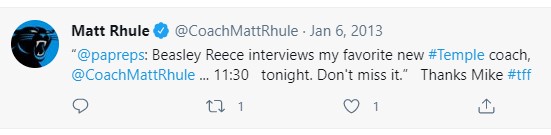
In recent weeks, head coach Geoff Collins has hinted at a new look for the program in his twitter feed. Past head coaches have put their own stamp on the program’s look with mixed success.

nohelmet

Hard to read the word Temple with a black-cherry background.

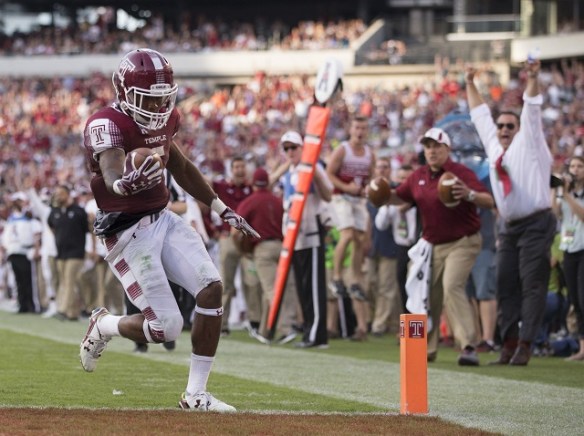
Wayne Hardin got rid of the ugly Owl on the side of the helmets and chose to spell the word “Temple” in large block letters and that stuck for awhile.

“We’re Temple; we want people to know who we are,” Hardin said.

Al Golden brought that back when he took over in 2006.

“That’s the football brand, Temple,” Golden said. “The school brand is the block T but when I played at Penn State when we saw Temple on the helmet that’s the brand we respected because those guys played tough and hit as hard as any team we played. So I wanted to bring that back for my guys.”

Steve Addazio ditched TEMPLE entirely for the ‘][‘ without providing any explanation.

My two cents: I like both the ‘][‘ and the TEMPLE look and have argued for a “King Solomon” solution in this space in the past. Split the baby. TEMPLE on one end as a tribute to the football brand and the ‘][‘ on the other as a tribute to the school brand.

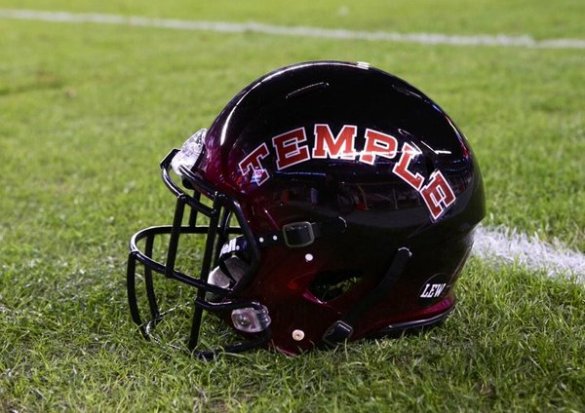
Matt Rhule almost nailed it when he came up with the version seen at the top of this post combining a version of the two. My only problem with that is the chin strap obscured the ][ to the point of annoyance. Put the ][ on the other side, keep TEMPLE on one and you have perfection.

Otherwise, keep it Cherry and White with the broken stripes down the pants and you have one of the cleanest and neatest looks in college football.

Now it’s Geoff Collins’ turn. In 24 hours, we will find out what he has decided.

Friday: The Reaction

5 CFB Pet Peeves


revolting

Anyone who has ever played the sport at some level will tell you about the butterflies.

To me, the excitement never was so bad I had to throw up before the game, but a surprising number of my teammates did.

As a high school linebacker, though, I knew all about the butterflies. You feel that queasy feeling in your stomach until the first hit and then you are fine.

It’s the way football works.

When I got to Temple, I was too short and too slow to play, but experienced the same kind of butterflies as a fan before the first game of the season.

Lately, though, the anticipation has waned because the game has changed a lot for my favorite college football team. Hell, it’s still my favorite sports team but I am more than a little annoyed at the changes in the game since I received my Temple sheepskin. In no particular order, they are these:

templehelmet

Helmet Targeting

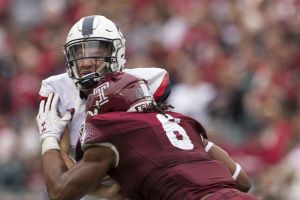
I know this is a necessary rule but a nice clean hit is a football play. Lately, though, the line between clean and dirty has been blurred due to the targeting rule. I completely understand it with the CTE and all but it’s not the football I grew up with and too many players are thrown out of the game when the worst thing that should happen is a 15-yard penalty.

The Schism Between The Haves and Have Nots

There are 127 teams in the FBS and 64 of those teams—the ones in the so-called Power 5—are treated fairly the others are not. If one of the “others” (UCF) can win all of its games—including wins over the two teams eventual champion Alabama lost to—and not be given an opportunity to compete in the Final Four, college football has lost all sense of fairness.

The Bowl Situation

With 80 and soon-to-be 84 bowls, college football has turned into a reflection of sports in society as a whole where a lot of “participation trophies” are handed out. Back in the day, it was so hard to get into a bowl that the 1984 Temple team beat a 9-2 Toledo team, 35-6, and Toledo got to play in the California Bowl while Temple stayed home. In 1986, Temple beat another 9-2 team, Virginia Tech, 29-13, but stayed home while Virginia Tech played in the Peach Bowl. Now, 40 teams get a participation trophy.

Pilfering of Players

Back in the day, when a player made a commitment to Temple, the commitment lasted through signing day. Over the last decade, up to five players a  year have decommitted from the school and signed elsewhere. The most high-profile of those was Arkum  Wadley, who ended up at Iowa. What happened to “your word is your bond?”

pitt

Regional Rivalries

A short trip to Rutgers or Syracuse or Pitt used to be on the agenda for every other season. Now those teams are in far-flung leagues playing against schools they have very little in common with. On the other hand, Temple has to travel to places like Memphis and Tulsa. It’s just not the same anymore. Pitt suffers from losing its rivalries with Penn State and West Virginia more than Temple does with Rutgers and Syracuse, but college football is better off with those regional rivalries and it does not look like they are coming back.

Sadly, that’s the state of college football in 2018. While kickoff against Villanova will be exciting, the way the game has evolved is in the other direction.

Still, no better sport but the fact it was better in the good old days than it is now is something that can be viewed as objective, not subjective.

Wednesday: The Ideal Temple Uniform

Recruiting: Fireworks or Dud?

hardwork

It’s quite possible this recruiting haul on the beach last  year was better than this year.

For nearly two weeks now, the Temple football twitter site promoted July 4th fireworks with at least a hint or two that a big-time recruit will be committing on that day.

That’s the deal with fireworks. The more promises you make, the greater the expectations. Sometimes they go off in multi-colored extravaganzas and sometimes they blow up in your face. This latest rollout qualified more in the latter category than the former from what I can see.

Our thoughts on Temple football recruiting, particularly since Al Golden brought his binder to town, have simply been this:

TRUST BUT VERIFY.

The Philly.com article did not mention where the six July 4 commits received offers from in addition to Temple, but Shawn Pastor’s excellent site, OwlsDaily.com, did.  One of them was Kennique Bonner-Steward, a 6-4, 215-pound, dual-threat quarterback from William Amos High in Cornelius, N.C. Bonner-Steward had 17 offers, most from FCS schools and his top “other” FBS offers were from Tulane, Old Dominion and Georgia State (err, not Tech).

This is the spin Pravda–otherwise known as Owlscoop.com–put on the day:

pravda

A little misleading as an astute guy named Steve correctly pointed out:

stevebest

You will never, ever, ever, find Pravda criticize a Temple football recruiting class perhaps because the editor of that site is a paid Temple employee. Everything ranks from honky-dory to downright spectacular over there. Just a theory based on years of observation.

Speaking of which, that elicited a very defensive response from Gauss’ boss (John DiCarlo, above). What the hell does Tyler, Tavon, Dion, Matt and Nate have to do with Collins under-performing against P5 competition this year? And what, exactly, did Collins have to do with developing any of those above players?

The answer would be zero.

Just because Matt Rhule got the job done doesn’t mean Collins will do the same.

The other commitments were  running back Jamal Speaks (Upper Marlboro, Md), Tampa (Fla.) wide receiver Josh Youngblood and two defensive linemen from Georgia, Zaylin Wood and Jacoby Sharpe. Speaks had an offer from Maryland and Youngblood had an offer from Minnesota so, on the day, those are the two most-high profile Temple recruits.

Not the kind of fireworks we were looking for considering that the Owls were able to land much-higher profile guys under both Golden and Rhule.

Here’s another take calling out Pravda:

another


Temple football has a highly paid staff of professionals in charge of these things but the thought out there is that other schools have more highly paid professionals in charge of the same things and that if the two ever agreed on a player that would be a good thing, not a bad one.

Temple is never going to win all the battles with the so-called Power 5 schools for players, but our formula for long-term success is that Temple should win at least a few of them—anything from a quarter to a half—and then trust its instincts on other type players.

Those instincts have served other staffs well with guys like Muhammad Wilkerson (a two-star who turned into a first-round NFL draft choice) and Haason Reddick, a walk-on who was a higher first-round choice. Then there is Tyler Matakevich, who turned his only offer (Temple) into a national consensus defensive player of the year (Bednarik, Nagurski Awards).

Those are the exceptions, though, to the general college football rule. The really successful programs develop players in addition to be able to win a majority of recruiting battles.

Ideally, that’s the kind of recruiting balance you are looking for in a good class. This one has leaned in the developmental direction and, while that might turn out to be a good thing, it leans more toward risk than reward.

No matter how Pravda spins it.


5 Owl Newcomers To Watch

Very few programs update their rosters online as well as Temple’s football team does these days.

Like the U.S. Constitution, it’s a constantly changing document and staying on top of things can be a daunting task but the days when Temple announced a roster on the last day of the season and did not change it until the first day of the next one (Bobby Wallace and Ron Dickerson were the biggest offenders) appear to be over.

If you’ve made it to the July 4 holiday, that’s saying something so for our “five newcomers to watch” list this summer, we’re going with guys only officially on the roster. The others, some guys who were recruited last year and big things were expected of, obviously either are not coming or have some loose ends to tie up before admission.

We have only one definition of “newcomer” and it is this: Simply, a player who has not made a single play in a previous Temple game:

ryanerasmus

Sean Ryan

Probably the most talented wide receiver in the New York City high school leagues, Ryan takes his talents to 10th and Diamond and already has acclimated himself to the workout routine. While Temple’s receiving duo of Ventell Bryant and Isaiah Wright is probably the most talented in the league, the ranks of the PROVEN are thin behind them and there is plenty of opportunity for advancement. That’s where the next guy comes into play as well.

Jadan Blue

Blue had over 100 yards receiving and two touchdowns in the spring game—both highs for any wide receiver—and has moved to the head of the class of guys who Dave Patenaude has confidence playing in any situation.

Rodney Williams

A safety transfer from a Power 5 program, Syracuse, Williams has the edge to form one of the most dynamic safety duos in the AAC. That’s because the other safety, Delvon Randall, has been projected as a first-round draft choice if he repeats or improves on his 2017 season. Williams has started 21 games for the Orange the last three seasons, including a win defending national champion Clemson last year (one of the first plays in that game was a tackle for a 6-yard loss by Williams).

Darian Byrant

A product of Chestnut Hill Academy, Bryant was one of the Owls’ most heralded recruits three years ago as an offensive lineman. Patenaude has said “the best development has been with Darian Byrant” who, at 6-5, 320, appears ready to start at right tackle.

Tyliek Raynor

Raynor has world-class speed (4.4) for a tailback and appears ready to slide into David Hood’s third-down back role. He was Philadelphia Public League MVP in 2015 while gaining 1,327 yards on only 99 carries. He spurned solid offers from Arizona, Miami (Fla.), West Virginia and Purdue to play for his hometown school. No one knows if the torn meniscus injury suffered last year will shave a tenth of  a second or so off that 4.4 but we should find out soon enough.

Friday (7/6): July Fireworks

Monday (7/9): College Football Pet Peeves

Wednesday (7/11): The Ideal Temple Uniform

Friday (7/13): Thoughts on the Rollout

Monday (7/16): Ranking the Schedule: 1-12

Burying the Nutile Graph

numberone

My friend and former co-worker, Marc Narducci, wrote the definitive piece on Temple starting quarterback Frank Nutile last week. If you can get behind the pay wall, it’s worth the effort. It dotted all of the I’s and crossed most of the T’s and weaved the necessary quotes nicely throughout.

As good as this article was, if I was the editor, I’d have to tell Marc he buried the Nut graph by not even including it in his story.

Make that the Nutile (pronounced New Tile) graph.

Of all of the terrific qualities Temple’s starting quarterback has, he was the No. 1 passer in the nation last season in terms of making positive plays while under pressure. While being pressured by the defense—meaning hit, touched or spun out of a play—Nutile make more positive plays of more than 20 yards per game than any quarterback in FBS football last year.

That includes the six quarterbacks who were drafted in the first 10 NFL draft picks last year. Marc did not mention that impressive factoid about Frank Nutile at all, though give him credit for mentioning that Nutile had 11 touchdown passes and a 60 percent completion percentage in those seven games. Extrapolate that out to the 13 games he should have started and that would be more than 20 TD passes.

frankster

Some guy with a beard pats Frank Nutile on the helmet

This is not to say that Frank Nutile will be a first-round NFL pick or he will be an NFL pick at all. The seven-game sample is not the same sample the first-round picks last year, but it bodes well for the 2018 season. Seven games, though, is enough to indicate that this guy is a proven guy under pressure, much like his quarterback coach, Adam DiMichele, was at Temple. Had DiMichele been granted his release by Penn State coach Joe Paterno, he would have started the 2009 Eagle Bank Bowl and the Owls would have had a signature win over UCLA. P.J. Walker was also good under pressure and chances are few Temple quarterbacks will have a signature drive like the one Phillip orchestrated with no time outs, 70 yards to go and 32 seconds left at UCF two years ago.

Having players like DiMichele, Walker and Nutile under center means a lot because that kind of fearlessness from a leader rubs off on his teammates. That’s a nice insurance policy to have considering much of this Temple fan base has been weaned on a lot of guys who looked like Aaron Rodgers in seven-on-seven passing drills but Mike McMahon in actual game situations. Chester Stewart, Vaughn Charlton and Mike McGann (22 interceptions in 2003) we are looking at you.

Fortunately, we are not looking at them in anything other than the rear-view mirror now.

One of the inspiring things about the Narducci article was the fact that his dad, Robert, a former quarterback at both Maryland and Louisville told him to keep grinding after the disappointment in losing the starting job to Logan Marchi last year. That grinding paid off when Nutile got his chance against Army, completing 20 of 29 passes and a touchdown in a game the offense did not lose.

It’s the same message the Anthony Russo family is giving to their son and no doubt the same message the Toddy Centeio family and the Trad Beatty family are giving to their sons. They have all seen what is on the other end of the grind, too, and the rewards are apparent.

Frank Nutile’s story has made that abundantly clear, even if the nut graph was buried so deep no one could find it.

July 4: 5 New Arrivals To Watch

Friday: Surprising Fireworks

Monday: How New Rules Impact the Owls

Stadium: The Alternatives

cbpfootball

TU fans would be right on top of the action at CBP.

For the next year, maybe five, the powers-that-be at Temple University who comprise the Board of Trustees can bang their collective heads against a wall or get to work.

Banging their heads would constitute essentially what they are doing now: Trying to make peace with people who want no peace.

Neville Chamberlain tried to do that with the Nazis in the late 1930s. When the British finally figured out the Nazis did not want peace, it was almost too late. Winston Churchill finally unraveled that mess.

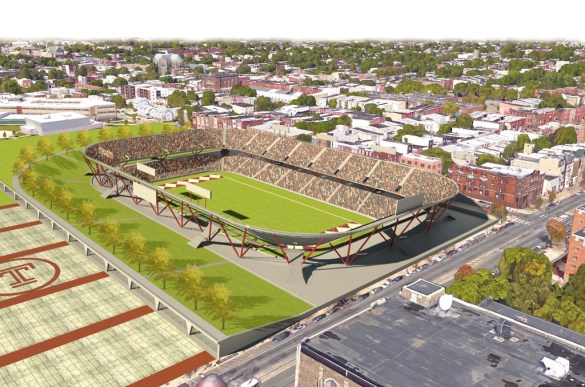
Temple wants peace with its neighbors and a stadium entirely within property it owns. Because a part of that property is a public street, the neighbors can block it so Temple must abandon this folly and figure out a place and a way to build its stadium or look for the alternatives.

Here are the acceptable ones:

skyview

Plenty of room (counting space on right) for a 35K stadium at Broad and Master.

Move the stadium to Broad and Master. This would require knocking down a brand new $22 million Olympic sports facility and moving it back to Broad and Norris. That probably means spending another $22 million on the Olympic facility but it would be worth it. Critics of this plan say “it won’t fit” but that’s only if  the fields are North-South. Anyone who attended the spring game saw plenty of room for an double-decker East-West stadium from Broad Street to 13th Street that would require no closure of a city street.

homes

A simple purchase of either “North Broad Getty” or “Auto Zone” or “Wheel thing” gives Temple plenty of room to connect the hospital with the main campus via a stadium


Connect the main campus with Temple Hospital. Put the stadium halfway up Broad Street. There is plenty of open land that Temple can acquire near the  North Broad SEPTA train stop that would allow for more parking. Just take a ride North of main campus (lock the doors) and you will see boarded-up property, not actual homes, along the old route that included the Phillies first home (Baker Bowl, Broad and Lehigh). Can’t imagine the neighbors would object to Temple purchasing homes that currently are unoccupied and boarded up. It would be within walking distance of both the main campus and the health sciences center and just as accessible to rail and subway transportation as the current plan. Again, no public streets would have to be closed.

Swallow hard and accept Jeffrey Lurie’s demands. Any way you look at it, Temple is going to spend a lot of money parking its football program. Either it’s the laughably low figure of $130 million for a stadium or increase its rent five-fold to the Philadelphia Eagles for the right to play in one of the nicest stadiums in major college football.

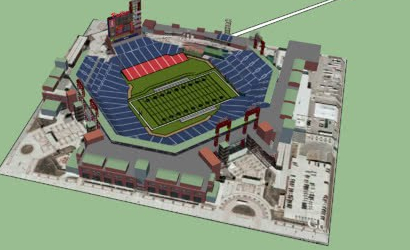
Wait The Phillies Out. This is not as crazy as it seems. Extend the lease and work with the city and the Phillies to get their long-sought-after Center City stadium. Then slide into Citizens Bank Park. Play at the Linc until then. A 45K Temple football stadium in South Philly makes more sense than a 70K Temple stadium in South Philly or even a 35K Temple stadium in Templetown.

Unacceptable would be a move to Ambler  or an upgrade of the Chester stadium (farther away than the Linc and less accessible to public transportation) or any deal with Franklin Field, which would be seen as a return to the bad old days.

Either way, if this last-ditch “community engagement” does not work, the BOT needs to roll up its sleeves and come up with a new plan.

Banging heads against a wall for the next five years serves no purpose to anyone.

Stadium Delay: Did You Expect Anything Else?

muchbetter

A much-more inspired rendering of what a TU stadium SHOULD look like.

All along in this never-ending Temple Stadium saga, there have been two types of people:

The first type, the believers, are the “wink wink, done deal” crowd, saying that everything is taken care of and nothing to worry about. Most of these people live in Virginia, New York and Florida.

The second group, the skeptics, are more intimately familiar with Philadelphia city politics, who have lived here all their lives and who have been through this whole thing once before with the building of The Apollo (now the Liacouras Center).

skyview

The site of the spring game

Those of you who have followed this space for years know to count me in the second group.

The Temple News deserves credit for breaking this story on Monday—really a lot of credit in that no other media outlet seems to care enough about—that Temple officials have decided to delay the project to “further engagement with the community.”

Did you really expect anything else?

From the time a BOT member told a long-time fan at the March 2012 NCAA Tournament (on the very day Temple beat North Carolina State) this was a “done deal” the stadium has been anything but a done deal.

badurban

The current uninspired rendering

The believers are more likely to claim to have inside information than the skeptics. As recently as May, we were told by those people to “expect shovels in the ground by August.”

Now it is much more likely that those shovels will be figurative ones burying the project than actual ones moving the AstroTurf off Geasey Field.

Here’s the bottom line on the stadium: The neighbors don’t want it and no amount of “engagement” is going to convince them otherwise. There is no political incentive for their representatives to do anything but oppose a project that includes the permanent closure of a city street where the city, not the university, has the final say.

Unlike the Apollo project in the 1980s, Peter J. Liacouras is not around anymore. When he threatened to move Temple out of the City of Philadelphia to Ambler, people believed him and then Mayor Ed Rendell brokered a deal to get the Apollo done. He had an outspoken ally and a respected community voice in then hoops coach John Chaney, who told them in no uncertain terms what their neighborhood would look like without Temple. Too much development on campus has happened since then to make a similar threat anything but an empty gesture.

This time, the city holds all of the cards, owns the card table and has a key to the basement where this game is played and there will be no dealing.

Friday: The Alternatives

Good News for Owls: More Bowls

sundevil

If the AAC can get a tie-in to the new bowl in Arizona, Temple could be playing in Tempe.

Anytime someone moans and groans about there being “too many bowls” I say there are too few.

After being hit with a “are you crazy?” stare, I mention two things:

  • Temple’s 2010 team
  • Cornhole Championships

By now, the story of the Temple 2010 team is well-known, but it’s certainly worth repeating.

Those Owls finished 8-4 and pummeled a team, UConn, 30-16, that made the Fiesta Bowl. The Owls being denied when the Huskies, also 8-4, were accepted (via being in a BCS league, the Big East) was widely regarded as one of the biggest miscarriages of justice in recent sports history.

Besides some mentions on the afternoon ESPN talk shows, Temple got nothing out of that bowl season and, the day after head coach Al Golden held a meeting to say: “Guys, we’re not going anywhere” he announced he was taking the head coaching job at Miami.

Talk about a punch in the gut one day followed by a kick in the nuts the next, that was it for Temple football.

Cornhole championships come into play simply because that—and poker and bowling—are staples of the ESPN programming after the bowl games are completed in January. If two or three extra bowl games take cornhole, bowling and poker off television that’s not only more palatable to me but for ratings in general.

Anything that gives an 8-4 or a 6-6 Temple team a greater chance at bowl exposure is good news, not bad so that’s why Brett McMurphy breaking the story of more bowls starting with the 2020 season is encouraging.

Chicago and Myrtle Beach, S.C., are locks to host two of the three new bowls. Phoenix, another attractive site, is rumored to be leading for a third bowl.

Meanwhile, from an American Conference perspective, the league is musing a permanent invitation for its champion to play in the Liberty Bowl, if the champion doesn’t make the NY6 game. That’s a good idea because the Liberty is a tier above the current places where the second-place team usually goes (Military, Boca).

All this should be officially announced on July 1, which is less than one week away.

Anything that’s good for Temple and bad for cornhole is OK in my book.

Wednesday: Stadium Delay

Friday: The Alternatives

Monday: Under Pressure

Wednesday (7/4): 5 New Arrivals To Watch

Friday (7/6): How New Rules Impact the Owls


Krafting An Entrance Strategy

Penn State v Temple

Pat Kraft (far right) going crazy for Temple after Jahad Thomas helped beat PSU.

Today’s post was supposed to be about the new transfer rule.

Then Pat Kraft happened.

Kraft has applied for and, depending upon who you listen to, will or will not get the University of Maryland athletic director job.

There is a pattern here.

Kraft happened like Al Golden happened, like Daz happened and like Matt Rhule happened and, inevitably, like Geoff Collins will probably happen.

Let’s face it: Until Temple gets into the P5, this will happen with every high-profile Temple athletics employee. That’s why, as I’ve been saying for years, everything Temple does in sports has to position itself to join the big boys in sports. In every way, Temple is a top-notch national school. It is the sixth-largest educator of professionals in the United States and it has top 10 national schools in business (Fox), Dentistry, Journalism (Klein) and arts (Tyler).

This is where the frustration comes into play for many long-time Temple fans. Once, with great people like Ernie Casale, Wayne Hardin, John Chaney and Skip Wilson, Temple was a destination and not a place to pass through. Maybe one day Temple will be able to attract those kind of athletic employees again and catch up to the students who already have this figured out.

It is located in the only city in America which has qualified for the prestigious designation of a World Class city by the World Heritage Foundation. Students over the last decade have indicated by a wide margin they’d prefer to go to college in a city than rural environment.

Temple’s football team currently–currently–plays in the nicest stadium in its conference and one of the nicest stadiums in college football.

The Owls have a lot of things going for them.

One, unfortunately, is not being in one of the top five conferences. It is something that the uni must fix and soon.

Kraft’s exit strategy must turn into an entrance strategy to make this a destination and not a stop along the way. Maybe the next guy can figure that out because it’s obvious this guy, like so many before him, is looking for a way out.

Stadium: No News Is Bad News

Colorado State was able to get this done in less than half the time TU talked about it.

Way back in May, a post from an ardent Temple fan on one of the two message boards covering Owl sports, read: “When You Hear Nothing, it’s a good thing.”

To use a double-negative for literary effect, nobody knows nothing about anything when it comes to concrete and mortar movement on a new football stadium, err, “multi-use complex” for Temple University.

Colorado State University

It will be a long time before the construction workers show up at Temple

That’s not a good thing, unless you are against the idea of an on-campus stadium at Temple.

Our esteemed friend who posted that is an Owl fan from Virginia who knows a lot about many things but very little about Philadelphia politics. In the same thread, someone else posted “I’m hearing a shovel-in-the-ground date will be in August.”

Obviously, that guy, too, is from a place where the Government functions at a reasonable pace without the palms outstretched and greased. Philadelphia City government in the 21st Century is something that would make the Tamney Hall guys blush.

There will be no “shovel-in-the-ground” date this August simply because there are no scheduled meetings of Philadelphia City Council’s facilities committee—the one that would have to approve Temple’s plan for closing 15th Street—on the docket.

City Council’s  adjourns for the summer after meeting tomorrow (June 21) and does not return until September. So file away the “I’m hearing” guy under another piece of misinformation that has been disseminated about this project since the words “done deal” were uttered in March of 2012.

That was six years ago.

Six.

By contrast, the new stadium at Colorado State was proposed in 2014 and construction started in March of 2016 and there has been a full season of football played in it already. That’s Fort Collins, Colorado. This is Philadelphia, Pennsylvania where there has been no progress with the neighbors and their representatives who oppose this plan and another key City Council period to get something done is about to expire.

No deal has been done and no news is definitely not good news.