Tea Leaves and The Coaching Shuffle

taver

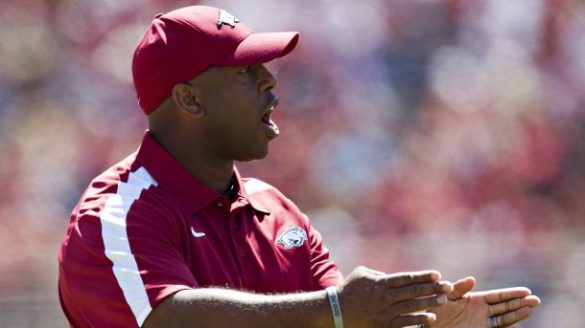
Taver Johnson

You’ve got to hand it to Geoff Collins.

With some recent coaching assignment reshuffling, his vague “Above The Line” concept  at least has extended throughout the Temple football organization.

A cynic would suggest that Andrew Thacker’s “promotion” to defensive coordinator would indicate that Collins was not entirely pleased with the job former defensive coordinator Taver Johnson did. Yet, despite the promotion of Thacker, Johnson was named “co-defensive coordinator” in the shuffle. So we have a new defensive coordinator, yet the old guy is the co-defensive coordinator, and an assistant head coach to boot.

Like the depth chart that really isn’t a depth chart, the lines are further blurred here because this doesn’t indicate who will be calling the defensive signals.  Got to think this is a way to get Johnson a raise, as well as some of the other guys. Presumably not getting a raise last year’s offensive coordinator Dave Patenaude because the title Johnson “assistant head coach” had on defense went to a familiar name on offense.

folmeister


Foley, who knows Temple tough inside and out, must have pulled the remaining hair of out his head when Patenaude called for a pass on first-and-goal from the 1


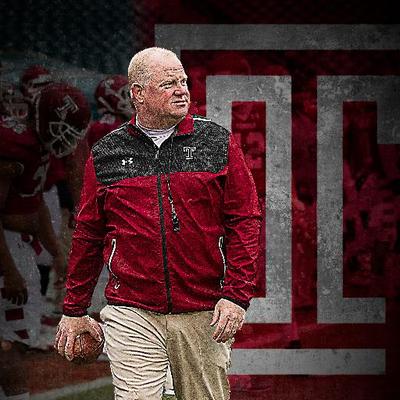
That’s also the title Ed Foley got on offense and all of us at Temple Football Forever (all one of us) are thrilled with that promotion. That means that Foley is the new boss of current offensive coordinator Dave Patenaude and we might not see a pass on first-and-goal at the one with 3:16 left in the Army game. At least that’s the hope. Foley, who knows Temple tough inside and out, must have pulled the remaining hair of out his head when Patenaude called for a pass on first-and-goal from the 1. Foley would have lined Ryquell Armstead (who had 151 yards in that game) behind fullback Nick Sharga and pounded Rock home for six on first down. Patenaude went Coastal Carolina soft and got zero points and cost Temple a win.

All in all, coaching assignments, like depth charts, should give fans an indication of who rises to the top of the organization but this is how Collins wants to operate so let’s hope he’s successful with it.

Other changes:

Reggie Garrett was promoted to defensive analyst after spending two seasons as a graduate assistant, working with the defense. Tom Pajic moves from director of player personnel to senior offensive adviser. Larry Knight, who was in charge of quality control for defense and recruiting, is now the director of player personnel.

Last week, Adam DiMichele was named recruiting coordinator/offensive assistant, allowing him to become the 10th full-time assistant coach. DiMichele shares similar offensive principles with Foley, which is a good thing.

Here are the coaches who have different roles and/or were promoted:

Ed Foley: assistant head coach offense/special teams coordinator/tight ends

Taver Johnson: assistant head coach defense/co-defensive coordinator/safeties

Dave Patenaude: Offensive coordinator/quarterbacks

Andrew Thacker: Defensive coordinator/linebackers

Jim Panagos: Defensive line/run game coordinator

Chris Wiesehan: Offensive line/run game coordinator

Tom Pajic: Senior offensive adviser

Larry Knight: Director of player personnel

Josh Linam: Quality control – defense

Friday: Killing Two Birds With One Stone

Monday: Strange Hastags

Wednesday; Great Expectations

Friday: The One That Got Away

2/5: Temple’s Super Bowl

2/7: Signing Celebration Primer

2/8: Signing Celebration Recap

5 Unanswered Questions

tuff

The thing about coaching changes is that bumps in the road are going to be an expected part of the process.

No one—at least the people I talk to—expected to hit this many major potholes on the way to what was largely an under-performing season in 2017. Plenty of starters and key contributors returned from the AAC championship team and Matt Rhule did not leave the cupboard bare for first-year coach Geoff Collins. Talent-wise, this was a team that should not have lost to UConn and Army. You may say that is crying over spilled milk but leaving that milk there without cleaning  it up could make next season more sour tasting that it should.

Part of the process is asking hard questions and answering them honestly.  So far, no member of the Temple football media (to our knowledge) has asked any of these five questions of  Collins and getting these answers by Cherry and White Day would be nice:

sharga

5) What happened to the fullback position at Temple?

Matt Rhule said he had an Epiphany after his second season that the way to create explosive plays in the passing game was not by spreading the field with receivers but by establishing the run behind a blocking fullback and then using play action to get receivers open. That plan worked for two 10-win seasons and Collins seemed on board with it as late as the season-ticket holder party in August. What happened? Will Nitro be used as a fullback this year or is the fullback position done at Temple? (And don’t say the fullback isn’t used in college football anymore. Just because other teams don’t use the triple option, that doesn’t mean that Navy will stop using it. The fullback fits the Temple TUFF football philosophy as the triple-option is to Navy. Run the ball, play great defense and special teams and hit explosive plays in the play-action game is what got Temple consecutive double-digit win seasons)

4) What happened to Jared Folks?

How does a guy start in the AAC championship game for a great team one year and become a non-factor for a mediocre team the next? Inquiring minds need to know.

nutile

3) How could it have taken them seven games to figure one quarterback was better than the other?

Despite saying for nine months leading up to the opener that all four quarterbacks were “equal” Collins rolled out an under-performing quarterback for seven games before an injury allowed Frank Nutile to play. Fans immediately saw that he was the far superior quarterback in the Army game. How could a highly paid coaching staff miss that?

2) What did Collins mean by his “square peg, round hole” comment?

Before the bowl game, Collins said that the offense didn’t come around because “I think we were trying to fit a square peg into a round hole on offense.” What were they trying to do that was wrong and what fixes did they apply to make it work?

journey

1) How could they have screwed up the kicking situation?

All over college football, you could see kickers on Power 5 teams miss chip-shot field goals but Temple had two kickers, Austin Jones, and Aaron Boumerhi, who were elite. That was an asset they should have extended by playing the healthy one and redshirting the other.  Instead the Owls tried to use two kickers from the jump. The Owls could have used Boomer for the extra year. Now Jones is gone and odds are the next one probably won’t be as good as Brandon McManus, Jones or Boomer. Great kickers are hard to find as Rhule found out in his first  year on the job.

Wednesday: The Coaching Shuffle

Friday: Killing Two Birds With One Stone

Monday: Strange Hashtags

Stadium: End Of The Beginning


badurban

Seats here are too far away from stadium and not on top of the field like this other example of a great urban stadium within essentially the same square acreage footprint.

urban

Roughly six years ago, a Temple University Board of Trustees member told a friend of mine at the NCAA Tournament that a football stadium on campus was a “done deal.”

My friend has a lot deeper pockets than me and often traveled to see the football team in remote Middle Atlantic Conference places like Mt. Pleasant, Michigan and Oxford, Ohio, with reports about the Temple fan presence there.

Often, he was it–the guy who was invited to home tailgates by the Central Michigan and Fake Miami fans like an alien who landed in a flying saucer.

This December, his move to Coral Gables, Florida made him a more likely prospect than I to make the Gasparilla Bowl and he bellied up to President Dick Englert at a pre-game function and dropped the question about whether or not Temple will build a new football stadium.

“We’ll see,” the coy Englert said.

goodurban

Temple fans should accept no less than this kind of stadium

Well, we saw a little bit on Thursday when the university announced to the world that the stadium is presenting plans to the city for the building of a “multi-purpose facility.” Notice the word “multi-purpose.” If it had been “a stadium” the already negative view of many of the city pols would have been further polarized.

Make no mistake about what happened Thursday.

This is not the end of the stadium process but the end of the beginning. The end is a long, long way away.

It was nice to finally see an artist’s conception of the stadium. To me, that was disappointing. The seats are too slopped back and not on top of the field. Some tinkering needs to be done on the architects’ end. Make the stadium like Boston College here and we’re in; otherwise, where is the Temple home field advantage?

The timeline that many stadium proponents state continues to be: Shovel in the ground by August, stadium done by 2019.

For someone who has lived in Philadelphia all of my life and knows the ins and outs of the corrupt political system here, that’s a pipe dream.

Figure on two years of hassle with the city and a shovel in the ground by 2019 at best. At worst, figure a thumbs’ down from the city and an extended Linc lease. I’m a lean toward a stadium at Temple because I think the ceiling for interest in Temple football is 35K at best. That still looks horrible in a 70K stadium and perception to many is reality.  Still, to think that today’s announcement puts this on a fast track to completion is pure fallacy.

Plan on going to that stadium for the opener maybe 2021 but more likely 2022.

I will have to eat a lot more salads, drink a lot fewer beers and work out about two extra hours a day to definitively  say I will see The Promised Land with you but I promise to try.

From what I’ve been told by my Philadelphia City Council peeps, there are 10 elected members and seven at-large members. For this to pass in the county, there will have to be nine votes. Right now, Temple can count on four. Getting to nine will not be impossible, but it will be close to impossible.

This is not the end but the end of the beginning. The end of the end could be longer than anyone knows. In short, not a done deal by a longshot.

Monday: Five Unanswered Questions

Commitment Issues: The New Norm


A very familiar headline appeared in the papers the other day.

“Matt Rhule Turns Down Colts to Remain at Baylor.”

Familiar, because I’ve seen that headline somewhere before:

“Matt Rhule Turns Down Missouri to Remain at Temple.”

Now, the chances are that Matt Rhule was offered either job are about as good as I being offered the job of replacing Mike Francesa on his highly successful radio show.

None.

yeahright

Yeah, right after I turned down WFAN’s offer to replace Mike Francesa.

It was just floated out there, maybe not by Rhule, but by his agent to make him look better returning to his other positions.

dyingbreed

These two unfortunately are a dying breed

This is the new norm in college football these days and that’s one of the two reasons that college football is harder to get into for me with each passing year.

Commitment Issues.

Gone are the days when a great coach like Wayne Hardin can stay at Temple for 13 years or the days when Joe Paterno plants his flag down in State College and turns down being a millionaire as head coach of the New England Patriots for lesser pay and a chance to build something at Penn State.

Money talks and bullbleep walks, as the late-night TV commercial used to say.

hardo

Wayne Hardin, talking about Temple in 1976

The other reason—lack of a true all-inclusive national championship—has been covered in this space in the past and I don’t see that as changing any time soon, either.

Today, though, is about Rhule.

My issue with him was these proclamations of lifelong fidelity to Temple and then to turn around and leave the team that made him millions for Baylor and not even coach the bowl game. That was his decision and, while I didn’t agree with it, I have to respect it.

The bottom line for Rhule is that he gave Temple a great 10 years and if he felt that he had to leave before the bowl game, that should be his decision. God bless him and I hope he has a great career, but the latest dalliance with the NFL makes me think he’s got second thoughts about the mess he’s gotten into at Baylor. It’s a similar situation to Al Golden at Miami, who gave Temple a great five years.

Hopefully, both will straighten things out and have solid careers. Funny thing is they could have had good-paying jobs at Temple for life with a fraction of the headaches.

Maybe it’s something for Geoff Collins to think about.

Friday: Five Unanswered Questions

Monday: The Coaching Shuffle


2018 P5 Opponents: Maryland and Boston College

tentative

As Central Florida found out this season, nothing makes a statement for a Group of Five program than a win or two over Power 5 teams.

The first statement—a 38-10 win on the road over a Maryland team which beat Texas (which beat USC)—was impressive enough, but beating an Auburn team that beat the both Alabama and Georgia took it to another level.

Not enough to finish in the top four, but a statement on the way to an unbeaten season nonetheless.

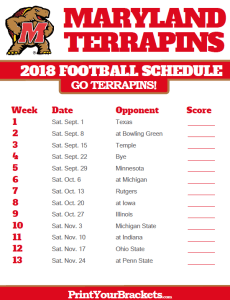
Temple, in its own way, has a path to such a statement by wins against the aforementioned Maryland team and Steve Addazio’s Boston College squad.

Hard, but doable.

marylandsked

That’s what sets the 2018 season apart from the 2017.

The Owls play both Maryland and Boston College and, with those wins and a win over a Power 5 team in a bowl game, would restore a brand closer to what Matt Rhule left after a pair of 10-win seasons than the hit that took a slight hit with a 7-6 one in Geoff Collins’ first season.

If the Owls will be, as Collins has said, a “ridiculous” team next year, there is no reason to believe they can’t pull those two wins off. I assume Collins means ridiculously good because he talks the kids’ lingo.  Call me skeptical about the Owls replacing two great wide receivers, two good edge rushers and an 3/4s of a defensive secondary. Losing the “best fullback in the country” probably not will be as devastating as I thought it was going to be four months ago because the Owls’ brain trust did not use him over the last two months.

Maryland made it a lot harder by hiring former Temple defensive coordinator Chuck Heater. Taver Johnson, the Owls’ current coordinator, doesn’t have a resume approaching Heater’s—the last Temple DC to post consecutive shutouts and a guy who Urban Meyer called a “Miracle Worker” leading the defense of his 2010 Florida Gator national championship team.

Boston College, despite a solid season last year, could be a relatively easier nut to crack simply because of the matchups. BC lost to a Syracuse team that lost to Middle Tennessee State, so anything is possible. Any Temple fan will tell you that Addazio’s affinity for the run game borders on obsession and Temple, if anything, should have a good run-stopping defense next  year and be vulnerable to the pass. If Daz follows the pattern he set at Temple—run, run, sack, punt—the Owls should be in good shape. Still, Boston College won five of its last six games to earn a Pinstripe Bowl bid.

So there are signs that this is probably not the Daz we know and hate.

Either way, both Maryland and BC add some spice to a schedule that has been peppered with too many Stony Brooks and Villanovas over the last couple of years.

Scheduling P5 teams is one thing but, if you are going to schedule them, you might as well follow Central Florida’s lead and go ahead and beat them.

Wednesday: Commitment Issues

Friday: Housecleaning Questions

Heating Things Up: Hiring Adam DiMichele

Every once in a while, Temple coach Geoff Collins does something that makes you think he gets his surroundings.

Hiring Adam DiMichele certainly qualifies with one of those somethings.

DiMichele is now the “recruiting coordinator” and the 10th fulltime assistant as allowed by the NCAA as of last Tuesday.

Hey, he could have hired another Coastal Carolina guy.

DiMichele kicks McNabb's butt

Adam as a Philadelphia Eagle (hey, they still need a backup to Sudfeld)

I’m not so provincial that I believe Collins should hire all Temple guys to coach at Temple but, with Adam, I’ve got a soft spot.

Including P.J. Walker, Steve Joachim, Matty Baker, Tim Riordan, Henry Burris and Lee Saltz, Adam DiMichele is my favorite Temple quarterback of all time.

Notice I wrote “favorite” and not “best.”

Favorite is because he was the conduit between a lot of bad years and a lot of good ones.

Sitting at Franklin Field right behind the late, great Peter “Doc” Chodoff watching Temple get waxed during the Dark Ages that culminated in a 20-game losing streak, Doc turned to me and said, “Mike, why does every other team have a better quarterback than Temple?”

“I’ve always said the same thing. Seems like it’s been that way forever, Doc. I don’t know.”
Doc Chodoff got a field named after him a few years later, right around the time  I got my quarterback who was better than the bad guy’s quarterback.

His name was Adam DiMichele.

DiMichele was the bridge between the 20-game losing streak and what Temple football is today. Had not Buffalo completed an inexplicable “Hail Mary” pass, he would have led the Owls to a bowl game in 2008.

Had not Joe Paterno denied him a transfer waiver, DiMichele—not Chester Stewart nor Vaughn Charlton—would have been the quarterback in the 2009 Eagle Bank Bowl and there is no doubt in my mind he would be the difference.

DiMichele was part of a lot of great plays while at Temple, my favorite being the “fake knee down” against Navy in the 2008 season. Temple looked like it was going to run out the clock but DiMichele feigned the knee and pulled it up just before it hit the ground and found Bruce Francis 30 yards behind the nearest defensive back. Francis walked in but the Owls lost that game, 33-27, in overtime. The year prior, DiMichele flipped the ball back to D’yonne Crudup on a double-reverse and Crudup tried to hit him in the end zone for a game-winning TD against UConn, but DiMichele tipped the ball to Francis, who caught it but it was ruled a non-catch.

DiMichele was always the quarterback of a fullback-oriented offense that head coach Al Golden and offensive coordinator George DeLeone believed in and was the beneficiary of a strong running game that set up great play-action passing. Hopefully, Adam will have enough influence on Dave Patenaude to go away from Coastal Carolina Soft back to Temple TUFF. If anyone can convince Patenaude to put Nitro back there leading the way for Rock and David Hood, it’s Adam DiMichele.

More than that, though, he’s got to convince Collins and, by getting hired, he’s at least halfway there.

Monday: The 2018 Power 5 Opponents

Paul Palmer: The Power of A Resume

vinny

Too bad they don’t allow college football nominees to sit down and type out a resume in order to be selected in the Hall of Fame.

Temple’s Paul Palmer would have been selected seven years ago when he was first nominated. All he would have needed to do is type some numbers compared to guys already in there and include a computer printout that had Temple’s schedule ranked in the Top 10 of the hardest schedules in two of his three seasons.

It should have been a no-brainer a long time ago.

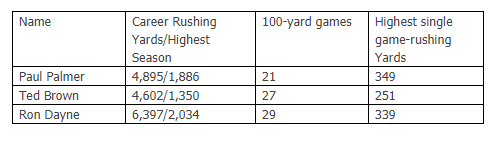
Palmer not only had the minimum requirement of being selected as a first-team All-America, but his numbers were far better than a lot of backs already in the Hall of Fame.

Check this list out. The other two guys on this group were already in the Hall during Paul’s first year of eligibility:

dayne

In other words, he should have been in there a long time ago.

Now he joins former Temple coaches Pop Warner, Ray Morrison and Wayne Hardin in the Hall of Fame and becomes the first Temple football player in the Hall in a history that began well over 100 years ago.

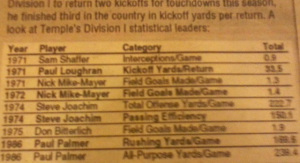
Temple had national stat leaders before Paul arrived on the scene, with Sam Shaffer leading the nation in interceptions and Paul Loughran kickoff and punt return yards, but Palmer took the numbers to a new level. lawhorn

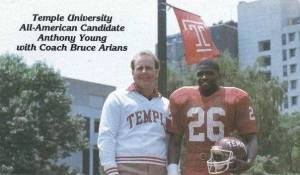
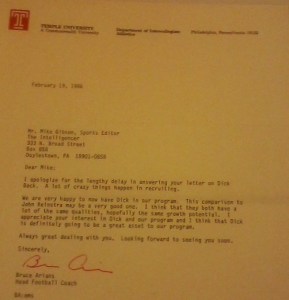
When Palmer was at Winston Churchill High School in Potomac, Md., Bruce Arians was the only Division I coach to offer him a scholarship and it paid off big-time for Arians and the Owls. Palmer had 100-yard rushing games 21 times and six 200-yard rushing games. In 1986, he led the nation with 1,866 rushing yards and 1,976 yards from scrimmage.

He broke the single-season all-purpose yard record previously held by USC’s Marcus Allen with his 2,633 yards that year.

Temple Owls Paul Palmer
He finished second to Vinny Testaverde in the 1986 Heisman Trophy balloting but probably should have finished first.

The numbers do not lie and now the truth is in the pudding or, more precisely, the Hall of Fame in Atlanta.

The induction will be on Dec. 1, and that day should be a party for all Owl fans.

Friday: Heating Things Up

Monday: Hope For Offense

Wednesday: February Surprise

A Book That Needs To Be Written

brucetwo

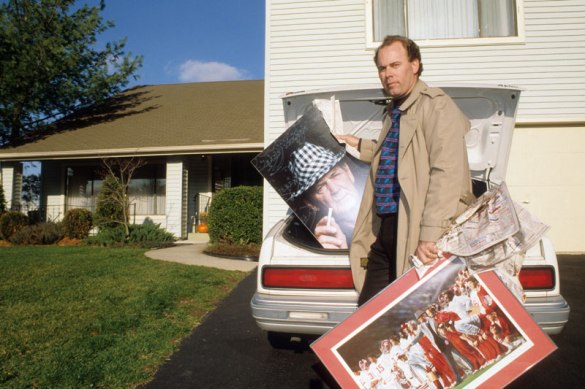
Bruce takes items from his office home the day he was fired at Temple

Anyone who knows Bruce Arians will tell you he will use approximately one week to rest and relax after his “retirement” and then get so restless he will have to move on to his next project.

I personally think he would be best-suited to be Jon Gruden’s replacement on ESPN (they could not pick a better person), but there is a compelling project that needs to be finished first.

Arians is a best-selling author, having published his first book “The Quarterback Whisperer” to great acclaim.

bruceone

“After writing that book, I realized there were a lot of good stories I left out, particularly from my Temple days,” Arians said. “Maybe I’ll include them in the next one.”

Include them?

He has to have enough great stories in that head just about Temple that would make an entire book a best-seller.

Five years as Temple’s head coach—two of them winning seasons against what the computer then rated the No. 10-toughest schedule in the country—should provide enough good stories for a 387-page book.

bruceandanthony1

Plenty of topics could be covered.

Loyalty?

In these days of leaving for Power 5 programs and big bucks at the drop of a hat, Arians can talk about the time he turned down the head coaching job at Virginia Tech, his alma mater, for more money so he could stay in Philadelphia. “I can’t leave my Temple guys,” Arians said.  That job went to a guy named Frank Beamer.

Temple returned that favor by firing him three years later. That was a move current Iowa coach Kirk Ferentz brought up unsolicited  during a St. Louis Post-Dispatch interview on colleges being quick to fire head coaches: “Look at Temple. Firing Bruce Arians set that program back 20 years.”

bruceletter

Arians could write about beating a one-loss Toledo team in the Boardwalk Bowl in Atlantic City, 35-6,  1984 and watching that same Toledo team go out to play in the California Bowl while his 6-5 Owls stayed home. We still don’t know what Bruce was thinking when Bill Cosby hid the ref’s flag under a piece of sod, causing a 22-minute delay of game.

He could spin a nice tale about beating another one-loss team, the aforementioned Virginia Tech, 29-13, in the 1986 Oyster Bowl and then watching those Hokies go on to play in that year’s Peach Bowl, while his own Owls remained home.

He could talk about being the only coach to offer a Division I scholarship to Paul Palmer and then coaching him up to be a Heisman Trophy runner-up and someone the numbers showed should have won the trophy.

He could talk about his hot and cold relationship with Peter J. Liacouras, which started off hot and ended cold when the then Temple President had the kind of obsession with the Owls returning to the Sugar Bowl which bordered on insanity.

Most of all, Arians could tell a lot of the personal stories that few of us know of how a 30-year-old got a major head coaching job and interacted with players who loved him for the rest of their lives.

It would be a compelling read and a book that needs to be written.

Wednesday: The Power of a Resume

Friday: February Surprises

G5-P5 Conundrum: System Gone Amiss

camel

The problem that faces college football is that the rich go to heaven and the poor can go to hell.

Usually, horoscopes are so general they make you laugh but occasionally one will grab you right where you are that day.

Such was the case for me on the stairmaster at the local gym on Tuesday. I opened the Philadelphia Daily News and, since the sports section is just a shadow of what it used to be (Gary Smith, Dick Weiss, Ted Silary, Tom Cushman, Stan Hochman, Ray Didinger, Tim Kawakami and Mark Whicker have never been replaced and not sure they can be), I went straight to the horoscopes and this is what I found:

gemini

Yes, amiss is a very good word when it comes to the current Group of Five versus the Power 5 conundrum. This is a system set up by the powerful to exclude the powerless. It must be changed. It should be changed.

It probably won’t be changed and that’s why no one should be satisfied and this is a system the G5 should have never signed off on. They have, though, and this year’s injustice is the result.

legit

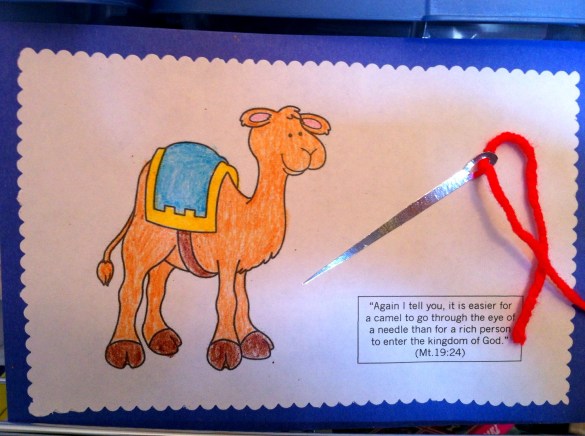
There’s a good verse in the bible that describes the problem: ” It is easier for a camel to pass through the eye of a needle than enter the Kingdom of Heaven.” (MT: 19:24)

In college football, the opposite is true.

When the rich, the Power 5, set the rules and have taken control of the NCAA, which they have, do not expect them to invite the poor in for a meal. Even the bowl committee president said as much.

College football is the only sport where a team can win all of its games, beat a Big 10 team by 38-10 and beat an SEC team that beat both of the national finalists and NOT be even given a chance to compete for the title.

For Temple, this is what HAS to happen for the Owls to be considered for the four-team playoff next year. They have to win all of their games, like UCF did, and have Boston College win the ACC title and Maryland win the Big 10 title. Heck, they probably won’t get in unless one of those two teams has only one loss under that scenario.

That’s a ridiculous standard for a system that allows a two-loss team into the Final Four.

Basically, college football is telling half of its members that they have no shot of ever winning a championship and never will. If that is not a violation of federal anti-trust laws, I don’t know what is. The G5 should get together and pursue legal relief in this if the NCAA is not going to get involved and expand this playoff.

That’s the only way to get to the bottom of this.

Monday: A Book That Needs To Be Written


Ten Reasons To Build The Stadium

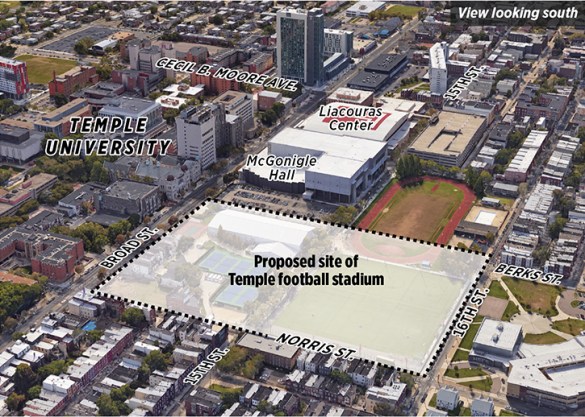
proposed

Snails have crossed the continental United States faster than Temple University has moved to build a football stadium since the first “done deal” was uttered by a member of the Board of Trustees to a follower in March of 2012.

That was the day that Temple beat North Carolina State in the NCAA basketball tournament. The listener was a long-time fan who made numerous road trips to support his alma mater in both basketball and football. The speaker was presumably well-connected with the powers-that-be at Temple.

Five months of March have come and gone and there has been no public announcement of the “done deals” so many of us have heard for five years. So call me skeptical that this thing will ever get built.

BOT meetings have come and gone and several of the last few have had “rumors” that the stadium would be discussed. Meeting agendas were released and no first “shovel in the ground date” could be found even in the fine print.

parking lots

There are 10 lots that will be mostly empty for tailgating on Saturday, plus a couple of garages for those who do not plan to tailgate.

An argument could be made both for and against a stadium and former Temple player Dave “Fizzy” Weinraub made such an argument against in this space a couple of weeks ago. My feelings have simply been this: If the university has reached the point where it feels it can no longer deal in good faith with the Philadelphia Eagles, then build the stadium. If it has created the conflict with the intent of going ahead and doing what it wanted to do in the first place, that would be a sad pretense on which to build.

It may have already reached one of those two crossroads. Five years of due diligence could be coming to an end and, hopefully, the university is doing what it has to do and not building it because it just wants to do it.

owlstudents

If it can cut a deal with the Eagles similar to what the Pittsburgh Steelers have with Pitt, then there is no reason to build. The alternative–Franklin Field–is not acceptable. Temple would have to have stadium control on Saturdays for television purposes and Penn, with its $6.9 billion endowment, could not be enticed to give that up to a school with a $579 million endowment.

Fizzy says the “neighborhood does not want it” but maybe if the neighborhood could get assurances that none of their houses would be torn down–and they won’t–and that local high schools like Engineering and Science can play their football games there and that stadium jobs would be available to immediate residents first, then something could be worked out.

Fizzy’s second point was that “Temple doesn’t need it.” If it wants to be a program that gets on television, and LFF’s rent is too high, that point could be disabused.

Fizzy’s third point was that “it closes off 15th Street” but 13th Street was closed for most of my four years at Temple due to various building projects between then Columbia Avenue and Norris and nobody died because they had to use Broad Street to travel Northbound.

studenttailgate

Student tailgate central

No. 4: “Parking Will Be Scattered Around Campus making it very difficult for older fans to walk to the stadium.” It’s not asking much to walk from, say, the No. 10 Lot at 11th and Norris to 15th and Norris but, I’m sure the university could provide a mode of transportation, maybe golf carts, for those who don’t feel they can make it. Owlclub members will probably get preferential parking in the McGonigle Hall outside lot, so that’s an option.

No. 5 is “there will be no common tailgating area” but that’s really not needed. Really, is the tailgating “one common experience” or is it smaller groups scattered throughout Lot K now? To me, it’s smaller groups who tailgate together and go in separately. Plus, students who take up a large part of Lot K now will be funneled to Liacouras Walk for their own tailgates. The official alumni tailgates now conducted under a large tent closer to the Linc entrance can be moved to the Bell Tower.

No. 6 “traffic will be horrendous” doesn’t really apply to football because fans usually don’t get there five minutes before a game. Their arrival is scattered starting with the opening of the lots five hours before the game, not five minutes, with groups filtering in four, three and two hours before the game. Traffic won’t be great, but it won’t be horrendous, either.

No. 7 “don’t take the subway” doesn’t really come into play, either because there is a perfectly good regional rail station located right on Temple’s campus that provides the kind of transportation option fans do not have going to LFF now. In fact, if the new stadium is built, my days of taking the subway to the Temple games–which I have done for 15 years–are over. I will hop on the Regional Rail and be at Temple in 20 minutes.

No. 8 “the Linc has easy accessibility” is true, but a football game is an event lasting from the start of tailgates to the end of the game and that’s an all-day deal.  Again, I don’t see all the traffic arriving at the same time. If you want to drive, get off the Roosevelt Boulevard extension and make your way down Broad Street.

No. 9 “Temple will lose a large percentage of its older fans” and some of their contributions. I’m an older fan. They won’t lose me but the point is that the university has 40,000 students now and must cultivate that fan base which really has not been tapped into seriously. This stadium could create the kind of experience for them that binds them to the university for decades to come.

No. 10 “Temple will incur a large unnecessary debt” could be true, but the bean counters running the university say it will be more than offset by combining the money they pay for rent now with revenue gained from parking and concessions and the retail element of the stadium.

To me, there is a larger issue involved that goes beyond signage on the field or comfort in the stands. In my lifetime, I have never experienced a real home-field advantage following the Owls except for maybe the Tulane game in 2015 when all 35,000 fans were screaming their heads off for Temple. Getting 35,000 fans in a defined space on top of the field and making so much noise that the bad guys’ quarterback has to use hand signals to snap the ball is something I’d like to see before I leave this earth. It hasn’t worked for the beautiful new on-campus basketball facility, but maybe football is another animal.

The university needs to end five years of constipation on this issue and bleep or get off the pot.

Friday: The G5-P5 Conundrum

Monday: A Book That Needs To Be Written