Eye on Atlanta: Root for Georgia Tech

urban

Hopefully, Temple’s stadium will be closer to this than the crude drawing released recently

Hard to believe, Harry (Donahue), that one of the websites that list such things has placed Georgia Tech’s Paul Johnson on the hot seat.

A few years ago, Johnson was one of the hottest coaches in the country at The Naval Academy, now he’s sitting on a hot seat. That’s life in the Power 5.

If you are a Temple football fan, you’ve got to root for him and his Georgia Tech team this season because when Owls’ head coach Geoff Collins called Temple “a developmental program” a month ago tomorrow, he probably meant it with his coaching staff, too. Three of four of Collins recent hires are from the state of Georgia and his current defensive coordinator, Andrew Thacker, was a position coach at Kennesaw State (also known as the Owls). Kennesaw is in Cobb County, which is in the Greater Atlanta metropolitan area.

Collins himself as a history at Georgia Tech, being the recruiting coordinator there for the Yellowjackets. If you don’t think this staff is being developed for a place like Georgia Tech, you probably don’t believe that General Billy Sherman burned the town to the ground 168 or so years ago. If Collins does well here this fall, he certainly would move to the top of the Georgia Tech wish list.

So that’s probably what Collins means by a developmental program. Ask him if he considers Georgia Tech a developmental program.

Still, rooting for a solid year from our friend Paul Johnson is almost as good as rooting for the Owls themselves.

That’s the lay of the land, though, in the “developmental” AAC.

In January, Navy head football coach Ken Niumatalolo interviewed for the Arizona opening. While he  decided to remain in Annapolis, had he left the Midshipmen it would have left Tulsa’s Philip Montgomery as the longest-tenured head coach in the American Athletic Conference, after only three seasons with the Golden Hurricane.

Coaching turnover has become a fact of life in the American with six head coaches leaving the AAC for jobs at “power five” schools. Next year, Memphis’ Mike Norvell and USF’s Charlie Strong are sure to attract suitors.

A good year for Paul Johnson probably won’t mean Collins will be here for life, but it would certainly close at least one very attractive door and limit the damage to Temple’s program for at least another year.

How’s that Georgia Tech fight song go again?

Friday: Thoughts on The Mitten Hall Fiasco

Monday: Spring (Practice) is in the Air

Wednesday: Our New Scheduling Buddies


What a Revolting Development ….

revolting

With only a few seconds in an eminently winnable game NBA at Miami, something stood out like a 6-foot-11 sore thumb.

The Philadelphia 76ers were winning and this decade’s version of “Hack-A-Shack” was in the game. Of course, instead of two 90 percent free throw shooters Mario Bellinelli and J.J. Redick being in there to catch the ball and get fouled and win the game, Ben Simmons was spotted and fouled immediately and the Sixers lost at the buzzer mostly because he missed two free throws.

What does this have to do with Temple football?

ceremony

Because after the game, Sixers head coach Brett Brown said it was “more important for Simmons’ development” to be in there than it was to win the game.

The word “development” caught my ear because I heard, by my count, Temple football head coach Geoff Collins a derivative of it not one, not two but four times at the recent recruiting celebration. Collins said “we’re a developmental program”  while reviewing some recruiting film and saying a lot of these players are in the developmental stage and are coming here to be developed. It wasn’t the first time he used it. This is what he said in an interview on SI.com last May:  “I think this place is a developmental program, so I take pride in that.”

I guess Florida wasn’t a developmental program.

Hmmm. I’m sure Collins means well, but I don’t like the term.

Developmental program is a term I’ve never associated with Temple football before Collins came to town. AAC championship program, yes. Top 25 program, yes. Developmental program, no. While players certainly have been developed and nurtured (the most recent example is Haason Reddick), the primary purpose of Temple football has been to win as many games as possible. If someone got developed along the way, fine, but development was always secondary to playing in championship games.

To me, like the Sixers’ game above, winning is not the most important thing, it’s the only thing. I could not give a rat’s ass about Simmons being in there to learn a lesson, nor could I give a similar derriere for Logan Marchi’s “development” as a quarterback meant keeping him in there for seven games, looking awful against a bad Villanova team and stinking up Lincoln Financial Field in winnable games against Houston and UConn. A seven-game career as a starter was way too long for Marchi, who failed an eye test two games into his starting career and should have earned a permanent spot on the bench.

Big-time college football is a business and, in business, it’s either up or out. Marchi wasn’t treading upward after a brutal Game Two performance against Villanova and should have been out.

One of William Bendix’s catch phrases in the old TV show “Life of Riley” was “What a Revolting Development” and that applies to the word “developmental” and Temple football. A year ago, Collins was touting Temple as a “Top 25 program” and now it’s “developmental program.”

I prefer Top 25, thank you.

Let’s hope Temple never becomes the Sixers and sacrifices a precious game for the development of any single player. The football Owls don’t get to play 82 games a year. They can’t afford to trade wins for development.

Monday: 5 Questions for The Stadium Meeting

Wednesday: Eye On Atlanta

Friday: Reflections on The Town Meeting

3/12: Spring Practice Begins


Current Staff? Meh ….

raponecould

This is the resume Nick Rapone could have brought to Temple.

Everything in life is a trade-off and, so it is with Temple football coaching staffs as this story illustrates.

“My son said, ‘Dad, it’s like Night and Day between this staff and Al Golden’s staff,’ “ John Palumbo’s father told me during Steve Addazio’s first Cherry and White Day. “He said, Dad, these guys are all National Championship coaches. They know what they are doing.”

interested

Palumbo knew what he was talking about. He started at center for both Golden’s last team and Addazio’s first team. Daz took Golden’s talent and made it a bowl-winning team.

Golden was the great CEO-type, someone with a binder full of recruiting contacts up and down the East Coast and nobody was more well-equipped to stock the Temple roster with the talent it needed to succeed—if not win—the MAC.

Addazio was the ambitious successor, a guy who supposedly loved the macaroni and South Philly Italian food so much that he would stay here 10 years. We later found out what he was, a bull-bleeper who could sell snowballs to the Eskimos. In that sense, Daz bought an all-star staff with him to Philadelphia—the defensive coordinator at Florida, Chuck Heater, and Scot Loeffler, a damn good offensive coordinator.

rosscard

They were a good sight better than Mark D’Onofrio and Matt Rhule, Golden’s last coordinators but part of the price of bringing that kind of talent to Philadelphia was that Daz probably promised that he would take them along to a P5 stop in a year or two.

When the Owls hired Geoff Collins from Florida, I had a feeling it would be more like a Daz hire than a Golden or Rhule hire in that he’d poach the Florida staff of a couple of top position coaches with a promise of making them coordinators here. No such luck. The only person he poached from the Gators was the equipment manager.

It wasn’t what I expected.

You get what you pay for. Two days after he was hired, Steve Addazio wooed his buddy, then Florida national championship co-defensive coordinator (really, THE guy according to Urban Meyer), Chuck Heater. Temple paid Mark D’Onofrio $200,000 to be DC in the 2010 season. Daz convinced Lewis Katz, his guy, to kick in an extra $200K to secure the services of Heater. Katz is gone and probably so are the days of Temple outbidding P5 teams for any assistant football coach’s services. Heater loved it here, biked every day from Center City to 10th and Diamond and had a good relationship with many Temple fans, big donors and small.

Now, we have an offensive coordinator from Coastal Carolina, a defensive coordinator from Kennesaw State and position coaches from West Alabama and Georgia State. It’s particularly sad in that Nick Rapone, a former FCS defensive coordinator of the year who spent the last few years with Bruce Arians with the Arizona Cardinals, expressed an interest in the DC job after Taver Johnson left. So did Temple legend Kevin Ross, who was the DB coach with the NFL team.

Instead of NFL guys, we have Kennesaw State and West Alabama guys. Not the kind of resumes that will make sons of the current Owls tell their fathers that the Rhule and Phil Snow did not know what they were doing.

Maybe the trade-off is a little more loyalty for fewer wins. Give me consistent wins on Saturday or any day of the week against mediocre 7-6 records and loyalty every year of the decade. I know I would have them with guys like Scot Loeffler, Chuck Heater, Nick Rapone and Kevin Ross.

These small school guys?

Not so much.

Friday: Developmental Program?


Coaching Shuffle: It’s Who You Know

vested

When it comes to getting an assistant coaching job at Temple, as anywhere, it really comes down to who you know.

Geoff Collins.

If you know Geoff Collins, you are in, and that was pretty much what happened with the hiring Nathan Burton as safeties coach after being the “quality control” coach at North Carolina State last season.

performance

Coastal Carolina soft

Burton met Collins when he was walk-on in the last century at Georgia Tech and Collins was a graduate assistant there.

Prior to his time with NC State, Burton served as the defensive coordinator at West Alabama for three seasons. West Alabama was the place where former Temple head coach Bobby Wallace finished his career after making his chops at North Alabama.
Burton was hired as safeties coach but will take over the entire defensive backfield due to the exit of Cory Robinson for Rutgers. Robinson had been the defensive backfield coach at Temple last year.

To me, that was addition by subtraction.

One of the most disappointing areas of the team was the play of the defensive backs. Three starters returned from the AAC championship team and a fourth, Mike Jones, eschewed a chance for being a late-round NFL draft pick last year (Mike Mayock had him projected as the steal of the sixth round of the 2017 draft) to play for Temple.

Time and time again, the Owls were burned by touchdown passes late in the games (particularly Army and Navy) and they appeared to be out of position and the communication was not there like it was two years ago. Fran Brown and Phil Snow did a much better job with essentially the same players.

Defensive coordinator Taver Johnson, who presumably had a role in that miscommunication, was “demoted” to co-coordinator, probably saw the handwriting on that wall and took a lesser job at Ohio State.

Larry Knight will take over the linebackers, a role current defensive coordinator Andrew Thacker had last year. Knight had been the “director of player personnel.”

To me, the Knight move was interesting considering that he performed that same role at Georgia State in both 2015 and 2016.  Nick Rapone and Kevin Ross, probably overqualified to be DC and DB coach at Temple, expressed interests in the open jobs through back channels. No doubt in my mind they would have been better for the kids than the guys hired, but Collins is comfortable with who he hired and it is Collins who will sink or swim with them.

Would I like to see more ex-Temple guys like Nick Rapone and Kevin Ross included in this staff? Sure, but they did not know Collins before now and apparently Collins apparently did not have the same comfort level with them.

At least those of us who care about those things still have native son Adam DiMichele and adopted son Ed Foley. Hopefully, that’s enough to swing the pendulum of the offense back in the direction of Temple TUFF and away from the Coastal Carolina SOFT we witnessed too much a year ago.

The defense is pretty much all Collins anyway. Maybe it takes a year to install the Mayhem we have been promised. Let’s hope so because I didn’t see any evidence of that last year, the lone exception being the bowl game.

Wednesday: Comparing Staffs

Taver, We Hardly Knew Ye ….

aramark

The Aramark indoor football field is twice as big as the old Student Pavilion and the ceiling is high enough for kicking practice.

Notes, quotes and anecdotes from about as interesting an offseason week for Temple football as we’ve seen in some time ….

Doing his best post-Pro Bowl Nick Foles’ impersonation, Taver Johnson walked sideways across the stage at the Aramark Center exactly a week ago and said this:

“How y’all doin’?”

famer

When a Temple Hall of Famer calls, Geoff Collins should have at least listened

Little did those of us in attendance know, at least at that time, that Johnson might as well kept walking and gone right out the side door for good because that’s where he was headed in a real sense. By then, it had to be obvious to head coach Geoff Collins that Johnson was leaving and Collins probably said, “hey, I need you through signing night.”

Going from defensive coordinator at Temple to a defensive backs’ coach at Ohio State is mostly seen as at least a lateral move, certainly not a step up in the coaching fraternity but if it floats Johnson’s boat, go for it. Heck, Taver had the same job at Purdue before being enticed to leave there for the DC job at Temple one year ago.

Temple was ranked No. 56 in total yardage defense and No. 58 in scoring defense a year ago and that screams two words to me: Mediocre and Replaceable. Giving up 28 (really, 21) points to UConn and 13 points to a Villanova team that Rhode Island … Rhode Island … held to six is not a ringing endorsement of last year’s defense.

With the dissolution of the Bruce Arians’ staff in Arizona, there are a number of “overqualified” guys with Temple connections who Hall of Famer Paul Palmer told me were definitely interested in the job: Former FCS Defensive Coordinator of the Year Nick Rapone and Kansas City Chiefs’ Hall of Famer Kevin Ross.

If one or both are hired, they immediately become the two best defensive coaches on the staff. Both guys are Temple (and Tempe) TUFF, love Temple, and would be a positive influence on the kids and their fellow staffers and the fans. This is about the biggest no-brainer in Temple history. Neither would leave Temple for lesser positions, even at Alabama. Of course, Temple being Temple it hired another less-qualified guy from the one of the same two directional Alabama schools Bobby Wallace last coached, West Alabama. It would have nice for Collins to look around and grab a guy or two from the pre-Al Golden Era at Temple. Sometimes, you think he believes Temple did not have football before 2005. This was one of those times.

“Mr. Mike”

Now that Nick Sharga has left, we all have to find our next favorite player on the Temple team.

(Hell, I’m not the only fan who had No. 4 No. 1.)

Mine has been Isaiah Wright since the end of our season.

wright

Like the guy said on the TV broadcast at the Army game, “Isaiah Wright is a touchdown waiting to happen.”

As I sat down next to long-time buddy and Temple linebacking great Steve Conjar, a guy across the table noticed me and said, “Mr. Mike!”

That guy was Isaiah Wright and it was the first time I had the pleasure of meeting him in person. He extended his right hand.

“I’m Isaiah Wright.”

“Isaiah Wright, my favorite Temple player. No joke.”

Then Isaiah introduced me to the guy sitting on his right, Linwood Crump (Junior), and I told the defensive back that he was going to be a starter but to not take anything for granted.

He said he would not.

Both can call me Mr. Mike any day of the week and, just maybe, they will give him No. 4 before the start of the season. Whatever number they give him, I just hope they don’t make him disappear like they did with Nick Sharga.

Aramark Center

Moody Nolan is listed as the architect for the new football stadium.

complex

He also did the job at the new Temple football indoor facility called the Aramark Center (the football team shares this spectacular indoor arena with locker rooms and training facilities with the rest of the students). This is a much-larger version of the old Student Pavilion, large enough to get some punting and field goal work in—something that could not be done at what Collins affectingly called the “Mayhem Mansion.”

That said, it takes up such a large portion of the 15th and Montgomery area that it would now be pretty hard to see how a 35,000-seat stadium could fit in a North-South configuration. It would have to be East-West and cross and close 15th Street permanently with the Student Pavilion and tennis courts knocked down. Had the Pavilion been knocked down and replaced by what is now Aramark first, there would have been no need to close down 15th Street.

Now it is really hard to conceive of a stadium fitting into the old Geasey Field square footage alone but that could be the least of Moody Nolan’s problems.

Friday: Thoughts on The AAC Schedule

Owls Need Experience at DC

cardinals

When Matt Rhule was putting the final piece to the puzzle that was his Temple coaching staff, he said to me over the phone two days after he was hired that “I have a older guy with a lot of experience in mind and with a young coaching staff, I think that’s the kind of guy we need.”

I later learned that was Phil Snow.

After a rocky start at Temple, Snow put his defense in place and, by the second AAC championship game he coached in, there were few better in the country. I wasn’t a big fan of Phil at first, but he won me over four years later when it took him that long to put in his defense.

formerowls

All but one of the above played for Rapone at Temple

Geoff Collins might be wise to consider the same approach now that Taver Johnson is headed to Ohio State to essentially fill the 10th coaching spot Adam DiMichele filled at Temple.

With all due respect to Andrew Thacker, he simply doesn’t have the experience at an important position that a school as large as Temple should demand.

Nick Rapone, who was the defensive backs coach with the Arizona Cardinals (Temple West, located in Tempe) for Bruce Arians, does and he has the ability to put any type of defense in at a faster rate than even the Sainted Phil Snow did for the Sainted Matt Rhule. You want real Mayhem? Hire Nick Rapone.

Rapone’s daughter graduated from Temple and Rapone himself has some deep ties to Philadelphia and the Owls, having served two stints as an assistant here already.

As DC at  Delaware, Rapone was a part of two NCAA national runner-up teams, including in 2010 when he helped the Blue Hens to a 12-3 record and a share of the Colonial Athletic Association title. Rapone was named the 2010 FootballScoop NCAA Division I FCS Coordinator of the Year as his defense led the nation in scoring (12.1 ppg), ranked fifth in total defense (280.7 ypg) and was 12th in rushing defense (105.3 ypg). The secondary included four All-CAA performers, including All-American selections Anthony Walters and Anthony Bratton at safety. The Hens also ranked ninth in the nation in passing efficiency (102.7), and the team’s 21 INTs were the third-highest total in the nation at the FCS level.

He was the Owls’ defensive coordinator under Arians and the Owls more than held their own as a defense against two top 10 schedules under him.

Most importantly, he’s available and he does have extensive DC experience at the highest levels of football, not at developmental programs like Kennesaw State.

That’s what Thacker does not have nor did Johnson. Neither of those guys have any history of stopping offenses. Rapone has a long and storied one.

Like Rhule said back then about Snow, I think that’s just the kind of guy Temple needs.

Collins should at least pick up the phone and give him a call.

Or vice-versa.

Valentine’s Day: Notes, Quotes and Anecdotes

Friday: A Closer Look at the AAC Schedule

Monday: Developmental Program?

2/21: Philly Special

2/23: New Transfer Rule


The King of All Classes


Cincinnati has Tavion Thomas, Temple has Travon King.

While no one really knows if either one will make an impact with their respective schools, the takeaway from National Signing Day on Wednesday was that Temple went for length and speed and character and Cincinnati reached for the stars.


You can talk about length,
speed and character until
you are blue in the face,
what matters most is wins
on Saturdays. That’s really
all that matters

Thomas, a 6-foot-2, 225-pound running back from Dunbar in Dayton, picked his nearby hometown squad after decommiting from Oklahoma. His final three were Cincinnati, Tennessee and Ohio State.

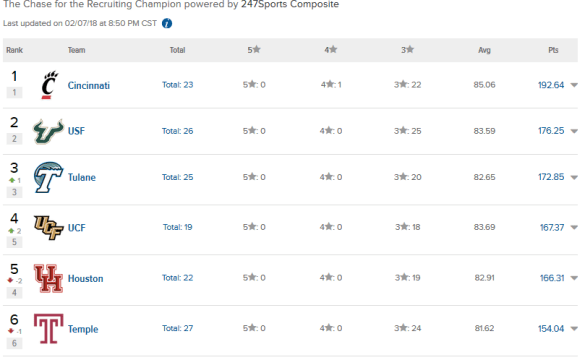
File that name away because what Cincinnati and the other AAC schools do is important in comparison to what Temple does. Cincinnati had the No. 1 recruiting class as ranked by the website 247.com (recently merged with Scout.com) and while the same service ranked Temple’s class as its best ever, it was still behind the Bearcats.

All you have to do is check the number of five-stars and four-stars on rosters like Alabama and Ohio State over the past few years to determine what the meaning of them on the field can be.

recruitingsnip

Geoff Collins, also a second-year coach, has not signed a four-star yet.

Maybe next year.

No one at the signing ceremony at the Aramark Facility (a huge upgrade, by the way, from the Student Pavilion) seemed to mind.

There were many of the obligatory ohhs and ahhs watching the highlight films of the Temple recruits. Here is the complete breakdown with heights, weights, 40 speeds and even some academic achievements. Nary a negative word will be found about this class on Pravda or any other site that covers Temple regularly using notepads, pen and tape recorders and “making phone calls”, but we will try to offer some balanced objective perspective here untainted by receiving a paycheck from Temple.

At the end of the presentation and remembering the similar feeling I had watching recruiting highlights the last three years, I got up out of my seat and the first thing I said to Temple linebacking legend Steve Conjar was: “How do we ever lose a game with these kind of players?”

(I did not have the heart to mention maybe it’s because we do some questionable, OK stupid, things like passing on first-and-goal at the Army 1 when we had the best fullback in the country available to lead block for a running back who gained 151 yards that day.)

It’s what you do with the players once you get them that determines wins and losses.

King represents what Collins is trying to do with this class. Collins called King a “designated pass rusher” and he had a couple of those in this class. If Temple can find a DPR who is also able to play the run well, that will be the guy who sees the field.

It would be nice to have reached up and grabbed a (five) star or four stars, but this is the process at Temple now and we won’t know if it’s a better one than the other teams in the conference until a couple of years from now. You can talk about length, speed and character until you are blue in the face, what matters most is wins on Saturdays. That’s really all that matters.

For now, though, the guys already in the program will have to make their mark. For the guys signed with this class, a little more patience is required.

Monday: Possible Johnson Replacement

Wednesday: Notes, Quotes and Anecdotes

Friday: Developmental Program?

5 Unanswered Questions

tuff

The thing about coaching changes is that bumps in the road are going to be an expected part of the process.

No one—at least the people I talk to—expected to hit this many major potholes on the way to what was largely an under-performing season in 2017. Plenty of starters and key contributors returned from the AAC championship team and Matt Rhule did not leave the cupboard bare for first-year coach Geoff Collins. Talent-wise, this was a team that should not have lost to UConn and Army. You may say that is crying over spilled milk but leaving that milk there without cleaning  it up could make next season more sour tasting that it should.

Part of the process is asking hard questions and answering them honestly.  So far, no member of the Temple football media (to our knowledge) has asked any of these five questions of  Collins and getting these answers by Cherry and White Day would be nice:

sharga

5) What happened to the fullback position at Temple?

Matt Rhule said he had an Epiphany after his second season that the way to create explosive plays in the passing game was not by spreading the field with receivers but by establishing the run behind a blocking fullback and then using play action to get receivers open. That plan worked for two 10-win seasons and Collins seemed on board with it as late as the season-ticket holder party in August. What happened? Will Nitro be used as a fullback this year or is the fullback position done at Temple? (And don’t say the fullback isn’t used in college football anymore. Just because other teams don’t use the triple option, that doesn’t mean that Navy will stop using it. The fullback fits the Temple TUFF football philosophy as the triple-option is to Navy. Run the ball, play great defense and special teams and hit explosive plays in the play-action game is what got Temple consecutive double-digit win seasons)

4) What happened to Jared Folks?

How does a guy start in the AAC championship game for a great team one year and become a non-factor for a mediocre team the next? Inquiring minds need to know.

nutile

3) How could it have taken them seven games to figure one quarterback was better than the other?

Despite saying for nine months leading up to the opener that all four quarterbacks were “equal” Collins rolled out an under-performing quarterback for seven games before an injury allowed Frank Nutile to play. Fans immediately saw that he was the far superior quarterback in the Army game. How could a highly paid coaching staff miss that?

2) What did Collins mean by his “square peg, round hole” comment?

Before the bowl game, Collins said that the offense didn’t come around because “I think we were trying to fit a square peg into a round hole on offense.” What were they trying to do that was wrong and what fixes did they apply to make it work?

journey

1) How could they have screwed up the kicking situation?

All over college football, you could see kickers on Power 5 teams miss chip-shot field goals but Temple had two kickers, Austin Jones, and Aaron Boumerhi, who were elite. That was an asset they should have extended by playing the healthy one and redshirting the other.  Instead the Owls tried to use two kickers from the jump. The Owls could have used Boomer for the extra year. Now Jones is gone and odds are the next one probably won’t be as good as Brandon McManus, Jones or Boomer. Great kickers are hard to find as Rhule found out in his first  year on the job.

Wednesday: The Coaching Shuffle

Friday: Killing Two Birds With One Stone

Monday: Strange Hashtags

Heating Things Up: Hiring Adam DiMichele

Every once in a while, Temple coach Geoff Collins does something that makes you think he gets his surroundings.

Hiring Adam DiMichele certainly qualifies with one of those somethings.

DiMichele is now the “recruiting coordinator” and the 10th fulltime assistant as allowed by the NCAA as of last Tuesday.

Hey, he could have hired another Coastal Carolina guy.

DiMichele kicks McNabb's butt

Adam as a Philadelphia Eagle (hey, they still need a backup to Sudfeld)

I’m not so provincial that I believe Collins should hire all Temple guys to coach at Temple but, with Adam, I’ve got a soft spot.

Including P.J. Walker, Steve Joachim, Matty Baker, Tim Riordan, Henry Burris and Lee Saltz, Adam DiMichele is my favorite Temple quarterback of all time.

Notice I wrote “favorite” and not “best.”

Favorite is because he was the conduit between a lot of bad years and a lot of good ones.

Sitting at Franklin Field right behind the late, great Peter “Doc” Chodoff watching Temple get waxed during the Dark Ages that culminated in a 20-game losing streak, Doc turned to me and said, “Mike, why does every other team have a better quarterback than Temple?”

“I’ve always said the same thing. Seems like it’s been that way forever, Doc. I don’t know.”
Doc Chodoff got a field named after him a few years later, right around the time  I got my quarterback who was better than the bad guy’s quarterback.

His name was Adam DiMichele.

DiMichele was the bridge between the 20-game losing streak and what Temple football is today. Had not Buffalo completed an inexplicable “Hail Mary” pass, he would have led the Owls to a bowl game in 2008.

Had not Joe Paterno denied him a transfer waiver, DiMichele—not Chester Stewart nor Vaughn Charlton—would have been the quarterback in the 2009 Eagle Bank Bowl and there is no doubt in my mind he would be the difference.

DiMichele was part of a lot of great plays while at Temple, my favorite being the “fake knee down” against Navy in the 2008 season. Temple looked like it was going to run out the clock but DiMichele feigned the knee and pulled it up just before it hit the ground and found Bruce Francis 30 yards behind the nearest defensive back. Francis walked in but the Owls lost that game, 33-27, in overtime. The year prior, DiMichele flipped the ball back to D’yonne Crudup on a double-reverse and Crudup tried to hit him in the end zone for a game-winning TD against UConn, but DiMichele tipped the ball to Francis, who caught it but it was ruled a non-catch.

DiMichele was always the quarterback of a fullback-oriented offense that head coach Al Golden and offensive coordinator George DeLeone believed in and was the beneficiary of a strong running game that set up great play-action passing. Hopefully, Adam will have enough influence on Dave Patenaude to go away from Coastal Carolina Soft back to Temple TUFF. If anyone can convince Patenaude to put Nitro back there leading the way for Rock and David Hood, it’s Adam DiMichele.

More than that, though, he’s got to convince Collins and, by getting hired, he’s at least halfway there.

Monday: The 2018 Power 5 Opponents

Geoff Collins’ Shocking Admission


dunce

Go through the posts on this website and you will find several references of Temple’s offense being one where the coaches tried to fit a square peg into a round hole.

shargamilk

So you can excuse us for wondering just where Temple head football coach got this notion from when he uttered this quote at the inaugural Bad Boy Mowers Gasparilla Bowl press conference.

“I think we were trying to fit a square peg into a round hole on offense,” Collins said. “Once we got a good taste of who our personnel was on offense, it kind of took off.”

Collins could have saved a whole lot of time and heartache by reading what was posted here in September.

Maybe he did.

This is what we wrote in a post on Sept. 22, after a 43-7 loss to USF:

“Ask any Temple fan who followed the team over the last 40 years (I will raise my hand here) who the best set of receivers are in Temple history and that fan will probably say the current group of Ventell Bryant, Adonis Jennings, Keith Kirkwood and Isaiah Wright. Any offense that has those four guys on it is not rebuilding, it should be reloading.

Emphasis on “should be” because the coaching is the X-factor here. Temple won the past two seasons because it catered an offense to suit the talents of its players, and did not try to force fit a square peg (spread offense) into a round hole (play-action offense). A good head coach tailors a scheme to the talent he has, not the talent he wants.”

Better late than never, but putting the square pegs into the square holes and the round ones should have been something that was figured out by August, not by the end of October. The real sad thing is that Collins seemed to be onto it at the season ticket holder party when one season-ticket holder asked him to “never take Nick Sharga out of the game” and Collins responded by saying that he would not and, if anything, Sharga’s role as a lead-blocker in a play-action-oriented offense would be greater than it was a year ago. For reasons only Collins knows, he lied. Maybe he allowed offensive coordinator Dave Patenaude to have too much input.


At least Collins dictated a heavy dose of play action over the final six games of the year and that saved their season. That was the personnel they had all along.


“Temple won the past two
seasons because it catered
an offense to suit the
talents of its players,
and did not try to force
fit a square peg (spread offense)
into a round hole
(play-action offense)”
_ Temple Football Forever, Sept. 22, 2017

“I think we were trying to kind
of fit a square peg in a round
hole
on offense. Once we got
a really good taste of who
our personnel was,
it kind of took off.”
_ Geoff Collins, Dec. 6, 2017


The Owls took way too long to figure out that they never needed a “running” quarterback as much as they needed a guy with a big enough arm to get the ball to their most talented players on offense, their wide receivers. They figured out too late that many of the “drops” they suffered in September were the result of these same receivers circling back on poorly thrown balls. When they inserted the guy with the big arm, those receivers caught balls in stride and away they went, usually into the end zone.

Collins followed the outline of the advice, although we would have liked to seen more running from guys like Ryquell Armstead and David Hood behind a guy like Nick Sharga.

Maybe next year with those two behind a guy who goes by the nickname of Nitro, opening passing lanes for a guy who goes by the name Juice.

Let’s hope a second-year coach isn’t as slow on the uptake as the first-year one was. One of the fastest ways to fix a problem is to recognize it and, with that one quote, Collins showed there is hope for a better future plan.

Monday: The Padre Pio Factor

Wednesday: Bowl Preview

Friday: Bowl Analysis

Christmas: Season Analysis