Temple: Worst-coached team in college football

digest

With the possible exception of Willie Taggart’s Florida State football team, it’s hard to come up with a convincing argument that Temple is not the worst-coached team in college football after two games.


No matter how hard
you work Sundays
through Fridays,
you are judged what
you do on Saturdays
and this Temple coaching
staff is a complete and
utter failure on the
most important day
of the week

We’ll go with Temple only because Taggart coached his way into two Power 5 jobs and he’s proven himself as a head coach in other places.

There is no offer on the horizon for Geoff Collins’ staff this year and maybe not for several.

Not only did the Owls lose to a FCS crosstown rival, Villanova, they had to beat in order to retain any football street cred in Philadelphia, Collins and his staff botched a simple game plan that was handed to them on a silver platter.

Playing a Buffalo team that gave up 199 yards to FCS Delaware State and was ranked No. 95 in the nation in rushing defense this year (and No. 96 last year), the Owls refused to go with the one offense—tailback behind a fullback—that would have kept the ball away from the two NFL players the Bulls had, Tyree Jackson and Anthony Johnson.


Playing a Buffalo team
that gave up 199 yards
on the ground
to FCS Delaware State
and was ranked No. 95
in the nation in rushing
defense this year
(and No. 96 last year),
the Owls refused to go
with the one offense—tailback
behind a fullback—that would
have kept the ball away
from the two NFL
players the Bulls had

Collins and offensive coordinator Dave Patenaude had just two jobs—score points and run the ball effectively enough to have six-, seven- and eight-minute drives and chew up the clock.

The Owls scored enough to win but they did not provide their defense with the requisite help needed by keeping the ball away from the Buffalo offense.

Temple had consecutive 10-win seasons by playing an every-down fullback but, on Saturday, did not have fullback Rob Ritrovato on the field to lead the way for Ryquell Armstead even once. With Ritrovato—an outstanding blocker in his own right—Armstead would have had essentially another offensive lineman in front of him and probably a lot more than the 107 yards he had on the ground. More importantly, had Armstead been able to put 200 yards on the board, Jackson and Johnson would have had far fewer possessions and Temple would have been able to come away with a much-needed win. Ritrovato was on the field to gain a short-yardage first down on a running play, but Wayne Hardin (Henry Hynoski, Kevin Grady and Mark Bright), Bruce Arians (Shelley Poole), Al Golden (Wyatt Benson) and Matt Rhule (Nick Sharga) would have been able to tell Collins a fullback can and should play a more vital role.

They either don’t care to use a fullback or don’t know how. Either way, it’s a bad look and not a Temple one.

Collins and Patenaude seem oblivious to that simple concept given an ill-conceived game plan that stopped the clock far too many times on incomplete passes and gave Buffalo far too many needless possessions.

Coaching is all about tailoring your schemes to the strengths of your players and attacking the weaknesses of your opponent. Temple’s coaches have failed miserably in those two most important areas in consecutive weeks. No matter how hard you work Sundays through Fridays, you are judged what you do on Saturdays and this Temple coaching staff is a complete and utter failure on the most important day of the week.

Unless something drastic changes, Temple is looking at a maybe two-win season coming off 27 wins in the past three years after losing two games in which it was a solid favorite. In one game, the Owls watched Villanova do the same damn things it did last year and showed zero adjustments. In another, the Owls stubbornly refused (or did not know how) to use a fullback leading a tailback to chew up clock and keep the ball away from a dangerous offense.

That’s about as bad a job as can be possibly done.

In fact, we’ve scoured the 127 FBS teams and haven’t found a worse coaching job after two games. The scary thing is that nobody will do a damn thing about it. That might not be Temple TUFF, but that’s tough for Temple players and fans who deserve better.

At least Taggart won his nightmare game last night. Temple fans have lived through a pair of nightmares and there’s a lot more tossing and turning ahead.

Tuesday: Fizzy Checks In With Buffalo Thoughts

Thursday: How Did We Go From AAC Champs To AAC Chumps in 2 years?

Saturday: Maryland Preview

Sunday: Game Analysis

Game Plan: No Wild Winging Against Buffalo

nitro

Hopefully, Nitro being named a game captain means he will be an every-down fullback which is just what the Temple offense needs right now.

Although both Villanova and Buffalo wear different shades of Blue and White, there is no doubt about one thing.

Buffalo is a better version of Villanova. Just because Buffalo is better than Nova, there is no reason for Temple to panic (3:30 p.m., Lincoln Financial Field, no over-the-air TV) against its former MAC rivals.

conditional

Fortunately, transitive property has been proven faulty on many occasions and matchups are more relevant than any other factor in college football.

In that area, Temple would seem to have the advantage.

The game will simply come down to this: Temple exploiting the one weakness Buffalo has demonstrated not only this year but over the past 13 games: Run defense. Against a very bad FCS team, Delaware State, the Bulls yielded 199 yards rushing. Villanova might be the Alabama of FCS football (although that is yet to be proven), but Delaware State is probably closer to the New Mexico State version of FCS football and the fact it could gain that many yards against a FBS team is alarming. Of the 127 FBS teams, Buffalo is ranked No. 95 against the run. Last year, the Bulls were even worse—ranked No. 96th (195.3 ypg) against the run in a 12-game season. This is probably not the game OC Dave Patenaude should have Frankie Nutile winging it all over the lot nor the kind of game he throws a couple of passes after getting first-and-goal at the 1 (like the Army game a year ago).

So if the Owls commit to the run behind a proven AAC championship tailback (Ryquell Armstead, 916 yards, 15 touchdowns in 2016)  following a fullback like they did in back-to-back 10-win seasons, they can accomplish two very important things:

  • Controlling the clock and the game, chewing up big chunks of yards and scoring touchdowns on the ground;
  • Keeping the ball away from the two NFL prospects on the Bulls, quarterback Tyree Jackson and wide receiver Anthony Johnson.

Jackson a very accurate 6-foot-7 passer and can see over a Temple pass rush that is already down one starting defensive end (Dana Levine, out 4-6 weeks with an injury). Levine’s subs got pushed around by the Villanova starting offensive line while the only heavy lifting at the defensive end position was being done by Quincy Roche at the other end. Too bad the Owls couldn’t recruit a guy who was named the No. 12-ranked DE in the United States when he got out of high school three years ago.

What’s that?


This will not be the easiest
game of the season, but
it will certainly be the
easiest game plan
of the remaining dozen or
so games left on the schedule.
In about 24 hours, we will
have a good idea if the highly
paid professionals running
the Temple program are able
to figure out what anyone
with a minimum football IQ can


They did?

Oh yeah, Karamo Dioubate is getting limited snaps in the interior of the line while walk-ons back up the other end. It would seem to be a simple move to slot Dioubate in his more comfortable position so as to help Roche create additional pressure.

A lot of things that appear logical to the casual observer about this Temple team were illogical the first week of the season.

Maybe naming fullback Rob Ritrovato one of the four game captains is a sign that the Owls are getting back to the Temple TUFF brand of running game Owl fans know and love. Maybe it’s just window dressing like calling Nick Sharga “the best fullback in the country” one year ago and limiting him only to five downs or less in the actual games.

This will not be the easiest game of the season, but it will certainly be the easiest game plan of the remaining dozen or so games left on the schedule. In about 24 hours, we will have a good idea if the highly paid professionals running the Temple program are able to figure out what anyone with a minimum football IQ can.

Sunday: Game Analysis

TU Offense and Geoff Collins: Sockless


Someone needs to show this film to Geoff Collins

The routine practice here is not to post about a game until a full day has passed so as not to let emotion get in the way of calm and rational thinking.

It usually works.

Not this time.

performance

It’s one thing to put up ugly numbers against USF; it’s quite another to fail against a team that lost to Rhode Island and Elon … that’s right, Elon… last season

No matter how many hours pass, nothing will change what we witnessed on Saturday, an Epic Coaching Fail that will rank with some of the worst days of The Unholy Trinity of Temple head coaches (Jerry Berndt, Ron Dickerson and Bobby Wallace). Don’t blame offensive coordinator Dave Patenaude or defensive Andrew Thacker, either.

This one falls squarely at the sockless feet of Geoff Collins, who is the CEO of this football operation and the buck clearly stops on his desk. He certainly either does not know how to utilize the talents of his best tailback or simply refuses to do so. Rob Ritrovato can pick up where Nick Sharga left off and lead the way for a successful running game, which will be the key to opening everything else up.

Collins hired Patenaude to run an offense ill-suited to the personnel recruited by Matt Rhule, the previous coach. Rhule said that the Owls did not experience the kind of success he envisioned until he went with his instincts, which were power I with a fullback to clear the way for a running back, bring the safeties and linebackers up to the line of scrimmage, and use play-action fakes to pass over their heads. In that kind of offense, Temple wide receivers were so open that quarterback P.J. Walker often had a hard time choosing which one would be on the receiving ends of his passes. In this offense, nobody fears the run and, as a consequence, nobody gets open in the passing lanes.

Clearly, Patenaude stubbornly wants to force this square peg into a round hole and it’s not working nor probably ever will.

This is what we said in our preview two weeks ago:

tome

Yesterday, guess how many opportunities Ryquell Armstead—a downhill back recruited to run behind a fullback—got to run the ball behind a fullback?

Zero.

As in none.

Instead, Armstead got limited chances in an empty backfield and that’s a recipe for disaster.

Someone—maybe Ed Foley, maybe Adam DiMichele—who understands the meaning of Temple TUFF and how it applies to offensive football, should take the film at the top of this post into Collins’ office this week.

Defensively, this is what we wrote about the Villanova game plan on Aug. 8, meaning roughly that the Owls had one full month (really, nine full months) to get ready for this:

“Villanova is going to throw to the tight end—a lot—and going to try to throw crossing underneath patterns to backs coming out of the backfield” _ TFF, Aug. 8

What did Villanova do?

Throw the ball to the tight end a lot and also gained the majority of its 405 yards total offense on crossing patterns to the running backs.

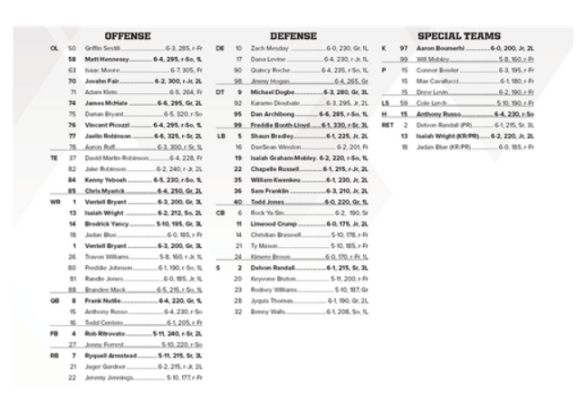
Then there is the matter of defensive ends or lack of them. That stuck out like a sore thumb when the “above the line” depth chart was released a few days ago. It’s not that the Owls lack defensive ends, it’s just that they have two really good ones—Dan Archibong and Karamo Dioubate—playing on the interior of the line where they are already set with tackles Michael Dogbe and Freddy Booth-Lloyd.

nitro

Nitro, Temple Nation Turns its lonely eyes to you (but as an every-down fullback, not as a tailback).

The Owls got pressure from only one end, Quincy Roche, when they could have both Roche and Dioubate meeting at the quarterback on a regular basis. So to get to the quarterback, they had to blitz, which resulted in a game-winning touchdown on 4th and 9.

When you don’t have to blitz, you can move your other defensive resources elsewhere and stop some of that crossing pattern bleeding. Plenty of questions, very few answers, on that backbreaking play. The first is what idiot  forced a lefty quarterback to run to his left–and most comfortable–side, when the rush could have been set up to flush him to his right make the more difficult throw across his body? Could that have been none other than The Minister of Mayhem?

If that all of those errors weren’t grievous enough, Collins proved that he was very bad at math.

With Temple up, 17-13, with 6:52 left and a 4th and 2, he went for a field goal that was missed. Forget the fact that it was missed. Remember that, up four, a field goal does you absolutely no good because a Villanova touchdown wins the game either way because it sends a deflated Temple into overtime in a game the Owls knew they frittered away. Conversely, a Temple touchdown there probably wins the game. A FG missed or made does zero good. Simple math. People in the stands were saying that before the kick. If Joe Blow knows it, a guy who is paid $2 million per year to make those decisions should know it, too.

Steve Addazio

“At least I beat Nova 42-7 and 41-10”

Collins needs to get better in a whole lot of areas but going back to Temple TUFF power football with a fullback and a tailback would be a good place to start. If Patenaude doesn’t like it, he can go back to Coastal Carolina. We hear they like that brand of football there.

Rhule did not have success here until he had that kind of an Epiphany. Collins won’t until he does the same.

Monday: Fizzy’s Corner

Wednesday: Ancillary Impact of the Villanova Loss

Friday: Buffalo Preview

Sunday: Game Analysis

What’s Wrong With This Picture?

atlphoto

Move Archibong or Dioubate to DE and you’ve solved this problem.

For a program that prides itself on “position flexibility” it boggles the mind that one position in particular sticks out like a sore thumb on the “above the line” so-called depth chart:

Defensive end.

footballseason

The weird thing is that it doesn’t have to be this way and there is a fix right under the coach’s noses. You’ve got to wonder if they are so close to the trees they can’t see the forest.

Or vice-versa.

What’s that, you say? “Mike, the coaches are around these guys all the time. They know what they are doing.”

Err, you mean the same guys who said at this time last year that Nick Sharga was “the best fullback in the country” and did not use Nick Sharga as a fullback? Those guys? The same guys who thought Logan Marchi was the best quarterback on the team for the first seven games when every fan who watched the Army game would tell you Frank Nutile was 10x better? Those guys? Yeah, I thought so. Not buying the excuse by the Collins’ apologists that Sharga was “hurt” because the same guy led the nation in special teams’ tackles in 2017. You don’t lead the nation in special teams’ tackles by being a cripple.

But back to this year’s sore thumb problem, though.

The Owls have only one proven defensive end—last  year’s sack leader, Quincy Roche—but an overabundance of flexible above the line talent in the interior of the defensive line.

All they have to do is move an All-American defensive end (that’s right, defensive end)  in high school, Karamo Dioubate, to one end and the problem is solved. Dan Archibong, another outstanding tackle, can also play end. Meanwhile, Michael Dogbe and Freddy Booth-Lloyd are two of the better interior tackles in the American Athletic Conference. There simply just aren’t enough snaps to get all of those guys the reps they need inside but there is plenty of opportunity outside the tackles.

If I was Dioubate or Archibong, I’d walk into Geoff Collins’ office today and tell him I think I can help the team better by rushing the passer and stringing out running plays from sideline to sideline.

Meanwhile, I can’t believe the defensive coaches don’t see that for themselves.

If there is a subplot to watch in tomorrow’s opener against Villanova (noon, Lincoln Financial Field), it is finding out whether the coaches are as flexible in their thinking as they hope the players are in their positioning.

Putting players in the best position to win is the definition of good coaching. In less than 24 hours, we will find out a lot about both.

Sunday: Game Analysis

Tuesday: What We’ve Learned After Week One

Thursday: Buffalo Preview


Playing Villanova: Coach Hardin Had The Right Idea

dogsofwar

Temple appears to have the talent to put a hurting on Villanova

On or about the time Temple was flirting with the Top 10 in the 1979 season, a reporter once asked Wayne Hardin why the Owls were still playing teams like Delaware and Villanova.

“I believe in playing Delaware and Villanova and beating the crap out of them,” Hardin said.

It wasn’t very politically correct and probably didn’t play well with large groups of local fans, but it was his mantra and it was Temple-centric.

Usually, he did.

clouds

Hopefully, the shower part will be after 3 p.m.

It helped having a Mensa IQ of 159 that translated to outsmarting just about every coach he ever played, but having the talent advantage helped even more.

Hardin won seven of his last nine games against legendary Delaware coach Tubby Raymond—father of the first Phillie Phanatic—and beat Villanova, 42-10, that year on the Main Line.

I thought about coach Hardin when reading a large sentiment on social media of current Temple fans’ opinions on this series.

“We have nothing to gain and everything to lose by playing Villanova.”

“It’s a no-win situation.”

“If you win, meh, but, if you lose, it’s a disaster.”

Around and around that goes and where it stops defeatism knows.


Last year’s 16-13 game
was a complete disgrace
and hopefully put as bad
a taste in the players’
and coaches’ mouths as
it did with the Temple fans


Coach Hardin was right. Temple SHOULD be playing Villanova and Temple SHOULD be beating the crap out of them. First, even though Villanova has contributed only about 2-3,000 fans to the last three games (all over 30,000), the game does get Temple fans motivated to put down the remote and potato chips and get to a game in person. Temple should never be “scared” to play Villanova in football.

If you are scared get a dog.

Fortunately, head coach Geoff Collins—who is a little more politically correct than Hardin was—has the dogs of war to beat the crap out of this team.

Do you think Villanova basketball goes around worried about playing Temple?

No. Villanova basketball is, for all intents and purposes, a Power 5 team now playing Temple, a mid-major basketball name.

They just go out and beat the crap out of them.

The roles are reversed in football with Temple being the FBS school and Villanova a FCS school.

It is high time Temple football fans got the same level of satisfaction out of this meeting the Villanova basketball fans routinely get. They got that during Hardin’s years and during the two Daz years (42-7 and 41-10). Last year’s 16-13 game was a complete disgrace and hopefully put as bad a taste in the players’ and coaches’ mouths as it did with the fans.

Now it’s just a matter of restoring the normal order of things.

Friday: Seeing The Forest Through The Trees

Sunday: Game Analysis

Collins: “I truly love this university”

collinslove

While Temple dodged a bullet in keeping its athletic director and receiving help in jettisoning the one arguably failed football coach of the last decade, the same cannot be said of the universities investing in Owl coaches not named Geoff Collins.

Collins got up at the season-ticket holder party exactly a week ago today and said “I truly love this university” and you had to hope that he finally was talking a little about Karma.

For no matter how much money Al Golden and Matt Rhule—who also professed love for the university—made from their Temple experiences elsewhere, you’ve got to wonder if they are truly happy now.

The ironic thing is that both knew they were headed into sanctions at Miami (Fla.) and Baylor, but took those jobs anyway when they probably could have parked themselves a year or two more at Temple and received better ones down the road. Worse yet, the sanctions when they signed on the dotted line turned out to be worse when they got at their new homes.

nitro

Hopefully, Collins has been taking mental notes.

It looks right now that Rhule might never win on the Art Briles’ level at Baylor and Golden, stuck as the tight ends coach with the lowly Detroit Lions, can only talk so much about the intricacies of seal blocking and pass catching before being bored to tears.

Tears not of happiness, either.

If anything those two guys proved, it is that you can win football games at Temple and $2 million-per-year for that kind of happiness might beat the uncertainty of double that losing elsewhere. If Collins does leave, Temple could do a whole lot worse than Golden (probably available) or Rhule (probably not) replacing him. For what it’s worth, I think Collins was sincere when he said “I truly love this university” on Wednesday.

An ancillary benefit for Temple is that these Power 5 schools might think twice before coming after a winning coach here. At least that’s the thought.

Whatever it is, Temple’s kids deserve the kind of loyalty of a head coach who does not have one eye on the exit door. What Collins said a week ago today gives us hope he  grasps what others preceding him have not.

Friday: Coalescing A Depth Chart

Monday: Summer Phenoms

Wednesday (8/29): Neighborhood’s Fastest Humans

Friday (8/31): Villanova Preview

Sunday (9/2): Game Review

A special bonding night with players

darkside

(Mostly) linebackers at the season-ticket holders event Wednesday night.  (photo by Ted DeLapp)

A little bonding between a fan base and a team is always a good thing.

On Wednesday night, at the beautiful Aramark Center—the indoor home of the Temple football Owls—there was a lot of it.

Out of the blue (well, mostly black uniforms), Temple linebacker Chapelle Russell reached out and approached me and shook my hand.

Now I have never met Russell before nor him me, nor do I even know if he knows who I am, but I appreciated the gesture. He honed in on me like I hope he does the Villanova quarterback on 9/1, reached out his hand and shook mine and said this:

“Hey, thanks for coming.”

“I can’t believe we have some Temple fans say this is a seven-win team,” I said. “This is a nine-win team at worst.”

“We all know it,” Chapelle said.


To me, it all depends
on whether Temple does
what it did in 2015 and
2016—get back to its Temple
TUFF offensive philosophy
of an elite running back
following an extra offensive
lineman (fullback) through
the hole to establish the
run and then explosive
downfield plays in the
play-action-faking passing game

“Yeah, we’re going for more than that,” he said. “Everything is looking really good. I mean, really, really good on both sides of the ball.”

Then we shook hands again and parted. I will never forget his amiability to a total stranger.

That was just a small part of what went on that night, with Temple fans and Temple players mingling and mind-melding. The good vibes were all around.

“You guys are the best fans in the country,” Temple quarterback Frank Nutile said in that deep New York accent. “You’re going to see a lot of great plays with a lot of great players on offense.”

On defense, tackle Michael Dogbe said: “We’re ready to go up against any offense in the country.”

Nutile might have been right on both counts. Temple fans make up more in quality than they make up in quantity and the last decade or so has rewarded them for sitting through a 20-game losing streak and 20 years of unmatched futility. On his other point, he has an AAC championship tailback to hand the ball off to (Ryquell Armstead) and plenty of athletic touchdown-makers to throw to, including Ventell Bryant (who caught a TD pass in the title game) and “touchdown waiting to happen” Isaiah Wright.

Dogbe and safety Delvon Randall have a chance … chance … of being first-round NFL draft choices. This is at least the equal of the two 10-win Temple teams in 2015 and 2016 seasons and the talent level just might be better.

To me, it all depends on whether Temple does what it did in 2015 and 2016—get back to its Temple TUFF offensive philosophy of an elite running back following an extra offensive lineman (fullback) through the hole to establish the run and then explosive downfield plays in the play-action-faking passing game. That’s the kind of offense that has a defensive coordinator’s head spinning, not an ill-advised spread that features an empty backfield that invites both blitzes and sacks. Matt Rhule said 2014 was a wasted season because he allowed his OC then to talk him into the spread.

These kids, and these fans, deserve head coach Geoff Collins to put his foot down and get the most out of this talent and not allow the current OC to make the same mistakes the one in 2014 made or that the current guy did for the first half of 2017.

Meanwhile, at least on this night, the fans, coaches and players were all on the same page. It was a beautiful thing to see.

For me, at least, I can’t wait to see Ryquell Armstead and Jager Gardner putting hands on the back of Rob Ritrovato and finding big holes to run through. Then, watching the bad guys’ safeties and linebackers inching closer to the line of scrimmage to stop that run and Owl quarterbacks deftly faking to the tailbacks and finding receivers running so open through the secondary they won’t know which one to throw to. … at least that’s the plan.

That’s Temple TUFF.

We haven’t seen it since 2016.

If we see it in a couple of weeks, nine wins might not even be the ceiling.

More Cons Than Pros in Flexibility

tool

Eighteen nights until game day and the Temple Owls are testing one of the tenants of the Geoff Collins’ football philosophy:

Position flexibility.

I’m all for it if the guy doing the flexing actually plays some downs at his other position during the season.

If not, it’s a waste of time.

That’s kind of where I was leaning when I heard that Shaun Bradley, arguably the Owls’ best linebacker, was getting some time on the other side of the ball as a running back. That’s a real head-scratcher because the Owls are deep and talented on the other side of the ball with Ryquell Armstead, Jager Gardner and Tyliek Raynor leading the way.

I’d just as well keep Bradley as a linebacker, thank you, and spend these 15 practices between now and Villanova mastering the art of disrupting those pesky crossing patterns over the middle.

That’s one side of the “position flexibility” argument. The other side, of course, is that all of the offensive linemen should be able to play any position—with the exception of tight end—along the line and the defensive ends should be able to play tackle and vice versa.

Now that would be valuable practice time well-spent.

When it comes to defensive players on the offensive side of the ball, the term “diminishing returns” comes to mind. Same way for offensive players on the other side. Matt Rhule believed in a limited amount of flexibility, playing Nick Sharga at both fullback and linebacker in 2015 and 2016. In the 2015 win (34-12) over Memphis, Sharga was easily the best defensive player that day on a field that included the national defensive player of the year (Tyler Matakevich). Sharga not getting extended looks at linebacker last year was a waste of talent, especially considering OC Dave Patenaude’s aversion to using a fullback.

This year, though, the roster does not need flexibility, at least not the cross-side-of-the-ball flexibility Collins advocates.

The Owls also appear set at wide receiver with the injured Broderick Yancy returning to practice later this week to join a talented and experienced group that includes Isaiah Wright and Ventell Byrant. That mollifies the loss of wide receiver Marshall Ellick, who transferred to Stony Brook.

Bradley isn’t the only defensive guy being used on offense but it doesn’t appear to make sense when he’s missing valuable reps on defense doing something he is unlikely to do during the regular season.

Hopefully, Collins knows what he’s doing but, last year, Keith Kirkwood was talked about as a defensive end and Nick Sharga as a linebacker and neither played much at their secondary positions.

Position flexibility might be a tenant of Collins’ philosophy but winning football games should be the landlord.

Friday: Thoughts From Season Ticket Night

Monday: Dodging Bullets

Wednesday: Taking Shots

The Case For The Defense

smiling

Karamo Dioubate (72) who had a hand in the last title, could have two hands in this one.

The other day I sent a message to a politican columnist I know that said simply this:

“Keep calling balls and strikes as you see them.”

I don’t always agree with her—actually, very rarely do—but I respect the way she approaches her craft and the logic of the arguments she makes.

In this day and age of polarization, it makes sense to hear  both sides rather than look for ones that ratified a pre-existing view.

Later in that message, I mentioned to her that the pitch cast on the Phillies games does a much better job at calling balls and strikes than the humans behind the plate do. That’s because the computer—setting the batter’s box the way it should be (belt to knees)—doesn’t make mistakes.

That brings us to the case Temple quarterback Frank Nutile made at media day.

“We’re loaded,” he said.

His head coach, Geoff Collins, was more cautiously optimistic in that kind of setting but said after the bowl game that he was going to have a “ridiculous” team in 2018.

I interpreted that as ridiculous as in the good kind because of the number of key returning players the Owls have in 2018.

Those are humans, though, and humans, like the umpires, can make mistakes in those types of evaluations.

Setting up the equivalent of the “pitch cast” box to take an objective view is the fact that the Owls have three immovable tackles in the middle of the field in Michael Dogbe, Dan Archibong and Freddy Booth-Lloyd and options at both ends in Quincy Roche and either Nickolas Madourie and Karamo Dioubate. Madourie is a junior college transfer who had 17.5 sacks at that level and Dioubate, who has been in the interior in his first two college seasons but was a high school All-American at defensive end, which got him recruited by schools like Penn State and Alabama. If Madourie’s jump to major college football doesn’t translate, Dioubate should be able to handle the other end position. Hell, Dioubate is more of a defensive end than he is a tackle and the Owls might want to utilize his talents where he can create more Mayhem. Just a thought.

The Owls have really good linebackers and defensive backs.

Put them all together and this should be a much more impressive defense that held eight-win Florida International to just three points.

Nutile has played against that defense every day in the offseason and it might be one of the reasons he used the word “loaded” or Collins used the word “ridiculous.”

Those are subjective words, but there is a lot objective data backing it up. The ultimate arbiter will be the record, not the humans who call the balls and strikes.

Play ball.

Wednesday: That’s Special

Friday: Silver Linings

Immediate Needs: RB, CB, FB

nitro

Geoff Collins checks the footwear to see if Nitro can fill Nick Sharga’s shoes.

There were at least a couple of times a first-year coaching staff was caught with its pants down a year ago at Temple University.

It wasn’t a pretty sight.

One of them came at East Carolina, running backs went down so fast that the Owls were down to moving their backup fullback—Nick Ritrovato—to tailback and he responded in a big way with 14 carries for 48 yards to close out a 34-10 win at ECU. Had the then walk-on not responded like a scholarship player, that game might have turned out differently. Nitro received his scholarship on Oct. 27th. The other time the Owls coaches got caught with their pants down was failing to identify that the gamer at quarterback was the backup, not the starter, for the first seven games.

In that instance, the season might have turned out differently.

For Temple to be successful this season, Nitro needs to move back to fullback and create holes for the tailbacks as a lead blocker to set up the play-action passing game for Frank Nutile. That’s Temple TUFF in a nutshell. Let’s hope Dave Patenaude can grasp that simple concept.

This year, the suspenders are tightened and the pants are mostly secure, but that does not mean the Owls have no immediate needs.

They can start with the areas they lost two players, a 6-foot-6 corner with speed in Derrick Thomas, who took his graduate transfer year and reunited with Matt Rhule at Baylor. The other was the unfortunate loss of David Hood at running back, who was told by the doctors that his last concussion was one too many. For what it’s worth, it would be useful as well to develop a backup plan at fullback should Nitro go down.


For Temple to be
successful this season,
Nitro needs to move back
to fullback and create holes
for the tailbacks as a lead
blocker to set up the
play-action passing game
for Frank Nutile.
That’s Temple TUFF in a nutshell

Thomas probably wasn’t going to beat out Linwood Crump Jr. at one corner position—he was behind him in the “above the line” area last year—and certainly wasn’t going to beat out FCS first-team All Big South corner Rock Ya-Sin at the other. Still, he would have provided a valuable insurance policy for the Owls at that position if attrition came into play.

At running back, Rock Armstead is primed for a Bernard Pierce-type season if he can stay healthy and Jager Gardner is back from his injury but the ranks are pretty thin behind that. Tyliek Raynor was a big-time recruit, and should be healthy but he is an unknown at this point. This looks like an area were one of the incoming true freshman, like Kyle Dobbins, will have an opportunity to make an impact.

The other areas—offensive and defensive lines—look like they are in good shape. Chris Wisehan, the offensive line coach, said the Owls interior three—two guards and center Matt Hennessey—were the best the team has had since he’s been here and he’s one of the few holdovers of the Rhule staff.

As loaded as the Owls are, cornerback and running back looks like the fastest way for the incoming freshmen to get on the field and it is vital for a couple of those to come through when their number is called.

Just like Nitro did.